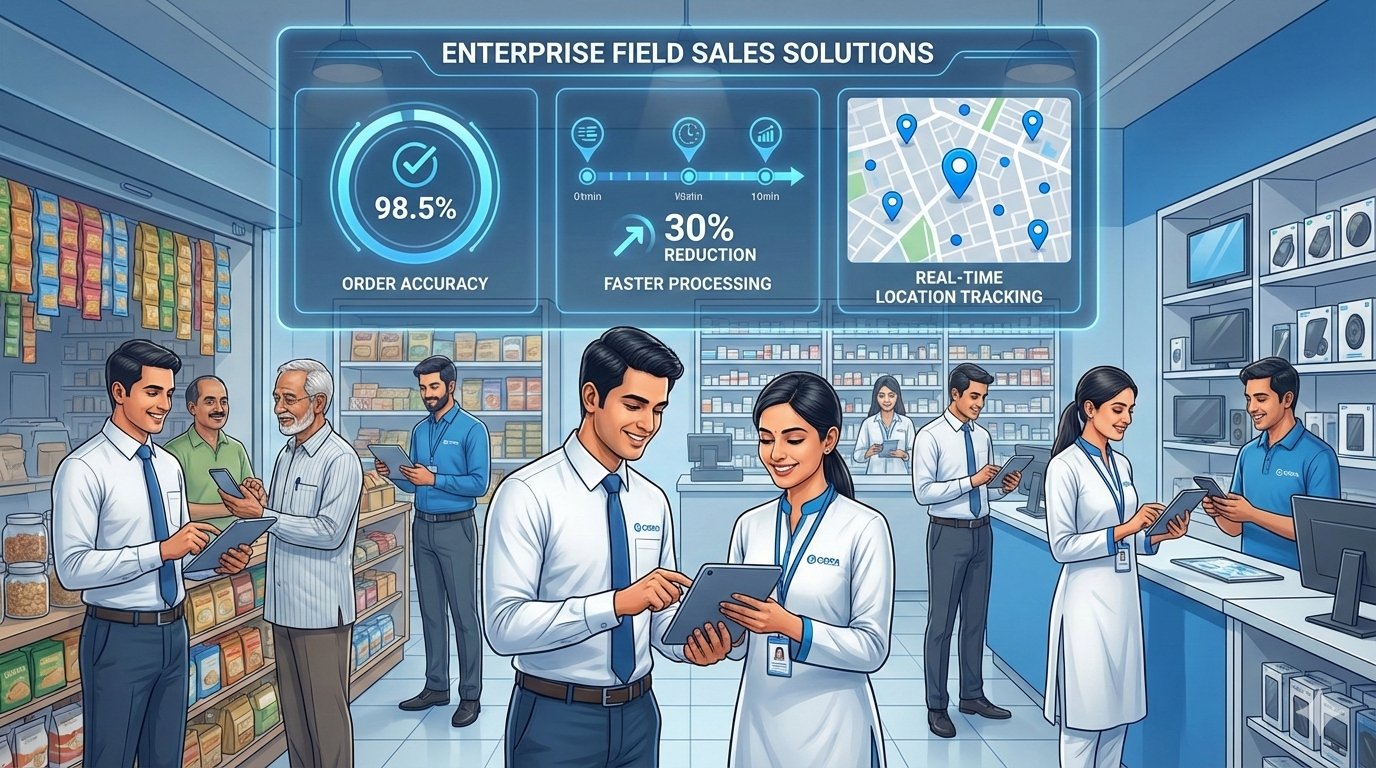
Indian enterprises today operate in one of the most complex field environments in the world. Sales teams are spread across cities, towns, and remote regions. Orders are captured on the move. Connectivity is unreliable. Inventory changes fast. Credit limits matter. One small mistake at the order stage can ripple through dispatch, billing, collections, and customer trust.
We see this every day while working with large sales-driven organizations. The challenge is rarely about effort. Field teams work hard. The problem lies in the system that supports them. When orders are managed manually or through disconnected tools, scaling becomes impossible.
This is where a modern Order Management System changes the equation. Indian enterprises that implement the right system consistently process more orders per day, with fewer people, and almost zero errors.
The Real Problem With Order Processing in Field-Driven Businesses
Most enterprises start with simple tools. Excel sheets. WhatsApp messages. Phone calls to the back office. For a small team, this works. As operations grow, these methods begin to break.
Field representatives spend hours writing orders, calling for stock confirmation, and following up on billing. Managers lack real-time visibility into what is happening on the ground. Finance teams deal with incorrect pricing, credit violations, and delayed invoices. Customers experience delays and errors they do not tolerate for long.
From our experience working with Indian enterprises across FMCG, pharmaceuticals, manufacturing, and distribution, the same issues appear repeatedly:
- Orders captured incorrectly in the field
- Delays between order capture and invoice generation
- No real-time stock or credit validation
- Duplicate data entry across systems
- No visibility into where field executives are or what they are doing
These gaps directly limit how many orders a business can process in a day.
Why Manual Systems Cannot Scale Beyond a Point?
Order volume does not increase linearly with headcount. Adding more sales representatives without fixing the system only increases chaos.
Manual order processes introduce friction at every step. Field executives slow down because they are unsure about pricing, schemes, or stock. Back-office teams spend their day correcting errors instead of processing new orders. Managers rely on end-of-day reports that are already outdated.
We have seen organizations where sales teams spend four to six hours a week just on reporting and order follow-ups. That is time not spent selling. That lost time alone caps daily order volume.
An Order Management System removes this friction by standardizing how orders are captured, validated, and processed.
What a Modern Order Management System Actually Does?
At its core, an Order Management System connects the field with the enterprise backend in real time. It ensures that every order captured is complete, accurate, and immediately usable.
A modern system is not just a digital order book. It acts as a control layer across sales, inventory, finance, and logistics.
In practice, this means:
- Orders are captured digitally at the outlet or customer location
- Product catalogs, pricing, and schemes are always up to date
- Stock availability and credit limits are validated automatically
- Orders flow directly into billing and ERP systems
- Managers see real-time order activity across regions
When these steps are automated, order processing speed increases naturally.
How Indian Enterprises Process 2x More Orders With the Right Order Management System?
The increase in order volume does not come from pushing teams harder. It comes from removing unnecessary work.
Faster Order Capture in the Field
Mobile-first order capture allows field executives to place orders in minutes. No paperwork. No follow-up calls. No waiting for confirmations.
Offline capability is critical in Indian conditions. Orders captured in low-connectivity areas sync automatically when the network is available. This ensures zero data loss and uninterrupted productivity.
When field teams trust the system, they place more orders confidently.
Built-In Validation Eliminates Rework
One of the biggest hidden drains on order capacity is rework. Incorrect pricing. Invalid credit limits. Out-of-stock items.
A strong Order Management System validates these parameters at the time of order capture. Errors are prevented, not corrected later.
This alone reduces back-office workload dramatically and frees teams to process more orders daily.
Real-Time Visibility Improves Manager Decisions
Managers who can see live order activity, field movement, and visit completion do not wait for end-of-day reports. They act immediately.
We have seen managers reroute teams, push priority SKUs, and resolve issues on the same day simply because they had visibility. That responsiveness directly increases order throughput.
Shorter Order-to-Cash Cycles
When orders move seamlessly from capture to invoicing, dispatch, and collections, cash flows faster. Faster cycles mean teams are not blocked by credit constraints and pending payments.
This financial efficiency enables higher daily order volumes without increasing risk.
The Role of Location Tracking in Order Management
For enterprises managing large field teams, order data alone is not enough. Knowing where orders are coming from and how field executives are operating is equally important.
Location tracking adds a layer of accountability and operational intelligence to order management.
With live location and visit proof:
- Managers confirm that orders are captured on-site
- Fake or duplicate visits are eliminated
- Route inefficiencies are identified
- Coverage gaps become visible
From our experience, organizations that combine order management with field location tracking see faster adoption, higher compliance, and more consistent order flow.
Key Features Indian Enterprises Should Look for in an Order Management System
Not all systems are built for Indian field realities. Enterprises should evaluate carefully.
A strong Order Management System should offer:
- Mobile-first design built for field use
- Offline order capture and auto-sync
- Real-time stock and credit validation
- ERP and accounting system integration
- Order analytics by SKU, region, and representative
- Location tracking and visit verification
- Enterprise-grade security and uptime
These are not optional features. They determine whether the system will scale with the business.
How We Have Seen This Work in Real Enterprises?
In our work with growing and large enterprises, the pattern is consistent.
Before implementing a structured Order Management System, teams struggle with visibility and errors. Order processing feels reactive. Growth feels stressful.
After implementation, something changes. Field executives stop worrying about mistakes. Managers stop chasing reports. Finance teams trust the data.
In one case, a distribution-led organization reduced its order processing time from days to hours. Field teams processed nearly twice the number of orders per day without increasing headcount. Error rates dropped below one percent.
The system did not make people work harder. It made work cleaner.
Industries That See the Biggest Impact
While every field-driven business benefits, some industries see especially strong results:
- FMCG with large distributor and retailer networks
- Pharmaceuticals with strict compliance requirements
- Consumer electronics with fast-moving SKUs
- Manufacturing and industrial sales with credit controls
In all these sectors, order accuracy and speed directly impact revenue.
Choosing the Right Order Management System Is a Strategic Decision
An Order Management System is not just an operational tool. It shapes how a business grows.
Indian enterprises planning to scale should think beyond basic digitization. The goal is control, visibility, and predictability.
A system that integrates order management with field force automation, location tracking, and analytics provides a long-term advantage. It allows leadership to plan with confidence and teams to execute without friction.
What’s Next?
Processing 2x more orders daily is not a bold claim when the foundation is right. Indian enterprises that invest in the right Order Management System consistently achieve this by eliminating errors, reducing delays, and empowering their field teams.
Growth stops being chaotic. Operations become predictable. Customers receive what they expect, on time, every time.
That is the real value of a modern Order Management System built for Indian field realities. Start your free Happisales trial or book a live demo to process more orders daily with zero errors and complete field visibility.
Leave a Reply