Author: Mathan Kumar J

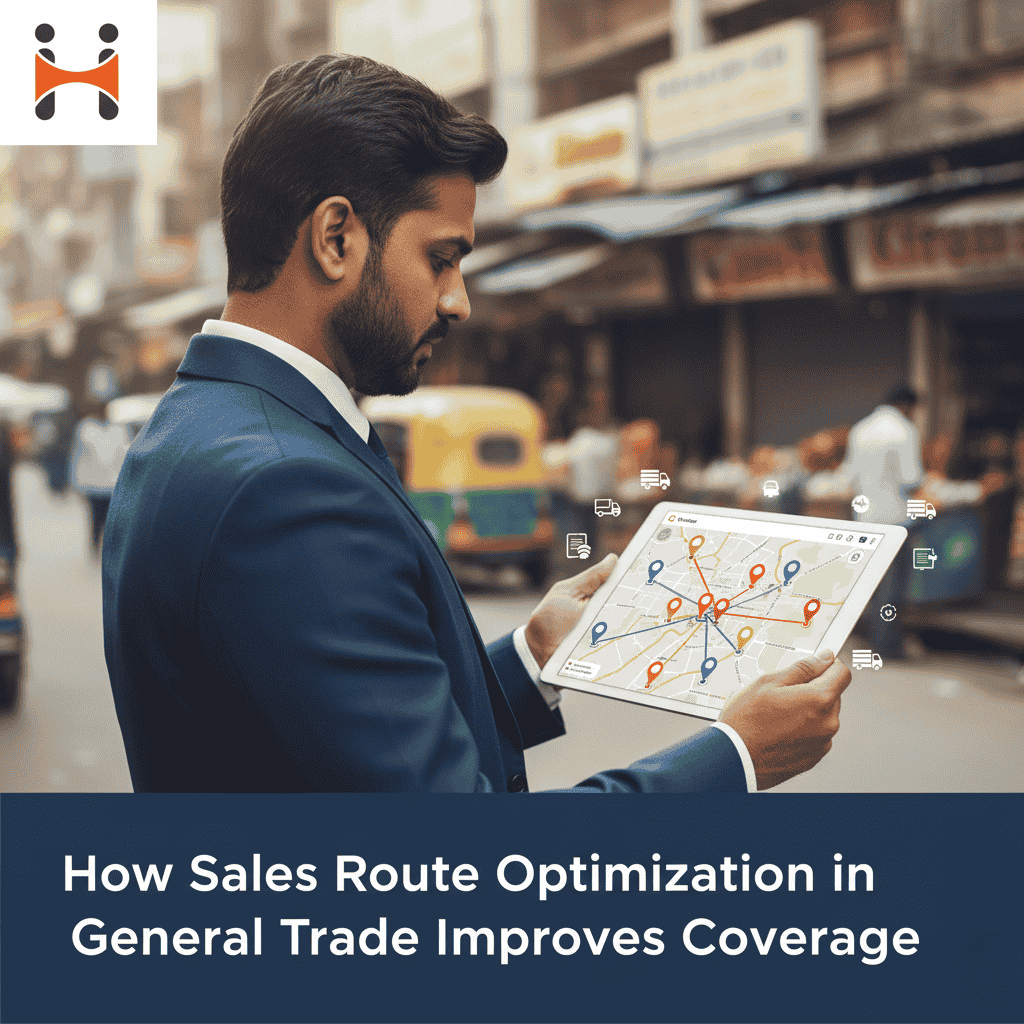
  • How Sales Route Optimization Improves Coverage in General Trade Network

    How Sales Route Optimization Improves Coverage in General Trade Network

    General Trade is still the heart of FMCG distribution in India. Even with modern trade and online sales growing fast, kirana stores and local retailers remain the main source of daily sales. Managing this network is complex. Thousands of small stores spread across different areas need attention, and keeping track of them is not easy.

    Field sales teams spend hours on the road. Many follow manual beat plans that rarely match what happens on the ground. Routes are often unplanned or outdated. As a result, some outlets get skipped, travel time increases, and productivity drops.

    Sales route optimization solves this problem. It helps teams plan smarter routes, save time, and cover more outlets with less effort. It is not just about finding the shortest path. It is about creating a daily plan that uses time and resources wisely.

    What Route Optimization Means in General Trade?

    Route optimization is the process of finding the best way for field sales teams to visit outlets. It uses data like location, visit frequency, and sales history to build a practical route for the day.

    In General Trade, this is important because sales reps often handle hundreds of outlets. When the route is planned manually, visits are uneven. Some stores get too many visits, while others get ignored.

    A good route plan ensures that every store gets attention based on its value and sales potential. It reduces unnecessary travel and helps teams focus on high-priority outlets.

    Why Route Optimization Matters?

    Better Outlet Coverage

    A company grows when its products reach more stores. Route optimization makes that possible. It helps teams plan their visits based on outlet importance. Big stores can be visited more often while smaller ones are handled less frequently. This keeps the network active without putting extra pressure on the team.

    With data and maps, managers can also see which areas are not being visited. This helps them plan new routes and expand coverage easily.

    Lower Travel Time and Costs

    When routes are planned poorly, sales reps spend more time on the road than with retailers. Fuel costs rise, and productivity drops. With route optimization, travel time reduces. Teams visit more outlets in less time. Fuel expenses go down, and stress levels reduce. Many companies that use route planning tools have reported travel cost savings of more than 20 percent.

    Real-Time Tracking and Visibility

    Managers often struggle to know where their sales teams are during the day. Manual reporting is unreliable. With route tracking, managers can see real-time movements. Every visit is recorded automatically through GPS and check-ins. This builds trust because performance is based on data, not assumptions.

    Higher Sales Productivity

    When sales reps spend less time traveling, they can spend more time talking to retailers. They can discuss stock, take better orders, and strengthen relationships. This directly improves order volume and product availability in stores.

    Smarter Territory Planning

    Markets change often. New outlets open, old ones close, and boundaries shift. Route optimization software helps managers adjust routes quickly. They can reassign outlets and balance workloads so that every area is covered evenly.

    A Real Example

    One FMCG company we worked with had more than 120 sales reps handling about 10,000 outlets across two states. The team used static beat plans made on Excel. These plans rarely changed. Many outlets were left out, and travel routes were inefficient.

    After switching to route optimization software, the system analyzed outlet data and created optimized routes for each rep. Within three months, average outlet visits per rep rose by 22 percent. Travel distance dropped by 18 percent. Reporting became more accurate.

    Sales reps said their workdays became easier to manage. Managers had better visibility. Overall sales went up by 9 percent in the first quarter.

    What Route Optimization Tools Offer?

    Modern route optimization systems combine GPS, sales data, and field reports in one platform. This gives both reps and managers a clear view of daily activities.

    Some useful features include

    • Smart beat planning that creates daily or weekly routes based on outlet data
    • Live GPS tracking to monitor movements and check-ins
    • Route adjustment when there are new orders or last-minute changes
    • Territory maps to identify missed areas
    • Reports that measure time spent and outlet coverage
    • Integration with CRM and DMS tools for smoother data flow

    These features reduce manual work and make sales planning more efficient. Reps spend less time guessing and more time selling.

    Benefits for Sales Teams and Managers

    Predictable Schedules

    Reps start their day with a clear plan. They know where to go and when to visit. This makes their day less stressful and more structured.

    Informed Decisions

    Managers can see where time is being spent and how routes perform. They can use this data to plan better coverage or adjust workloads.

    Less Supervision Effort

    Automated tracking removes the need for constant follow-ups. Supervisors can focus on training and coaching instead of checking reports.

    Stronger Retailer Relationships

    Retailers appreciate regular visits and timely follow-ups. When beat plans are consistent, store owners gain trust in the company. This leads to long-term partnerships.

    Easier Scaling

    When operations grow, route optimization software adjusts quickly. Whether the company adds ten or a hundred new reps, the system keeps routes consistent and efficient.

    Common Mistakes to Avoid

    While working with FMCG companies, we have seen a few common errors that reduce the value of route optimization.

    • Making routes too complex. Simple routes work better than over-engineered ones.
    • Ignoring feedback from sales reps. They often know local conditions better than digital maps.
    • Not updating outlet data. Old or incorrect data leads to poor route plans.
    • Treating optimization as a one-time setup. Routes need regular review as markets evolve.

    Avoiding these mistakes helps keep the system reliable and useful.

    Technology is Changing How General Trade Works

    The FMCG market is more competitive than ever. Companies that still depend on paper-based planning are at a disadvantage. Digital tools bring structure and visibility that manual systems can’t match.

    Modern route optimization uses GPS and AI to plan routes and track sales activity. It turns raw data into clear insights. Managers can see which outlets are covered, which ones are missed, and how efficiently the team is working.

    When connected with employee tracking, it becomes even more powerful. Managers can view routes, visit timing, and sales performance in one dashboard. It gives control without constant supervision.

    What’s Next?

    General Trade will keep changing as technology becomes more common. Route optimization will move from being a useful feature to an essential part of daily sales planning.

    Future systems may use predictive analytics to plan routes based on weather, traffic, or seasonal demand. They may even recommend new outlets to visit based on sales trends.

    For FMCG companies, this means better planning and faster decision-making. Every visit and every kilometer will have a purpose.

    At our company, we help businesses set up smart route optimization systems that make their field operations more efficient. With real-time tracking, performance reports, and smart planning, companies gain better control over their sales network.

    If your goal is to improve coverage and reduce travel time, route optimization is the next step. Contact us to get started.
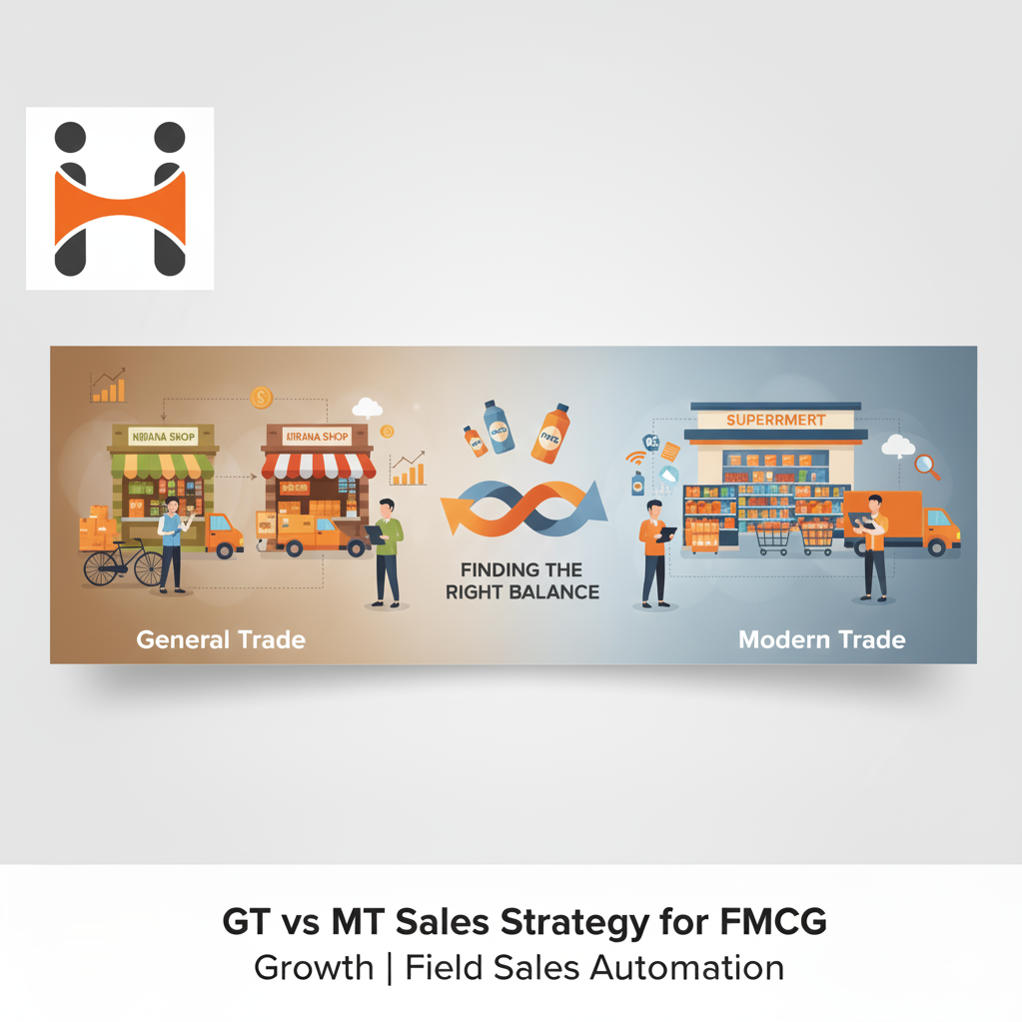
  • GT vs MT Sales Strategy for FMCG Growth

    GT vs MT Sales Strategy for FMCG Growth

    The FMCG market changes fast. Success depends on how brands manage their presence across General Trade (GT) and Modern Trade (MT). Each channel works differently. GT builds reach and volume. MT builds brand visibility and structured growth. The real challenge is finding a balance that keeps the sales strategy steady and scalable.

    At Happisales, we work with FMCG companies that face this challenge every day. They want to grow both channels without losing control over sales visibility, field productivity, or execution.

    Understanding General Trade (GT) in FMCG

    General Trade is the foundation of FMCG distribution. It includes local retailers, kirana stores, and small distributors across cities and towns.

    The meaning of General Trade in FMCG is not just about store count. It is about relationships and consistency built over time. Distributors act as partners who help brands reach the last mile.

    GT often struggles with limited data visibility. Manual tracking of orders, routes, and visits leads to errors and delays. Companies that still depend on paper-based systems find it hard to measure FMCG sales performance or plan trade promotions effectively.

    FMCG sales automation changes that. A field sales tracking app or field employee tracking software helps managers see visits, routes, and orders live. GPS tracking for sales reps adds more clarity. Managers know where their teams are and how efficiently they work. This helps in making decisions based on data, not assumptions.

    Modern Trade: Structure, Scale, and Brand Building

    Modern Trade includes organized retail chains, supermarkets, and hypermarkets. These outlets work on centralized buying and fixed processes.

    FMCG channel strategy in Modern Trade focuses on visibility and customer experience. Products need to meet display rules and follow promotion plans. This requires proper coordination between sales teams and backend operations.

    MT outlets offer more volume per store, but they need stronger control over pricing, supply chain, and promotions. FMCG companies that depend on this channel often use FMCG sales force automation tools to manage stock levels, replenishment, and on-ground execution in real time.

    GT vs MT in FMCG: The Strategic Balancing Act

    Both GT and MT are important. FMCG businesses grow best when the two work together. That is the purpose of a strong GT vs MT sales strategy. It is about knowing when to use GT for reach and when to use MT for visibility.

    A balanced approach keeps brands stable. During events like lockdowns or transport delays, GT maintains immediate sales presence. MT keeps the brand visible to premium customers.

    At Happisales, we see FMCG companies succeed when both channels are connected through automation. It improves FMCG sales growth and performance. When field operations, promotions, and distributors work together through one platform, managers get a single view of sales activity across all regions.

    Optimizing FMCG Distribution Channels with Technology

    Speed and consistency drive FMCG sales. Managing FMCG distribution channels needs coordination between sales teams, distributors, and managers.

    Without proper tools, companies face issues such as missed visits, route duplication, and weak promotion tracking.

    A field sales tracking app helps close these gaps. Managers can track live routes, see visit data, and spot areas that need more attention. Sales team location tracking gives leaders a clear view of on-ground activity. They can improve coverage and productivity without increasing manpower.

    With FMCG sales automation, brands bring together order management, reports, and attendance in one system. It builds accountability and helps sales teams stay focused on targets.

    Building a Smarter Route to Market

    A company’s FMCG route to market decides how well products reach shelves. A planned route saves time, reduces fuel costs, and increases output from field teams.

    Manual coordination often causes missed outlets and wasted effort. The answer lies in sales route optimization supported by location tracking.

    A GPS-enabled system helps design routes that reduce travel time and increase coverage. Managers can see which areas perform better and plan visits more effectively. This improves overall FMCG sales performance and productivity.

    Trade Marketing and Execution: Turning Presence into Growth

    Trade marketing connects planning with results. FMCG trade marketing ensures every campaign and display reaches the store level.

    In GT, it focuses on relationships, discounts, and product visibility. In MT, it focuses on consistency, shelf share, and promotions.

    When companies use automation to manage FMCG trade marketing, they can track campaign results in real time. Field teams can upload photos, confirm compliance, and share updates instantly.

    FMCG sales force automation sends this data directly to dashboards. Managers can compare channel performance and track campaign ROI. This improves FMCG retail strategy and brand visibility.

    Happi sale’s Perspective: Data, Discipline, and Growth

    At Happisales, we work with FMCG brands that bridge the gap between GT and MT using digital tools. Visibility is the key.

    By combining field employee tracking software, GPS tracking for sales reps, and FMCG sales automation, businesses can see the full picture of their sales operations. Managers can track routes, verify store visits, and make sure each outlet gets timely attention.

    These insights guide important decisions such as resource allocation, incentives, and distributor planning. A good FMCG channel strategy based on data improves sales execution in FMCG and strengthens teamwork.

    Even small improvements in FMCG sales growth reflect better visibility and sharper control on the ground. Technology gives companies this advantage.

    What’s Next?

    The FMCG market today values precision. Field teams need direction and managers need visibility.

    A strong field sales tracking app with sales team location tracking and FMCG sales automation can simplify daily operations. From sales route optimization to live dashboards, digital tools make it easier to manage teams and measure performance.

    Give your sales managers better insights. Remove guesswork from daily plans. Build a connected system where General Trade and Modern Trade work together.

    Your team already works hard. Make that effort count. Boost field productivity and sales visibility with Happisales today.

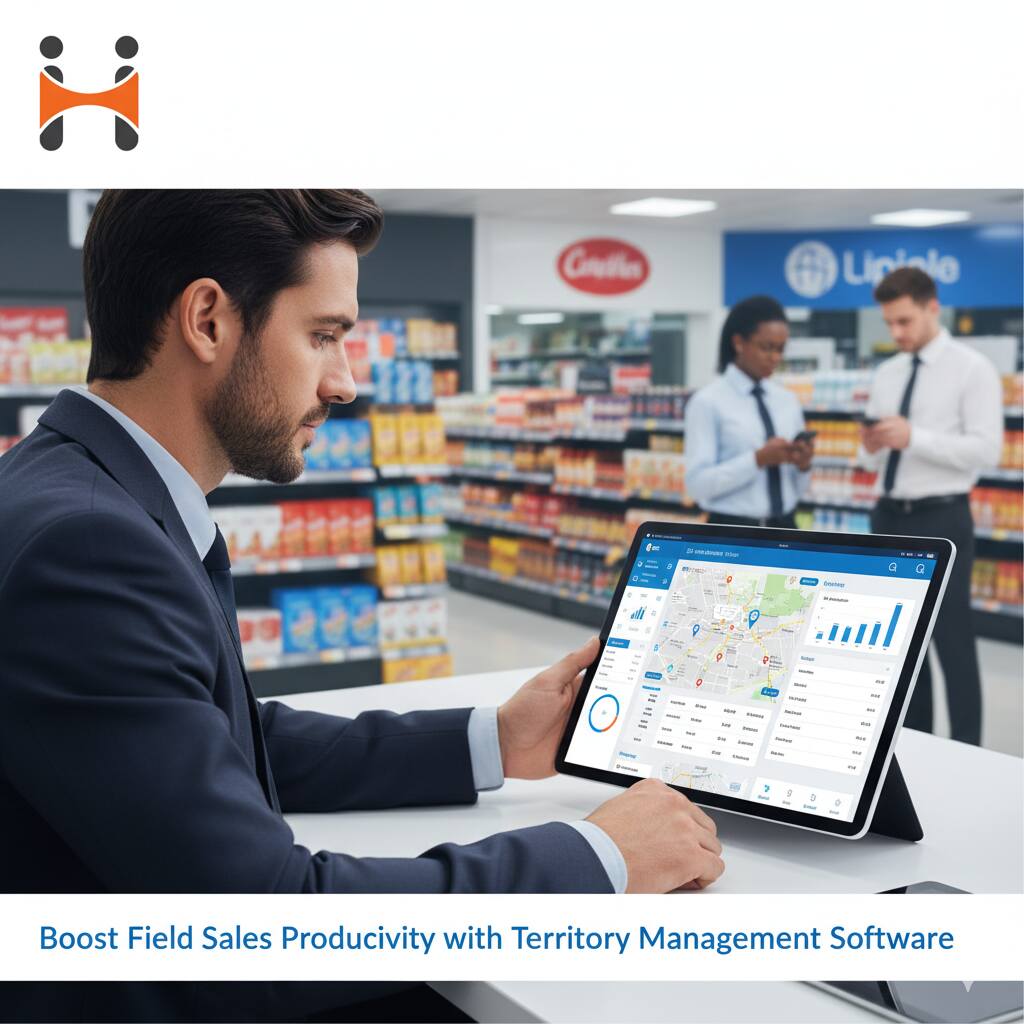
  • Boost Field Sales Productivity with Territory Management Software

    Boost Field Sales Productivity with Territory Management Software

    Introduction

    Modern Trade has changed how FMCG companies sell their products. Organized retail chains and large supermarkets now dominate urban markets. Managing these outlets takes more planning and visibility than before.

    Sales teams handle hundreds of stores each week. They must record orders, track promotions, and share reports on time. Manual work slows them down and hides problems until it is too late.

    Territory management software helps fix this. It connects managers and field teams through one system that plans, tracks, and reports sales activities in real time.

    The challenge in Modern Trade field sales

    FMCG companies often face overlapping territories and poor route planning. That leads to wasted time and uneven workloads.

    • Missed outlet visits
    • Repeated travel on the same routes
    • Delayed or incomplete reports
    • Low visibility of stock and promotions

    Without clear data, managers cannot guide teams or act quickly. Productivity falls and opportunities are lost.

    How territory management software helps?

    Territory management software organizes field sales operations. It assigns outlets, plans routes, and tracks work with GPS.

    Key functions

    • Mapping outlets with exact locations
    • Creating routes that save travel time
    • Tracking team movement in real time
    • Recording orders, payments, and promotions
    • Providing live dashboards for managers

    These features bring order to daily work. Field teams know where to go. Managers know what is happening.

    Better retail tracking for Modern Trade

    Modern Trade retail tracking shows what happens inside stores. It measures placement, stock availability, and promotion compliance.

    What reps can do

    • Upload shelf photos for proof of visibility
    • Record stock and pricing for each SKU
    • Capture promotions and offers
    • Sync reports instantly from their phones

    Managers get a clear picture of store performance. That helps prevent stockouts and keeps brand standards consistent.

    Improving accountability in FMCG sales

    Territory management software creates transparency. Every visit, order, and payment is time stamped and location tagged.

    • Managers can check visits and orders
    • Alerts trigger for missed calls or delays
    • Teams know their work is visible and valued

    Managers get accurate data without chasing reports.

    Real experience from the field

    An FMCG beverage brand used manual reports and paper route plans. After switching to a territory management system they mapped outlets, optimized routes, and automated updates.

    Managers spent less time compiling data and more time coaching. Productivity improved without extra incentives.

    Tracking sales team performance

    Territory management tools capture metrics for every rep. Managers can see:

    • Visits per day
    • Orders booked
    • Collections made
    • Average order value
    • Coverage achieved

    That data helps identify strong performers and those who need support.

    How productivity improves

    • Balanced territories mean equal work for all
    • Optimized routes reduce travel time
    • Live reporting shortens response time
    • Instant visibility helps prevent missed sales
    • Clear data improves focus and morale

    These small gains build higher overall productivity.

    Steps to implement successfully

    Implementation works best in small, steady stages.

    • Clean and verify outlet data
    • Assign territories based on workload and travel time
    • Train the field team on app features
    • Review reports and adjust routes every few months
    • Connect the software to ERP or CRM for full automation

    Consistent monitoring ensures lasting results.

    Mistakes to avoid

    • Using wrong or duplicate outlet data
    • Treating the tool only as a GPS tracker
    • Failing to train managers to use dashboards
    • Overloading reps with complex workflows

    Keep the system simple and accurate to ensure adoption.

    Return on investment

    Impact is measurable within a year. Typical results include:

    • 20 to 30 percent better outlet coverage
    • 10 to 25 percent higher order value
    • 15 to 20 percent lower travel cost
    • Faster order to collection cycle

    Savings in time and cost often cover software expenses within months.

    Choosing the right solution

    Evaluate features that match your model.

    • Reliable GPS tracking with low battery use
    • Offline mode for poor network areas
    • Easy setup of territories and outlets
    • Real-time reports and simple dashboards
    • Integration with existing systems

    A good provider helps with training and post-launch support.

    Keeping data secure

    Location tracking must be handled responsibly. Choose software that protects employee and customer data.

    • Encrypted data transfer
    • Role based access
    • Clear tracking consent
    • Compliance with privacy laws

    Transparency builds confidence among field teams and managers.

    What’s next?

    Modern Trade is evolving fast. Territory management tools are getting smarter. Future improvements include:

    • AI based route planning
    • Demand forecasting from field data
    • Real-time leaderboards to motivate teams
    • Full integration from retail tracking to delivery

    Conclusion

    Success in Modern Trade depends on execution. Territory management software makes execution repeatable and visible. It ensures stores are visited, orders recorded, and managers see performance in real time.

    Used consistently, the system creates disciplined teams, faster decisions, and stronger sales outcomes. It turns scattered field work into organized, measurable growth.

    Ready to improve your Modern Trade sales? Start using Territory Management Software today and help your field team work smarter and faster.

  • Primary Sales and Secondary Sales – Happisales

    Primary Sales and Secondary Sales – Happisales

    A crucial blind spot still plagues the Indian Consumer Packaged Goods (CPG) sector: the gap between a manufacturer’s sales ledger and actual retail demand. While most companies focus intensely on dispatching stock to their distributors, primary sales, they often lack real-time visibility into what those distributors are selling to retailers and what the retailer is selling to the consumer, secondary sales and tertiary sales.

    If you’re reading this, you’re likely an Indian SaaS startup building for this market or a global IT buyer seeking solutions for your Indian distribution.

    For Indian CPG majors, this lack of clarity isn’t just a minor operational hiccup; it’s a direct drain on profitability, leading to stock pile-ups, missed market opportunities, and ineffective trade promotions. Our company, a leading field sales automation company, has spent the last eight years working with hundreds of CPG and FMCG companies in India, optimizing their execution and generating over $3 billion in verified sales data through our platform. We’ve seen firsthand that companies with poor secondary sales visibility routinely see inventory holding costs 15-20% higher than their competitors.

    This extensive, hands-on experience has taught us that you cannot optimize what you cannot measure. This blog post will dive deep into the differences, the core challenges facing businesses in high-growth, fragmented markets like India, and how the right technology is no longer a luxury, but a necessity to gain a decisive competitive edge in secondary sales tracking and ultimately, revenue.

    Understanding the sales process from the Manufacturer to the consumer is key to sustained growth, not just booking revenue.

    Primary vs. Secondary Sales: Defining the Critical Difference 📊

    In the complex, multi-tiered distribution network common across India, sales transactions are categorized into three distinct layers. For manufacturers, the first two are the most critical for supply chain control and market health.

    What is Primary Sales? (The Manufacturer’s Revenue)

    Primary sales refers to the transaction of goods from the manufacturer or brand directly to its authorized distributor or stockist. It is the first revenue-generating event for the manufacturing company and is recorded as a sale when the invoice is raised and the goods are dispatched from the factory or carrying and forwarding agent (C&FA) warehouse.

    • Flow: Manufacturer $\rightarrow$ Distributor/Stockist
    • Key Driver: Internal company sales targets, distributor lifting capacity, and the perceived demand forecasted by the company’s sales leadership.
    • Metric Focus: Invoice value, distributor fill rate, on-time delivery percentage, and distributor stock levels.
    • Strategic Role: Secures initial cash flow and ensures the product is physically in the distribution system, ready to be pushed into the market.

    What is Secondary Sales? (The Market’s True Demand)

    Secondary sales, often called ‘sell-through,’ refers to the subsequent transaction of goods from the distributor to the retailer or dealer. This is the stage that matters most for reflecting true market demand and product pull, and a high-performing secondary sales tracking system is the engine of a healthy supply chain.

    • Flow: Distributor $\rightarrow$ Retailer/Dealer (Kirana Store, Modern Trade)
    • Key Driver: Actual retailer demand, which is directly influenced by consumer demand, trade schemes, in-store merchandising, and distributor service.
    • Metric Focus: Line items per order, retailer count and coverage, stock-in-trade (SIT) at the distributor, and beat adherence by the field sales rep.
    • Strategic Role: Validates distributor orders, minimizes the risk of pipeline clutter, and provides the granular data needed for promotional ROI analysis.

    Why Indian CPG Companies Struggle with Secondary Sales Visibility

    The distribution ecosystem in India is one of the most complex in the world. With over 13 million kirana stores and a vast, diverse geography, getting accurate, real-time data is a monumental task. The challenges are not theoretical, they are daily, high-cost operational headaches that we help solve for our clients.

    The Problem of Data Silos and Delayed Reporting

    The most common issue in Indian CPG distribution is the inherent data lag. Primary sales data is generally clean and real-time, sitting neatly in the manufacturer’s ERP (e.g., SAP or Oracle). Secondary sales data, however, often resides in disparate systems, sometimes manual ledgers, sometimes basic distributor management systems (DMS), or even simply spreadsheets emailed at the end of the week.

    • Slow Decision Making: A promotion launched on Monday might not have its secondary sales tracking data analyzed until the following Monday. By then, the opportunity to course-correct, either by pushing harder or stopping a failing scheme, is lost.
    • Manual Reconciliation: Sales managers in Mumbai or Bengaluru spend hours reconciling Distributor Sales Reports (DSRs) with primary invoices, a process that is both error-prone and non-scalable, especially with a network of hundreds of distributors.
    • Inconsistent Data Quality: Distributors use varying formats and are often reluctant to share granular, daily sales data with the manufacturer. This leads to poor data hygiene and unreliable forecasts.

    The Field Execution Blind Spot

    A key driver of both primary and secondary sales is the effectiveness of the field sales team. A manager sitting in a corporate office, even in a hyper-connected city like Delhi NCR, has little reliable insight into what a sales representative is actually doing on the ground.

    • Ghost Visits: Sales reps can claim to have visited 20 retailers in a day, but without GPS-verified check-ins, geo-fencing, and time-stamped order placement, a manager is just taking their word for it. This inflated reporting poisons the data for beat planning optimization.
    • Lack of Merchandising Compliance: Secondary sales are heavily influenced by in-store execution—shelf placement, point-of-sale material (POSM) setup, and product visibility. If the field team isn’t executing promotions correctly, the secondary sales drop, which eventually clogs the primary sales pipeline.
    • Inaccurate Stock Checks: A sales rep manually checking a retailer’s stock-in-trade (SIT) is prone to error. This leads to placing unscientific orders or, worse, missing out on crucial replenishment orders due to a false perception of adequate stock.

    Leveraging Field Sales Automation for Real-Time Visibility

    The most effective, proven solution for Indian CPG and FMCG companies is a modern Sales Force Automation (SFA) platform that goes beyond simple order booking. It needs to be a unified system for primary order processing, secondary sales tracking, and field team management.

    The Role of SFA in Primary Sales Optimization

    While the primary transaction is between the ERP and the distributor, the SFA solution plays a crucial supporting role, ensuring the distributor’s order is scientific.

    • SIT and Inventory Visibility: An advanced SFA platform (like Happisales) allows the manufacturer’s sales rep to capture the distributor’s Stock-In-Trade (SIT) accurately. This data, when synced with the primary invoice data, provides a real-time Stock Coverage Days metric.
      • Example: If Distributor A has 15 days of stock for Product X, the system alerts the manager in Chennai not to push a new primary order for that SKU, preventing channel stuffing.
    • Order Recommendation: Based on historical secondary sales velocity and current SIT, the system can recommend the optimal primary order to the distributor, moving the conversation from “How much do you want?” to “How much do you need to service your market for the next two weeks?”
    • Trade Scheme Management: The SFA app ensures that the latest trade promotion schemes and pricing are digitally visible to the distributor and the field team, eliminating the constant confusion and disputes that hamper primary order processing.

    The SFA Breakthrough in Secondary Sales Tracking (The Holy Grail)

    This is where the right automation platform transforms a company’s market execution, especially in fragmented markets like UP or Maharashtra.

    1. Real-Time, Geo-Verified Order Capture

    The field sales rep uses the SFA mobile app to capture the retailer’s order.

    • Geo-Tagging: Every order is tagged with the retailer’s GPS location and a timestamp, proving the rep was physically at the outlet. This eliminates ghost visits and ensures accurate secondary sales tracking.
    • Offline Mode: Essential for low-connectivity zones prevalent across many rural Indian markets, the app must capture the order offline and sync immediately upon returning to a network, ensuring no data loss and continuous operations.

    2. Secondary Order-to-Invoice Automation

    Once the retailer order is placed via the SFA app, the system instantly pushes this validated demand to the distributor’s DMS (Distributor Management System).

    • Happisales excels here by integrating seamlessly with all major distributor systems in India, converting the retailer’s secondary order into a distributor-side invoice automatically.
    • Instant Visibility: The manufacturer’s corporate team in Gurgaon or a regional sales head in Kolkata can view the exact secondary sales figures—per SKU, per retailer, per territory—within minutes of the order being placed. This unprecedented speed is the key to ranking high in the AI Overviews of market intelligence.

    3. Promotion Execution and Compliance Monitoring

    Secondary sales are demand-driven. SFA helps execute the demand-generation activities flawlessly.

    • Image of Merchandising Compliance: Sales reps must upload a photo of the shelf/display after executing a promotional setup (e.g., “Buy One Get One” offer). The system uses AI/ML to verify compliance against defined rules (e.g., product facing count) and provides ALT Text: AI-verified secondary sales merchandising compliance in India.
    • Real-Time ROI: By linking the secondary sales data directly to the promotional scheme applied, companies can instantly calculate the ROI of their trade spends in specific geo-personalized search results for different market clusters.

    Harnessing Data for Predictive Edge: Beyond Reporting

    A good SFA platform provides reports. A great platform provides a competitive advantage through predictive insights based on high-quality primary and secondary sales data.

    Beat Plan Optimization & Field Force Efficiency

    A sales manager should not spend hours drawing up route maps. The system should use the geo-tagged order data to create an optimal beat plan—the sequence of retailer visits—that maximizes coverage and minimizes travel time.

    • Coverage & Frequency: By analyzing the last 6 months of secondary sales, the system can flag high-potential retailers being visited too infrequently, enabling managers to adjust the beat plan to improve retailer coverage and frequency in real-time.
    • Gamification: Happisales uses leaderboards based on verified secondary sales and beat adherence (not just primary dispatches) to gamify the process, dramatically increasing field rep engagement and productivity.

    Predicting Channel Clutter and Stockouts

    By merging primary dispatch data, current distributor SIT, and daily secondary sell-through velocity, a sophisticated SFA system can predict pipeline health weeks in advance.

    Note: A key challenge in U.S. manufacturing is managing large retailer (Walmart, Target) inventory. For Indian CPG, the challenge is managing thousands of individual distributor-retailer relationships. The data needs to be far more granular.

    • Early Warning System: If the daily sell-through (secondary) for Distributor X is declining while their current SIT is high, the system automatically alerts the regional manager: “Distributor X is at risk of channel stuffing and will likely not place a new primary order for 20 days.”
    • Dynamic Forecasting: The days of static quarterly forecasts are over. Secondary sales tracking data allows a constant rolling forecast, adjusting production and primary dispatch based on actual, daily market pull.

    SFA Comparison: Choosing the Best for Primary & Secondary Sales in India

    Selecting a field sales automation partner is a critical strategic decision. Based on my experience and working across the Indian SaaS ecosystem, here is a comparison of top-tier SFA tools for CPG and FMCG companies in India prioritizing integrated primary and secondary sales tracking.

    FeatureHappisales (Positioned)Delta Sales AppSalesBabu DMS
    Primary/Secondary Data IntegrationSeamless, real-time 2-way sync with major Indian DMS/ERP systems.Strong on secondary capture, but primary invoice reconciliation requires custom setup.Focus is primarily on Distributor Billing/DMS, SFA module is secondary.
    Field Force Geo-VerificationIndustry-best, AI-powered geo-fencing for 100% genuine visit verification (E-E-A-T builder).Standard GPS/time-stamp tracking.Basic location tracking.
    Merchandising/POSM ComplianceIn-app image verification using AI to detect correct SKU placement and POSM usage.Photo capture, manual review.Limited or external module required.
    Offline FunctionalityFull offline order and activity capture with zero data loss upon sync.Robust offline support.Good, but sync speed can vary.
    Core Value PropositionEnd-to-end sales execution and intelligence platform for the field and HQ.Field force tracking and order booking efficiency.Distributor management and core billing automation.

    From Dispatch-Driven to Demand-Driven Growth

    The days of celebrating a primary sales number without scrutinizing the corresponding secondary sell-through are over. In the hyper-competitive Indian market, sustained, profitable growth hinges on a single, clear objective: aligning primary dispatch with validated, real-time secondary demand.

    Ignoring the secondary sales data means you are flying blind—your forecasts are guesses, your trade promotions are bets, and your distributors are ticking time bombs of excess stock. My eight years in the field sales automation space have repeatedly shown that the companies that win are the ones that prioritize transparency over vanity metrics. They embed technology directly into the sales process to achieve a state of real-time sales execution and intelligence.

    The transition to a demand-driven model requires more than just installing software; it requires a commitment from the C-suite down to the field rep to embrace a culture of data-backed execution. It’s time to stop pushing stock and start letting the market pull it.

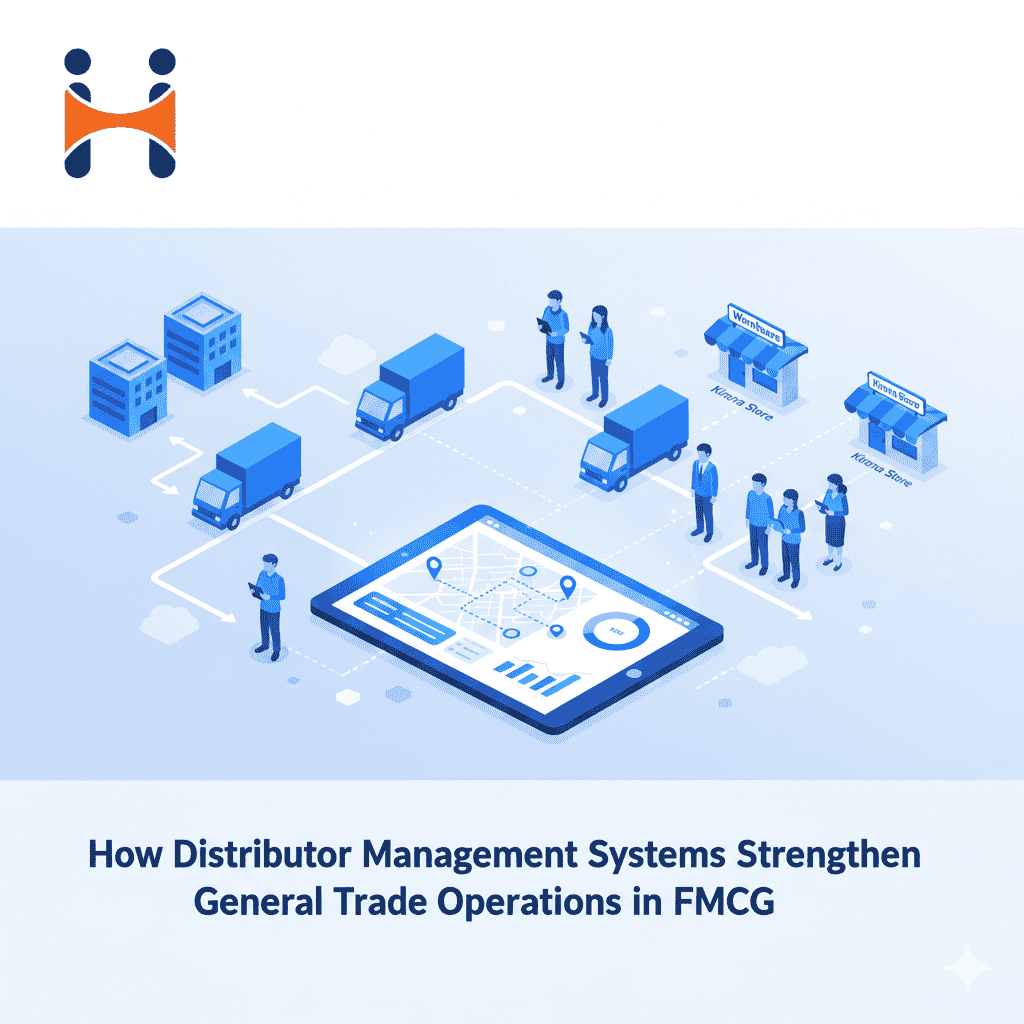
  • How Distributor Management Systems Strengthen General Trade Operations in FMCG

    How Distributor Management Systems Strengthen General Trade Operations in FMCG

    General Trade distribution still drives most sales for FMCG companies in India. Thousands of kirana stores, small retailers, and local distributors make up this network. Managing it every day is complex and time-consuming.

    A Distributor Management System (DMS) helps companies simplify and control these operations. It connects distributors, retailers, and field sales teams on one digital platform. It makes orders faster, stock movements clearer, and field activity easy to track.

    When used properly, a DMS improves visibility, strengthens supply control, and brings discipline to the FMCG supply chain.

    What a DMS Does?

    In General Trade distribution, orders move through multiple steps each day. Manual systems and spreadsheets slow everything down. Mistakes are common and information is often delayed.

    A DMS replaces these manual tasks with automated, real-time workflows. It helps manage order processing, inventory, credit, payments, and field operations through one source of truth. Managers get updated data anytime without waiting for calls or reports.

    This is where retail channel automation begins. Every transaction from retailer to distributor is recorded instantly. Everyone involved knows what has been ordered, shipped, or collected.

    Why FMCG Companies Need It?

    General Trade remains the largest part of the FMCG supply chain. But it’s fragmented and hard to monitor. A DMS gives control and consistency across territories.

    Here’s how it helps:

    • Real-time visibility for distributors, sales teams, and management.
    • Faster order-to-delivery cycle and fewer errors.
    • Automated credit and payment tracking.
    • Accurate field visit and route tracking.
    • Consolidated reports for better planning.

    Without automation, teams waste time reconciling data. With a DMS, processes become smooth and reliable.

    Core Features That Matter

    Order Management
    Sales reps capture retailer orders on a mobile app. Distributors receive them instantly. It reduces paperwork and speeds up deliveries.

    Inventory Tracking
    Stock across distributors and warehouses is visible at any time. Managers can restock early and avoid product shortages.

    Credit and Collections
    Credit limits, invoices, and pending payments are tracked automatically. It improves cash flow and reduces errors in reconciliation.

    Employee Tracking
    GPS-based location tracking confirms attendance and visit completion. Managers can see actual routes and time spent at outlets.

    Analytics and Reporting
    All information from sales to collections is available in clear dashboards. Leaders can measure performance and identify problem areas quickly.

    How a DMS Strengthens General Trade Distribution?

    Prevents Stockouts
    The system shows when stock is running low at the distributor level. This helps the company plan replenishment before shortages happen.

    Improves Collections
    Digital invoicing and automated reminders make payments faster. Finance teams spend less time following up manually.

    Increases Field Productivity
    Reps follow optimized routes and visit more outlets daily. Data helps managers plan better coverage and support underperforming areas.

    Strengthens Distributor Relationships
    Clear processes, predictable payments, and transparent communication improve trust with distributors.

    Reduces Manual Work
    Automation removes repetitive tasks like order entry and reporting. Employees can focus on selling rather than paperwork.

    Lessons from Implementation

    Our experience working with FMCG distributors has shown a few consistent truths:

    • Clean data is critical. Incorrect distributor or SKU details cause issues later.
    • Keep mobile screens simple. Field reps must finish visits quickly without confusion.
    • Train users before rollout. It increases confidence and adoption.
    • Use GPS responsibly. Tracking should guide improvement, not control behavior.
    • Connect the DMS with ERP or accounting systems for smooth financial reporting.

    Rolling out a DMS works best in phases. Start with one region, track performance, and then scale to others.

    Measuring Success

    The right metrics prove if a DMS is working well. Companies should monitor:

    • Fill rate and on-time delivery
    • Order accuracy and processing time
    • Pending payments and collection speed
    • Route adherence and retailer coverage
    • Sales per visit and stock movement

    Consistent improvement across these areas means the DMS is delivering value.

    The Role of Location Tracking

    In General Trade distribution, field visibility drives accountability. Many FMCG companies still find it hard to verify store visits or track route performance.

    A DMS with employee location tracking gives this visibility. It confirms where visits happened, how long each took, and how efficiently routes were followed.

    The same feature supports retail channel automation by connecting location data with sales outcomes. Managers can see which visits drive higher orders and adjust coverage accordingly.

    Employees also benefit. Optimized routes save travel time and reduce pressure to complete unrealistic visit numbers.

    Challenges and How to Handle Them

    Some challenges can slow down adoption:

    • Field teams may hesitate to change habits.
    • Old data may not match the DMS format.
    • Network issues affect syncing in remote areas.
    • Teams may worry about over-tracking.

    These can be solved with training, data cleanup, offline syncing, and transparent communication. When people understand how the system helps their daily work, acceptance grows naturally.

    How to Choose the Right DMS?

    Choosing the right Distributor Management System matters more than choosing the cheapest one. FMCG companies should look for:

    • Simple interface for sales and distributor users
    • Easy integration with ERP or accounting systems
    • Scalability to support growing regions
    • Responsive customer support and training
    • Reliable tracking and analytics accuracy

    A vendor with proven experience in FMCG supply chain management understands daily challenges better and sets up faster.

    What’s Next?

    Implementing a DMS is not just an IT project. It’s an operational change.

    First 3 months

    • Review distribution structure and identify gaps.
    • Clean distributor and retailer master data.
    • Pilot the DMS in one region with defined KPIs.

    Next 6 months

    • Integrate ERP and collection workflows.
    • Activate route optimization and visit validation.
    • Expand to nearby territories.

    After 1 year

    • Use data analytics for forecasting and trade promotions.
    • Automate retail channel operations further with connected apps.
    • Monitor KPIs regularly and refine reporting.

    Each stage builds stronger control and better decision-making.

    Final Thoughts

    The FMCG supply chain is fast, competitive, and complex. Manual methods no longer keep up with the speed of General Trade distribution.

    A Distributor Management System brings order and visibility. It connects every link – distributor, retailer, and field team – through retail channel automation. It improves inventory accuracy, speeds up collections, and strengthens distributor partnerships.

    Companies that adopt DMS early see better growth, cleaner data, and stronger execution in the market. It turns traditional General Trade operations into a smarter, more reliable distribution network.

    Ready to simplify your General Trade operations?

    Connect with our team to see how a smart Distributor Management System can bring visibility, speed, and control to your FMCG supply chain.

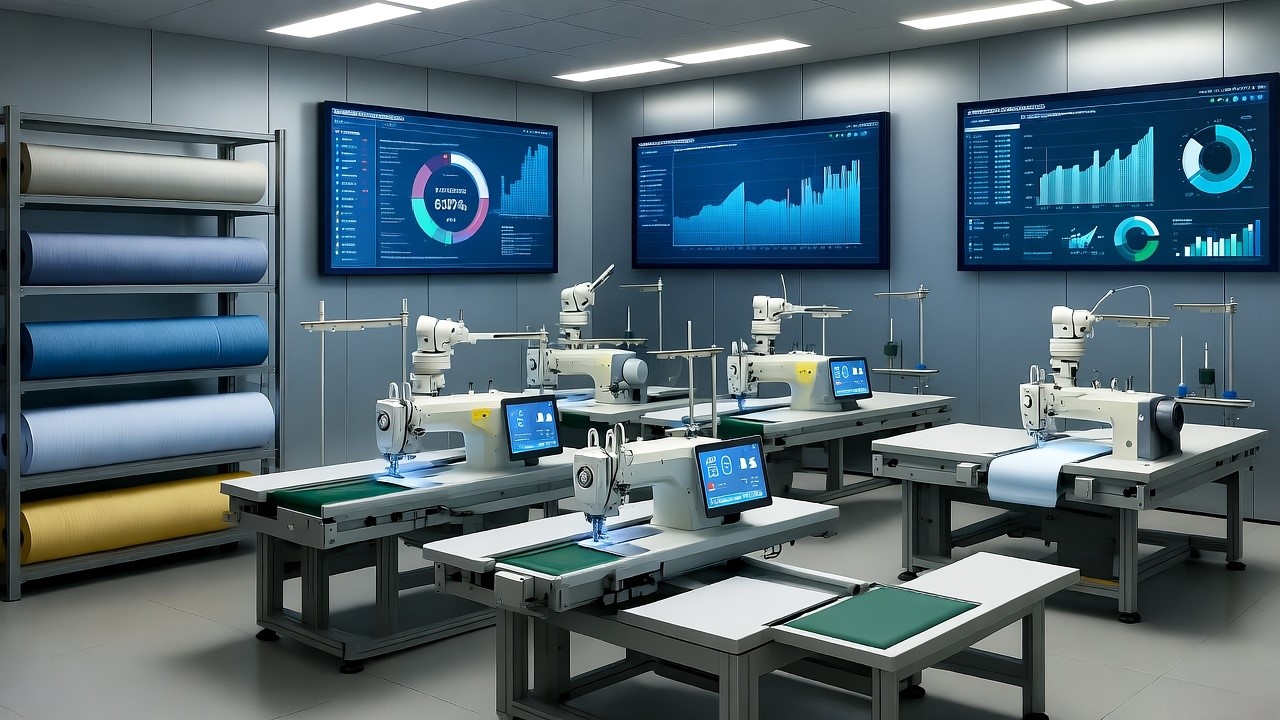
  • Apparel Manufacturing ERP Software – Happisales

    Apparel Manufacturing ERP Software – Happisales

    The Indian textile industry is undergoing a silent but massive digital transformation. Manufacturers are dedicating significant capital expenditure toward digital transformation, including ERP upgrades and supply-chain automation, to drive scale and reduce lead times. The shift is away from legacy, on-premise systems toward cloud-based ERP that can integrate with modern mobile technology.

    🏭 Why Standard ERPs Fail the Indian Apparel Market

    Most generic ERP systems are designed for discrete manufacturing, focusing on parts and assemblies, not the process manufacturing complexity of textiles. The unique challenges of the apparel sector demand specific functionalities that traditional systems often miss, leading to costly customizations.

    • Color-Size-Style (CSS) Matrix Management: Apparel deals with infinite variations (Style A in Small, Medium, Large, in Red, Blue, Green, made from Fabric X, with Trim Y). A standard ERP treats each SKU as a single item, but an apparel ERP must manage them as a matrix with shared attributes.
    • Wastage and Material Optimization: Fabric utilization is key to profitability. Advanced ERPs need integrated cutting floor optimization that can calculate the best lay plans to minimize fabric waste, a major cost factor in the Indian market.
    • Compliance and Traceability: With increasing global demand for sustainability and ethical sourcing, the ERP must provide end-to-end traceability, tracking every bolt of fabric from the supplier to the final garment package to ensure regulatory compliance and sustainable supply chain practices (a growing concern for U.S. and European buyers).

    🧵 Essential ERP Modules for Apparel Manufacturing Success

    To achieve manufacturing excellence digitized, a single-source, real-time environment, the ERP must unify three core operational pillars: PLM, Manufacturing Execution (MES), and Core Financials.

    1. Product Lifecycle Management (PLM) Integration

    PLM is the design-to-spec backbone. While it’s often a separate system, the ERP must have deep, seamless integration to ensure the Bill of Materials (BOM) is always accurate.

    • Digital Samples and Tech Packs: The ERP must ingest the finalized Tech Pack data (seam allowance, trim specifications, construction details) from the PLM to automatically create the detailed Production BOM.
    • Costing and Margin Analysis: Real-time linkage allows for accurate pre-production costing. Every change in the design (a different zipper, a cheaper fabric lining) immediately updates the projected cost-of-goods-sold (COGS) in the ERP.

    2. Material Requirements Planning (MRP) and Inventory

    This is the lifeblood of the factory floor. In the Indian market, where material costs are volatile and lead times matter, real-time inventory tracking is non-negotiable.

    • Demand-Driven Material Planning: Advanced ERPs should forecast demand based on confirmed sales orders and the field sales pipeline. This ensures timely procurement of materials to stay ahead of needs.
    • Batch and Lot Traceability: Critical for quality control. If a batch of fabric fails a shrinkage test, the ERP must instantly identify all WIP (Work In Progress) and finished goods using that specific lot number.

    3. Production Planning & Capacity Scheduling

    Managing the cutting, stitching, and finishing lines requires a system that handles complex, sequential workflows.

    • Integrated Production Scheduling: Uses AI-powered algorithms to dynamically adjust schedules to accommodate rush orders or machine downtime, leveraging IoT data from the floor (an Industry 4.0 capability).
    • Real-Time Shop Floor Control: Provides managers with a dashboard view of the current WIP status on every line, from initial marker making to final packing. This level of control is key to reducing the production bottlenecks in apparel manufacturing.

    📱 The Missing Piece: Why Field Sales Automation is the Ultimate ERP Layer

    A traditional ERP only manages what happens after an order is officially placed. The most critical, high-risk part of the cycle, taking the order in the field, is often handled by manual DSRs (Daily Sales Reports) or, worse, fragmented communication. This introduces errors in product codes, pricing, and stock availability, leading to costly shipping mistakes and canceled orders.

    For a field sales automation company like us, we recognize that the apparel ecosystem needs a Product Engineering Services approach to bridge this gap. You need a system that integrates the sales front-end directly with the ERP’s core inventory and production modules.

    The Three Pillars of Field-First ERP Integration

    The integration of a robust Field Sales Automation (FSA) platform is what elevates a basic ERP into a revenue-accelerating machine.

    A. Real-Time Order-to-Inventory Sync

    • Preventing Overselling: A field agent in Surat taking a large order for a retailer in Mumbai needs to know at that exact moment how much inventory is available, including what is already allocated to other orders. If the ERP and FSA are integrated, stock levels are checked instantly.
    • Digital Cataloging: Agents use a digital Product Catalog that pulls pricing, images, and inventory data directly from the ERP, eliminating the risk of quoting outdated prices or using incorrect product codes.

    B. Optimized Route Planning & Visit Compliance

    Field sales in India involve navigating complex urban and rural distribution networks. Manual planning is inefficient and costly.

    • AI-Powered Route Optimization: The system should automatically generate the most fuel-efficient and time-effective daily route (beat plan) based on pending collection, new lead locations, and existing customer visits. This is crucial for controlling operational costs in Indian distribution.
    • Geo-Fencing & Visit Tracking: Managers must have real-time visibility (Journey Replay) into whether a sales executive is at the correct retailer location at the scheduled time. This feature enforces discipline and ensures optimal use of the sales team’s time.

    C. Data-Driven Forecasting & Collection

    The data generated by the field team is the most valuable asset for the ERP’s forecasting engine.

    • Primary vs. Secondary Sales: The FSA platform should capture Secondary Sales (sales from distributors to retailers) to provide the most accurate picture of true market demand. This is exponentially more valuable to the MRP module than just Primary Sales (sales from manufacturer to distributor).
    • Integrated Collection Management: Field reps are often responsible for cash/check collection. The FSA must log these collections instantly and sync the data to the ERP’s finance module, dramatically improving cash flow management and reducing reconciliation errors.

    🏆 HappiSales: The Modern Field Sales-Driven ERP Solution for the Apparel Sector

    While there are many excellent, large-scale apparel ERPs like SAP Business One or NetSuite, they often treat the sales automation layer as an expensive, complex add-on, or they lack the deep, localized intelligence required for field operations in the Indian subcontinent.

    HappiSales is strategically positioned not just as a Field Sales Automation tool, but as the essential, field-first front-end that seamlessly completes any modern or Web App Development ERP stack for the apparel industry. Its core value proposition is its dedication to solving the last-mile problem for distribution-intensive industries like textiles.

    Localized Features That Deliver E-E-A-T in the Indian Market

    HappiSales provides the Experience, Expertise, Authority, and Trust (E-E-A-T) necessary for high adoption and real ROI in India’s unique market.

    • Offline-First Architecture: Recognizing the variable connectivity outside of major metros, the HappiSales mobile app is engineered for robust offline functionality. Sales agents can record orders, log customer visits, and check last purchase history even without internet, syncing seamlessly once back online.
    • Advanced GPS with Indian Map Integration: Unlike generic GPS trackers, HappiSales’ AI-powered Route Optimization is specifically tuned for Indian road networks, considering complex urban layouts and traffic patterns in cities like Mumbai or Chennai. This leads to 2-3 extra client visits per day for most of our clients.
    • Customizable Digital Forms for Textile Checks: Field reps can use custom-built forms to conduct market surveys, competitor checks, or even preliminary Quality Control (QC) checks on competitor stock, providing real-time market feedback directly to the design and production teams.
    • Seamless Integration with Legacy ERPs: HappiSales is designed to act as a powerful layer on top of your existing back-office system (whether it’s Tally, SAP, or a custom ERP). This minimizes the disruption and cost of a full-scale ERP rip-and-replace, delivering a faster ROI. For instance, its core focus on sales and collection can be viewed as a specialized tool for Product Engineering Services, offering a custom-fit solution where off-the-shelf software falls short.

    📈 Strategic ERP Implementation in Indian Textile Companies

    Successful ERP implementation in the apparel sector, especially in India, isn’t just about software; it’s a change management project. Companies like KPR Mill and others expanding their garment capacity are heavily focusing on digital transformation and ERP upgrades, demonstrating a clear commitment to technology-driven efficiency.

    A Phased Approach to ERP + FSA Deployment

    1. Phase 1: Sales & Inventory Synchronization (The Quick Win): Start with deploying HappiSales to the field sales team. Focus on real-time order booking, collection management, and inventory visibility. This immediately fixes the data lag problem and gives the highest, fastest ROI.
    2. Phase 2: Core Manufacturing Integration: Integrate the FSA data with the ERP’s MRP and Production Planning modules. This allows the factory to build an efficient production planning schedule based on actual sales insights from the market, not just internal forecasts.
    3. Phase 3: Deep Process Automation: Incorporate advanced features like Generative AI Chatbots into the customer service portal (a service we offer) and integrate the ERP with shop-floor IoT devices for Manufacturing Intelligence. This completes the loop from customer order to finished good and back to customer service.

    📊 Comparison Table: HappiSales vs. Traditional Apparel ERPs

    Feature / SoftwareHappiSales (Field-First/SFA)SAP Business One (Traditional ERP)AIMS360 (Apparel Specific ERP)Oracle NetSuite (Cloud ERP)
    Primary FocusField Sales Automation & Data CollectionFinancials, Core Accounting, & InventoryPLM, Core Operations, & Supply ChainFinancials, CRM, & Global Operations
    Geo-OptimizationExcellent (AI-Route Optimization for India)Good (Requires complex localization modules)Good (Primarily US-focused)Good (Global, with regional consultants)
    Offline FunctionalityNative, Robust Offline-First Mobile AppRequires add-ons/specific configurationsAvailable, dependent on moduleAvailable via mobile app, requires sync
    Real-Time Secondary SalesCore Feature (Direct Retailer Data Capture)Requires extensive customization & integrationPossible via external POS/CRM syncRequires Advanced CRM/Commerce Module
    Pricing ModelPer-User/Per-Month (Lower Entry Cost)High Initial License Fee + ImplementationSubscription (Mid to High-Tier)Subscription (High-Tier, Scalable)
    Time to Deployment (Sales)Fast (Weeks)Slow (6+ Months for Full ERP)Medium (3-6 Months)Medium (4-8 Months)

    Your Competitive Edge is Outside the Factory Wall

    The future of the apparel manufacturing ERP software market isn’t about bigger, more complex systems; it’s about smarter, more connected ones. For Indian manufacturers and global IT buyers targeting efficient supply chains, your competitive advantage lies not just in optimizing your stitching line, but in digitizing the order and collection process that feeds it.

    Ignoring the sales team’s data needs means your multi-million-dollar ERP is running on guesswork. By adopting a field-first solution like HappiSales—built with the complexities of Indian distribution in mind—you gain unparalleled visibility, prevent overselling, and cut down your sales-to-factory data lag from days to seconds. This shift transforms your ERP from a cost center into a true revenue accelerator.

    🤔 People Also Ask (PAA)

    What is the most crucial module in apparel ERP software?

    The most crucial module is the integrated Material Requirements Planning (MRP) and Inventory Management, because it directly manages the highly variable Color-Size-Style (CSS) matrix and dictates the factory’s ability to minimize fabric waste, secure raw materials on time, and accurately meet committed delivery dates.

    How does ERP software handle the different sizes and colors in apparel?

    Apparel ERP software uses a Style/Color/Size (CSS) Matrix to treat product variations as dimensions of a single style, instead of creating thousands of individual SKUs, which streamlines inventory, production planning, and order entry across all systems.

    What is a major challenge for Indian textile companies implementing ERP?

    A major challenge for Indian textile companies is bridging the gap between factory floor systems and the fragmented, often manual, field sales data collection, leading to inaccurate demand forecasting and high rates of order correction and reconciliation errors.

    Can a Field Sales Automation tool replace a traditional ERP for a textile company?

    No, a Field Sales Automation tool cannot replace a traditional ERP’s core functions like accounting, payroll, or deep PLM/MES, but it acts as the essential, revenue-focused front-end that feeds the ERP the real-time, accurate sales data it needs to be effective.

    What is a simple, effective way to reduce fabric waste using ERP?

    An effective method is to integrate cutting-floor optimization tools with the ERP’s inventory and order modules, enabling the system to calculate the optimal marker/lay plan based on current orders and available fabric roll dimensions, thereby minimizing scrap material.

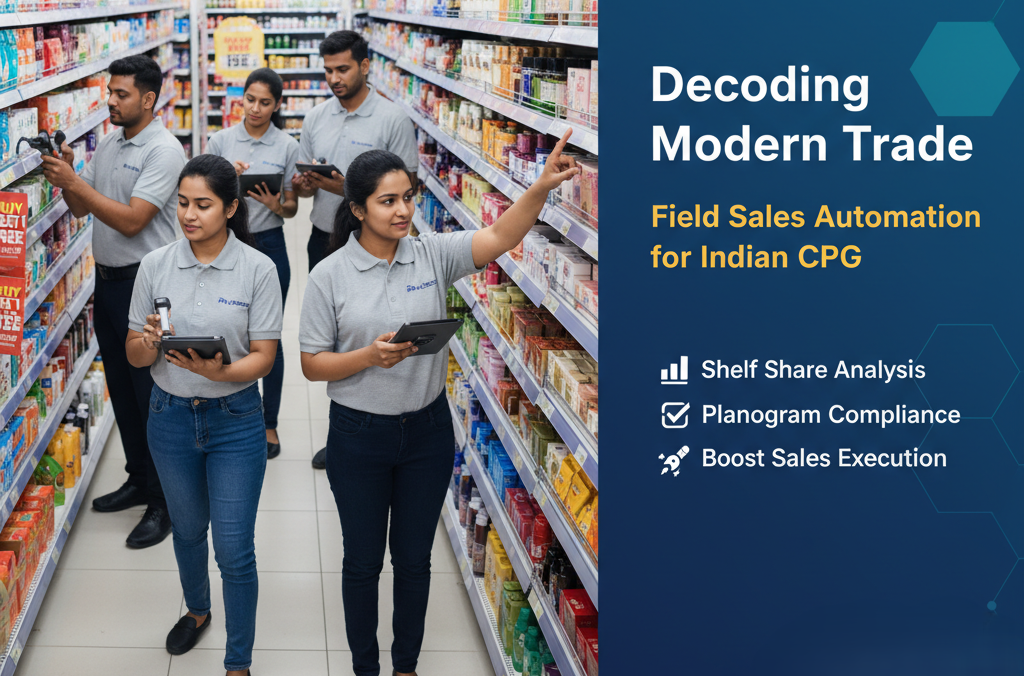
  • Decoding Modern Trade: Why Your Field Sales Strategy Needs to Evolve Beyond the $900 Billion Indian Retail Hype

    Decoding Modern Trade: Why Your Field Sales Strategy Needs to Evolve Beyond the $900 Billion Indian Retail Hype

    The Indian retail landscape is an enigma of scale and complexity. For most Fast-Moving Consumer Goods (FMCG) and Consumer Packaged Goods (CPG) companies, the vast network of small, traditional stores, the kiranas, represents the bulk of the market. But a critical, high-value segment is accelerating past this traditional model: Modern Trade.

    It’s not enough to just know what Modern Trade is; your sales teams must master how to execute within it. Since 2018, our field sales automation platform has tracked over 500 million store visits across India. We’ve seen first-hand the shift where organized retail formats, though accounting for only about 15% of the total market, drive significantly higher volume and offer unparalleled data access. The winning difference is often not the product, but the precision of sales execution in modern trade outlets.

    In this deep-dive, we will move past the textbook definitions and show you, the leaders of Indian and global FMCG and CPG firms, precisely how to optimize your field sales strategy for the modern retail environment. We’ll cover what Modern Trade truly is, its unique challenges, and the non-negotiable role of field sales automation for Indian CPG companies to win the battle for the shelf.

    Modern Trade (MT) is the organized, corporate-managed retail channel, including supermarkets, hypermarkets, and chain convenience stores—that provides a structured shopping experience, fixed pricing, and utilizes sophisticated supply chain and data technology.

    🏬 What is Modern Trade Retail and How Does it Differ from General Trade in India?

    Understanding the distinction between Modern Trade (MT) and General Trade (GT) is the starting point for effective retail strategy in India. General Trade is the unorganized, traditional channel—the local, family-run kirana or mom-and-pop store. It operates on trust, credit, and personal relationships, still commanding over 70% of the overall Indian retail market, as reported by industry analysis in 2024.

    Modern Trade, on the other hand, is the fully organized retail format that emerged in the 1990s. It’s a purely urban and semi-urban phenomenon, driven by corporate entities. For Indian SaaS startups and CPG companies, this is where standardized execution and data-driven decisions translate directly into higher volume and better margins.

    Key Characteristics of Modern Trade Channels

    Modern Trade stores are not just bigger; they are fundamentally different operational ecosystems. These differences demand a specialized approach from your field sales force:

    • Organized Structure: MT outlets, such as Reliance Retail, D-Mart, or Avenue Supermarts, are typically corporate-owned. This means standardized layouts, centralized purchasing, and a fixed, national pricing strategy.
    • Technology Integration: They rely heavily on sophisticated systems like Electronic Point of Sale (EPoS), Warehouse Management Systems (WMS), and dedicated inventory software. This provides real-time sales and inventory data that GT stores simply cannot match.
    • Customer Experience Focus: Shopping is self-service, focused on convenience, attractive visual merchandising, and extensive product variety under one roof. They also drive sales through organized promotions, loyalty programs, and bulk discounts.
    • Supply Chain: MT uses a highly structured supply chain, often favoring Direct-Store-Delivery (DSD) or central warehouse replenishment, reducing the number of intermediaries compared to GT.

    The MT vs. GT Sales Execution Divide

    The field representative’s role changes entirely when moving from a GT store to an MT outlet.

    FeatureGeneral Trade (GT) – Kirana StoresModern Trade (MT) – Supermarkets/Hypermarkets
    Store ManagementOwner/Family-run, localized decisionsCorporate/Store Manager-run, centralized mandates
    PricingFlexible, often credit-based, or negotiatedFixed, standardized, system-driven
    Sales FocusRelationship selling, product availabilityMerchandising, visibility, and primary/secondary display compliance
    Order ProcessInformal, often telephonic or physical visit-basedFormal, system-driven (pre-sales or van sales apps)
    Data VisibilityLow (relies on manual logbooks/memory)High (real-time EPoS data, planogram compliance reports)
    Key MetricRelationship, timely deliveryShelf share, off-take, promotional compliance

    This comparison highlights why generic sales training fails in the MT environment. A rep negotiating credit with a kirana owner is useless when dealing with a chain store manager focused solely on execution against a central modern trade planogram compliance mandate.

    📈 The Economic Imperative: Why Modern Trade is Crucial for CPG Growth

    While GT dominates the volume, MT drives critical aspects of CPG success: brand building, premiumization, and high-value sales. For any Indian FMCG company aiming for an IPO or global expansion, MT performance is a key indicator of organizational maturity and market control.

    Leveraging the Higher Average Transaction Value (ATV)

    MT outlets, especially hypermarkets like D-Mart or Big Bazaar (now part of Reliance), naturally encourage bulk buying and category shopping. This results in a higher Average Transaction Value (ATV) compared to the smaller, fill-in purchases at a kirana.

    • Brand Visibility: Premium and new product launches benefit immensely from the expansive, well-lit shelf space and clear category segmentation in MT stores. If your product isn’t visible on the primary shelf or secondary display, you don’t exist for that urban consumer.
    • Promotional Effectiveness: MT offers a clean, measurable environment for large-scale promotions—Buy-One-Get-One (BOGO) offers, end-cap displays, and festive bundling. We’ve observed that a perfectly executed promotion in a Tier-1 city MT chain can generate the equivalent sales volume of dozens of GT stores.
    • Efficiency of Scale: Serving one hypermarket is logistically and administratively simpler than serving 50 scattered kiranas. This scale improves the efficiency of your sales reps, your delivery partners, and your overall supply chain costs.

    For a mid-sized Indian CPG enterprise, a 1% gain in modern trade shelf share analysis can translate to millions in annual revenue, providing the capital for further expansion into the more difficult rural GT markets.

    🛠️ Field Sales Automation: The Non-Negotiable Tool for Modern Trade Execution

    The transition from relationship-based selling to execution-based selling is the biggest operational hurdle in Modern Trade. This is where field sales automation for Indian CPG companies becomes an essential infrastructure investment, not a luxury. A field sales app transforms the rep from a paper-pushing order-taker into a real-time data auditor and in-store execution specialist.

    1. Real-Time Planogram and Merchandising Compliance

    The core challenge in MT is compliance. Central headquarters issue planograms (diagrams showing where and how products should be displayed), but execution often fails at the store level due to internal store issues or competition activity.

    • Geo-Tagged Photo Capture: An automation app allows the rep to capture mandatory, geo-tagged and time-stamped images of the shelf. This provides irrefutable proof of execution—or non-compliance—for both the brand and the MT retailer.
    • Planogram Verification Modules: Our system, for example, uses embedded image recognition algorithms that can instantly score the compliance of the shelf. Did the rep ensure a 3-facings-wide display of the new shampoo? The app instantly checks and flags any deviations from the central mandate. This dramatically reduces the time spent on manual auditing.
    • Competitive Intelligence: Reps can quickly log competitor activities—their promotions, new product launches, or price changes—with visual evidence, providing your marketing and sales head with actionable, real-time modern trade competitive analysis.

    2. Streamlining the Order-to-Delivery Cycle

    In MT, speed and accuracy in ordering are critical, particularly for products with a short shelf-life.

    • Real-Time Inventory and Stock Audit: Reps use the mobile app to conduct a quick, guided stock audit on the shelf and in the backroom. This feeds immediately into a sophisticated algorithm to suggest an optimal replenishment order, minimizing both stock-outs (a major sales killer) and excessive inventory.
    • Eliminating Out-of-Stock (OOS): OOS is the single biggest revenue drain in MT. By making Modern Trade Out-of-Stock analysis a mandatory, automated part of the rep’s visit, and instantly flagging high-priority items to the store manager and your distribution center, we’ve seen clients reduce OOS rates by up to 25%.
    • Integrated Promotions Engine: The automation system applies all central offers and discounts automatically to the order, eliminating errors and disputes with the store manager over pricing, which is a common point of friction.

    3. Optimizing Route Planning for U.S. and Global IT Buyers

    While our immediate focus is India, the principles of optimized route planning using field sales automation are universally relevant. For our clients who are U.S. manufacturers operating distribution networks in India or other high-density markets, efficiency is everything.

    • Dynamic Route Optimization: Rather than following a static, weekly route, the automation platform analyzes which MT stores have the highest potential for an order, the highest OOS risk, or the highest non-compliance score. It then builds the most efficient daily route based on GPS and these real-time business parameters, ensuring your rep visits the most critical modern trade outlets in Bangalore or Mumbai first.
    • Geofencing and Visit Verification: The app uses geofencing to ensure the rep is physically present at the store location for the required time, adding a layer of transparency and trust to the process. This shift from trust-based management to data-verified management is key to scaling field teams.

    📊 Comparison: Sales Execution Tools for Modern Trade

    Choosing the right technology is the foundation of mastering Modern Trade. The difference lies in a platform’s ability to handle the complexity of organized retail versus a simple lead-management tool.

    Here is a comparison of tools and approaches relevant to Field Sales Automation for Indian CPG.

    Tool/ApproachCore FunctionalityModern Trade (MT) Value PropositionBest For
    Paper/ExcelBasic record keeping, order notesZero. No real-time data, high error rate, no compliance tracking.Very small regional distributors only.
    Standard CRM (e.g., Salesforce)Lead/Opportunity ManagementGood for account-level history, poor for in-store execution, lacks specific image recognition.Key Account Managers (KAM) managing regional contracts.
    Specialized Field Sales Automation (FSA) Platform (e.g., BeatRoute, Bizom)Route optimization, EPoS integration, Planogram/Image Recognition, OOS tracking.Essential. Transforms sales rep into an in-store execution auditor and data collector, enabling real-time compliance reporting.All CPG/FMCG brands focused on scaling and optimizing modern trade outlets in Pune and other metros.
    Generative AI Chatbots (Our Service)AI-powered data interrogation, automated report generation, predictive sales forecasting.Can analyze FSA data to predict OOS before a rep’s visit, and auto-generate executive summaries on modern trade sales performance metrics.Senior management for data-driven, strategic decision-making.

    How to Improve Modern Trade Shelf Share Analysis with Data

    Shelf share is the percentage of linear feet your brand owns on the shelf. This metric is a zero-sum game. The best way to improve it is through accurate, timely audits and data-backed negotiations.

    • Strategy: Implement an in-store image recognition tool within your field sales app. The rep takes a photo of the entire shelf, and the tool immediately calculates your current share versus the competition.
    • Actionable Insight: The rep presents the factual, timestamped data to the store manager, allowing them to instantly see the difference between the central planogram mandate and the ground reality, thus driving immediate corrective action instead of waiting for a weekly report.

    Mastering Modern Trade Promotional Execution Checklist

    Promotions are the lifeblood of MT sales, but failure to execute them correctly—missing Price Off stickers, incorrect display material, or wrong placement—is rampant.

    • Strategy: Create a mandatory, step-by-step digital checklist for every promotional campaign in the field sales app. The rep must check off each item—”Display Unit Placed,” “POS Material Fixed,” “Correct Price Tag Applied”—and attach a verification photo.
    • Actionable Insight: This ensures 100% compliance. Your central marketing team gets real-time, store-level proof that their multi-crore campaign budget is being correctly utilized at all critical modern trade locations in Hyderabad.

    Future-Proofing Your Modern Trade Distribution Strategy

    The Indian retail ecosystem is constantly evolving. The rise of Quick Commerce (q-commerce) platforms is already blurring the lines between MT, GT, and e-commerce.

    • Strategy: Future-proof your sales organization by integrating data from your MT distributors with your field sales automation platform. This allows you to forecast demand not just based on historical sales, but on real-time inventory and promotional data.
    • Actionable Insight: Use the integrated system to model potential OOS risks during high-demand periods like the festive season. Our tools help clients maintain buffer stock at their distributor points serving UAE logistics hubs in India, ensuring no last-mile fulfillment gaps occur during peak sales windows.

    Enhancing Modern Trade Rep Productivity Metrics

    A happy, productive sales rep is one who is spending less time on paperwork and more time on high-value activities.

    • Strategy: Measure productivity not by the number of visits, but by outcome metrics: Compliance Score, OOS Reduction Rate, and Secondary Display Placement Success.
    • Actionable Insight: Use the FSA platform’s analytics to identify the top 10% of reps who consistently hit these metrics. Dissect their process, route planning, in-store pitch, photo execution—and build a new standard operating procedure for the entire team.

    What is the biggest challenge for a CPG company in Modern Trade?

    The biggest challenge in Modern Trade is ensuring 100% execution compliance for merchandising, planograms, and promotions at the store level, which often falls short due to the high volume of SKUs and the physical distance between central planning and store reality.

    What is the typical market share of Modern Trade in India?

    Field sales automation helps with Modern Trade shelf management by using geo-tagged photo capture and image recognition technology to instantly audit and score the physical shelf for planogram compliance, OOS, and competitor activity.

    How does field sales automation help with Modern Trade shelf management?

    Modern Trade accounts for approximately 15% of the total Indian retail market share in 2024, while General Trade still holds the dominant 70%+ share, highlighting the vast potential for organized retail growth.

    Should my focus be on General Trade or Modern Trade for expansion?

    For deep market penetration and reach into rural and semi-urban areas, General Trade remains crucial, but for brand building, premiumization, and capturing high-value urban sales volume, a primary focus on scaling and optimizing Modern Trade is essential.

    What are the main types of modern trade retail formats?

    The main types of modern trade retail formats include hypermarkets (massive scale, non-food and food), supermarkets (primarily food and groceries), specialty stores (focus on one category like electronics or apparel), and chain convenience stores.

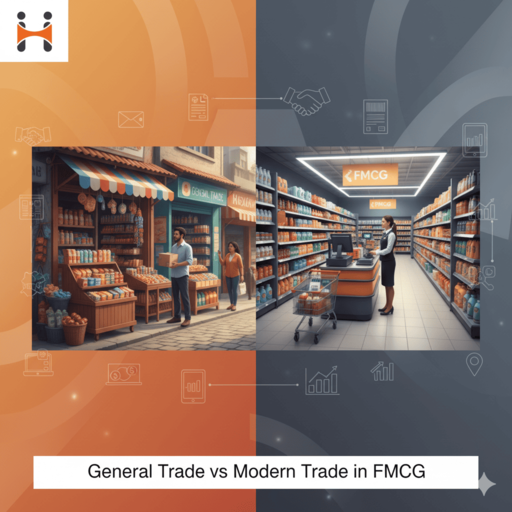
  • General Trade vs Modern Trade: Key Differences Every Sales Team Should Know

    General Trade vs Modern Trade: Key Differences Every Sales Team Should Know

    Introduction

    In our company, we work with FMCG and retail sales teams that rely heavily on technology to manage field operations. Most of these teams use field force tracking software, territory management tools, and employee location tracking systems to monitor visits, collect data, and improve accountability.

    But one challenge keeps coming up- how to plan and measure performance across two very different retail ecosystems: General Trade (GT) and Modern Trade (MT). Understanding the difference between General Trade and Modern Trade matters because it defines how your team sells, where they visit, and how your software should be configured.

    This post explains what each channel represents, how sales operations differ, and how tools like field sales management software and sales automation for FMCG companies can help you track and optimize performance in both.

    What is General Trade and What is Modern Trade?

    General Trade (GT)

    General Trade represents the traditional retail network – thousands of small, independent stores, neighborhood shops, and kiosks. These are usually family-run and scattered across cities, towns, and rural areas. Despite the rise of organized retail, GT remains dominant in India and many developing markets.

    Key characteristics of General Trade:

    • Smaller store size and limited stock-keeping units (SKUs)
    • Manual inventory management and informal credit systems
    • Strong personal relationships between shopkeepers and distributors
    • Wide geographical coverage, including rural and semi-urban zones

    For sales teams, GT coverage means more frequent visits, smaller orders, and broader territory management. Field sales productivity tools and sales route optimization are vital for maximizing efficiency in this space.

    Modern Trade (MT)

    Modern Trade, on the other hand, refers to organized retail formats like supermarkets, hypermarkets, convenience store chains, and online grocery platforms. These outlets operate with structured systems, standardized merchandising, and formal purchase processes.

    Key characteristics of Modern Trade:

    • Centralized procurement and negotiated contracts with brands
    • Larger store formats with digital billing and barcode tracking
    • System-driven inventory and sales reporting
    • Strong presence in urban and semi-urban areas

    Brands view MT as essential for premium positioning, visibility, and consistency. While the number of outlets is fewer, the volume of business per store is significantly higher.

    When comparing Modern Trade vs Traditional Trade, the difference lies in scale, data accessibility, and structure. For FMCG companies, integrating retail execution tracking and digital workflows into MT operations drives higher returns on every visit.

    General Trade vs Modern Trade: Core Differences for Sales Teams

    Sales teams that handle both channels must adjust strategies, routes, and KPIs accordingly. Here’s how these two trade models differ from a sales-tracking perspective.

    1. Reach and Coverage

    General Trade offers deep penetration into every neighborhood. A sales rep may cover 30 to 40 outlets per day. That’s where territory management software becomes critical—it ensures every small shop is visited without overlap or missed opportunities.

    Modern Trade offers fewer outlets but higher sales volume per visit. Here, reps might manage only a few key accounts. Field force tracking software helps verify planned visits, monitor display setups, and validate store engagement data.

    2. Visit Frequency and Field Effort

    In GT, reps travel extensively, visiting small retailers and distributors. They handle everything from order taking to stock verification. High mobility makes employee location tracking for sales teams and sales route optimization essential for accuracy and fuel efficiency.

    In MT, reps follow structured schedules with specific accounts. They focus on compliance, planogram checks, and promotional activities. Tracking tools here emphasize fewer but more detailed visits.

    3. Order Size and Inventory Flow

    GT involves frequent, smaller orders. Distribution happens through intermediaries or regional stockists. Sales automation for FMCG companies can simplify the process -capturing order data, managing credits, and automating follow-ups.

    MT focuses on large, consolidated orders with stable inventory cycles. Data-driven sales forecasting helps brands maintain consistent stock levels and shelf presence.

    When comparing General Trade vs Modern Trade distribution, FMCG firms must align their delivery, logistics, and tracking systems accordingly.

    4. Data and Visibility

    Data is the biggest differentiator. General Trade relies more on manual records. Modern Trade uses digital systems that provide near real-time analytics.

    For GT, outlet visit tracking apps help gather field data efficiently- photos, order details, timestamps, and GPS validation.
    For MT, retail execution tracking ensures visibility into display compliance and promotion performance.

    This variation means your field sales management for FMCG must support both low-tech and high-tech environments.

    5. Supply Chain and Logistics

    GT logistics are decentralized – many small drops, multiple intermediaries, and flexible routes.
    MT logistics are centralized, with structured distribution centers and defined delivery schedules.

    Territory management software can help sales heads balance these logistical differences, ensuring optimal coverage for both channels.

    6. Strategic Role and ROI

    GT is the backbone of FMCG reach. It’s ideal for high-frequency, low-value transactions across diverse markets.
    MT is the engine of urban growth, focusing on high-value, branded, and organized retail experiences.

    A successful GT vs MT sales strategy should balance both: GT for reach and MT for visibility.

    Why These Differences Matter for Field Tracking?

    Sales tracking tools only work when they align with channel strategy. Here’s how tracking differs between the two.

    • General Trade: Frequent visits, more outlets, small orders. Tools need fast check-ins, geo-tagging, and offline data capture.
    • Modern Trade: Fewer visits, more time per store, detailed compliance checklists. Tools need scheduling, reporting, and analytics integration.

    A good field force tracking software adapts automatically- logging GT visits efficiently while managing MT accounts with precision.
    When integrated with sales team performance tracking, you get full visibility into territory health, visit frequency, and revenue per rep.

    Our Experience: Adapting GT and MT Tracking

    We worked with a large FMCG brand operating across multiple regions. Their challenge was the same: tracking hundreds of field reps handling both GT and MT.

    In General Trade zones, we deployed our field sales productivity tool with GPS-based visit logging, route mapping, and outlet photo capture. Reps were assigned 30 outlets per day with automated performance dashboards.
    After three months, missed visits dropped by 25%, and coverage improved across smaller towns.

    In Modern Trade regions, we configured structured account management. Reps used digital checklists for display audits and order tracking integrated with chain store systems.
    Within a quarter, display compliance improved by 18%, and visibility data became available in real time.

    What worked best was not just the tool- but the alignment of General Trade and Modern Trade processes within one platform.

    Key Lessons Learned

    1. Customize tracking by channel – GT and MT require separate workflows.
    2. Use data smartly – In GT, focus on coverage data; in MT, focus on compliance data.
    3. Train your team – Reps must understand why General Trade vs Modern Trade tracking works differently.
    4. Leverage automation – Use sales automation for FMCG companies to capture orders and manage credits automatically.
    5. Align metrics – GT reps are measured by visit count; MT reps by display compliance and order volume.
    6. Review territory data – Territory management software helps identify where to add or reduce field reps.

    Strategic Tips for Sales Teams

    • Classify each outlet as GT or MT and set separate visit norms.
    • In GT, use outlet visit tracking apps and sales route optimization to plan efficient routes.
    • In MT, use retail execution tracking and sales team performance dashboards for compliance and visibility.
    • Deploy field force tracking software to validate visits in real time.
    • Keep your database clean- remove duplicate outlets and ensure correct geotagging.
    • Monitor your GT vs MT sales strategy quarterly and adjust field coverage.

    Hybrid Retail and the Future

    The lines between Modern Trade vs Traditional Trade are blurring fast.
    Small stores are adopting POS billing and digital payments, while large chains expand into semi-urban areas.

    This evolution means your tracking and management systems must handle hybrid formats.
    Future-ready tools should combine field sales management for FMCG, retail execution tracking, and territory optimization into one platform.

    As technology grows, employee location tracking for sales teams will connect directly with data analytics, allowing smarter route plans and performance forecasting.

    What’s Next?

    Both General Trade and Modern Trade are critical for any FMCG or retail business. They differ in structure, behavior, and scale- but both demand technology-driven execution.

    For GT, focus on reach, coverage, and volume using field sales productivity tools and sales route optimization.
    For MT, focus on compliance, visibility, and relationships using retail execution tracking and territory management software.

    A unified field force tracking software bridges both worlds- helping you manage visits, validate performance, and grow sales efficiently.
    Aligning your GT vs MT sales strategy with smart automation and tracking will not just streamline operations but strengthen your competitive edge in the evolving retail landscape of India.

    Schedule a Demo to see how our unified field force tracking software can optimize your GT reach and MT compliance.

  • Best Software for Sales Reps: India Guide 🇮🇳

    Best Software for Sales Reps: India Guide 🇮🇳

    I’ve been in the sales management software space for over a decade, first as a sales leader struggling with manual processes, and now as a founder helping companies streamline their operations. In India, I’ve seen countless startups and established businesses hit a wall because their sales teams are drowning in spreadsheets, fragmented data, and administrative tasks. The idea that a team can scale without a dedicated software for sales reps is a myth I’ve seen busted time and again. Without the right tools, you’re not just losing deals; you’re losing valuable time and opportunities. From my experience with hundreds of clients, implementing a robust sales management system isn’t just a nice-to-have; it’s a fundamental shift in how you do business. This post will walk you through why a specialized solution is non-negotiable for modern sales teams in India, what to look for, and how a platform like Happisales stands out from the competition.

    The best software for sales reps provides a unified platform to manage leads, automate tasks, track performance, and centralize customer data, directly leading to increased productivity and higher sales conversions.


    Why Sales Reps in India Need a Specialized Sales Management System

    The Indian market is unique. Sales cycles can be complex, involving multiple follow-ups, intricate relationships, and a high volume of inquiries that need to be managed efficiently. A sales rep here is not just a closer; they are a relationship builder, a data entry clerk, and a project manager all rolled into one. Relying on spreadsheets and siloed communication tools like WhatsApp and email creates chaos. It leads to missed follow-ups, duplicate data, and zero visibility for managers.

    A dedicated software for sales reps changes this. It gives them a single source of truth for all their activities. This is not just about logging calls. It’s about automating the mundane, so they can focus on what they do best: selling.

    • Lead Management & Distribution: In India, leads can come from diverse sources—website forms, trade shows, social media, and cold calls. Without a system, it’s a mess. Software automates lead capture and instantly assigns them to the right rep, preventing them from falling through the cracks.
    • Pipeline Visibility: A visual, drag-and-drop pipeline helps reps see where every deal stands. They can instantly identify bottlenecks and prioritize hot leads. For a manager, this offers a real-time, bird’s-eye view of the entire sales funnel.
    • Activity Tracking: How many calls did your team make? How many emails did they send? Without a system, this data is manual and often inaccurate. Software automatically logs these activities, providing a transparent view of a rep’s day-to-day work.
    • Mobile-First Approach: For field sales teams, a mobile app is crucial. They need to update customer information, check schedules, and log meetings on the go. The right software is built with this reality in mind.

    The Problem with Generic CRMs for Indian Teams

    Many Indian companies start with a generic CRM like Salesforce, Zoho, or HubSpot. While these are powerful, they are often designed for a global, enterprise audience. This can lead to significant friction for local teams. The user interface might be clunky, and the feature set can be overwhelming and unnecessarily complex for a small or medium-sized business.

    Furthermore, they often lack specific features tailored for the Indian market, such as integrations with local payment gateways, GST-compliant invoicing, or regional communication platforms like WhatsApp for Business.

    The Happisales Advantage: The Best Software for Sales Reps in India

    At Happisales, we built our platform from the ground up to solve the unique challenges faced by sales teams in India. Our mission was to create a software for sales reps that is not only powerful but also intuitive, affordable, and deeply integrated with the local business ecosystem. We knew that for a tool to be successful here, it had to be a seamless extension of a rep’s daily workflow, not an extra burden.

    Our approach is centered on three core principles: Simplicity, Automation, and Visibility.

    1. Simplicity: Designed for the Indian Sales Rep

    I’ve worked with teams that have high attrition rates. The last thing a new rep needs is a steep learning curve. We’ve found that a simple interface drastically reduces onboarding time and increases adoption. Happisales is designed to be self-explanatory. A rep can get started in minutes, not days. We focus on a clean, visual pipeline and easy-to-use mobile application, ensuring that the sales team spends more time selling and less time figuring out the software.

    • Clean Pipeline View: No cluttered dashboards. Just a clear, visual representation of your deals.
    • Intuitive Mobile App: For the field reps on the move, our app is as easy to use as any social media app. They can update data, check-in to locations, and access customer information with a few taps.
    • Zero Learning Curve: Our user interface is built to be so simple that new reps can be productive from day one, which is a major benefit for startups and SMBs with limited training resources.

    2. Automation: Supercharging Sales Productivity

    The average sales rep in India spends hours on non-selling tasks. Data entry, lead qualification, and follow-up reminders consume valuable time. Happisales automates these tasks, giving reps their time back. Our platform is built on a philosophy of “automation-first.”

    • Smart Lead Qualification: Automate lead scoring based on engagement, behavior, and source. The system tells your reps exactly which leads are most likely to convert.
    • Automated Follow-ups & Reminders: No more missed opportunities. Our system sends automated reminders for calls, emails, and meetings, ensuring every prospect is nurtured.
    • Workflow Automation: Set up automated actions like sending a welcome email when a new lead is assigned or creating a task when a deal moves to a new stage. This reduces manual errors and ensures a consistent process.
    • WhatsApp Integration: This is a crucial feature for the Indian market. We offer deep integration with WhatsApp for Business, allowing reps to send and receive messages directly from the CRM, and log all conversations automatically.

    3. Visibility: Data-Driven Decisions for Managers

    For a sales manager, flying blind is not an option. You need real-time data to coach your team, forecast revenue, and make strategic decisions. Happisales provides a comprehensive suite of analytics and reports that give you a complete picture of your sales operation.

    • Real-time Dashboards: See team performance, pipeline health, and top-performing reps at a glance.
    • Sales Forecasting: Accurately predict future revenue based on real-time pipeline data and historical trends.
    • Performance Analytics: Identify which activities lead to the most conversions, and use this data to coach your team and optimize your sales process.
    • Custom Reports: Generate detailed reports on specific metrics like lead source performance, deal velocity, or rep activity, helping you answer critical business questions.

    How to Choose the Right Software for Sales Reps in India

    With dozens of options available, selecting the right platform can be overwhelming. As a founder in this space, I’ve seen what works and what doesn’t. Here’s my advice on how to evaluate a software for sales reps for your Indian team:

    • Geo-Relevance & Integrations: Does the software integrate with tools specific to the Indian market? Think payment gateways, GST-compliant billing, and local communication channels. A globally-focused tool might not have these.
    • User Adoption: If your reps don’t use it, it’s useless. Look for a clean, intuitive UI. Ask for a free trial and let your team test it. Pay attention to how quickly they grasp the core functionality.
    • Customer Support: When you run into an issue, you need fast, local support. A company with a presence in India understands your challenges and can provide assistance in your time zone.
    • Scalability: Choose a solution that can grow with you. It should be affordable for a small team but also offer advanced features and support as you scale to a large enterprise.
    • Pricing: Look for transparent, per-user pricing. Avoid hidden fees and complex enterprise contracts. A good sales management system should offer a clear ROI.

    Happisales vs. The Competition: A Comparison of Sales Management Solutions

    To help you make an informed decision, let’s look at how Happisales stacks up against some of the major players in the Indian market.

    Feature / PlatformHappisalesZoho CRMSalesforceHubSpot
    Primary AudienceIndian SMBs & StartupsGlobal SMBs & EnterprisesGlobal EnterprisesGlobal SMBs & Enterprises
    User InterfaceExtremely Intuitive & CleanCan be Complex & ClutteredHighly Complex, Steep Learning CurveUser-Friendly, but with many features
    Mobile AppSimple, Field-Force OptimizedFeature-rich, can be slowPowerful but complexGood, but can be overwhelming
    Local IntegrationsDeep (WhatsApp, local gateways)Limited, requires custom workLimited, requires custom workLimited, requires custom work
    PricingAffordable & TransparentTiered, can get expensiveExpensive, Enterprise-focusedGood Free Tier, but paid tiers are costly
    Key DifferentiatorBuilt for India, focuses on simplicity and automation for local sales workflows.A versatile, all-in-one suite that offers a wide range of features.The industry standard for large, complex enterprise sales.Strong in marketing automation and inbound sales.
    Software for Sales Reps – Comparision

    How a Real-World Indian Company Benefited from Happisales

    We recently worked with a mid-sized manufacturing company in Chennai. Their sales team was using a combination of shared spreadsheets and phone calls to manage leads. The sales manager had zero visibility into the team’s daily activities, and lead follow-up was inconsistent.

    After implementing Happisales, the results were dramatic:

    • 20% Increase in Lead Conversion: By automating lead assignment and follow-up reminders, the sales team was able to respond to inquiries faster and nurture every lead more effectively.
    • 30% Reduction in Administrative Time: Reps spent less time on data entry and more time on high-impact activities like client meetings and closing deals.
    • Complete Performance Visibility: The manager could now see every rep’s activity in real time, enabling them to provide targeted coaching and support.

    This case study is a testament to the power of a purpose-built software for sales reps that truly understands the local context.


    People Also Ask

    What is sales force automation software?

    Sales force automation (SFA) software is a tool that automates sales-related tasks such as contact management, lead tracking, and order processing to help sales teams work more efficiently. It’s a core component of most modern CRMs.

    What is the difference between a CRM and sales management software?

    A CRM (Customer Relationship Management) is a broader category that manages all customer interactions, while sales management software focuses specifically on the sales pipeline, from lead to close. A good sales management software is a specialized type of CRM tailored for sales teams.

    What are the benefits of sales performance management software in India?

    Sales performance management software helps Indian businesses track and analyze the effectiveness of their sales team by providing real-time data on individual and team performance, enabling better coaching and strategic decision-making.

    How can a small business in India benefit from a sales CRM?

    A small business in India can benefit from a sales CRM by centralizing customer data, automating repetitive tasks, and gaining clear visibility into the sales pipeline, which leads to improved productivity and scalable growth.


    Conclusion

    For any business in India looking to scale, relying on outdated sales processes is a dead-end. The right software for sales reps is the engine that drives productivity, provides invaluable insights, and ensures that no lead or opportunity is ever missed. From my years of experience, I’ve seen firsthand how a well-implemented system can transform a sales team from a group of individuals into a cohesive, data-driven machine.

    Happisales was created to be that very engine for the Indian market. We believe that every sales rep deserves a tool that empowers them to sell more, not just manage data. If you’re a sales leader or founder in India, it’s time to move beyond the old ways and adopt a solution that’s built for your reality.

    Ready to supercharge your sales team?

    Contact us today for a personalized demo of Happisales and see how our platform can help you achieve your sales goals.

  • 5 Ways SFA Can Boost Sales Efficiency for Your CPG Business

    5 Ways SFA Can Boost Sales Efficiency for Your CPG Business

    Introduction

    In today’s competitive Consumer Packaged Goods (CPG) industry, every second on the field counts. Your sales team isn’t just responsible for selling – they’re responsible for executing perfectly at every store visit. From route planning to retail execution, the quality of field performance determines how well your brand stands out on the shelf.

    At Happisales, we’ve learned that one of the most effective tools to drive that execution is Sales Force Automation (SFA). When used correctly, SFA doesn’t just simplify reporting – it transforms how you sell, plan, and monitor performance in real time.

    If you’re reading this because you want to track your field employees’ locations, monitor their store visits, and ensure your team executes with precision, this blog is for you. We’ll show you how SFA helps align employee location and visit data, automate and optimise workflows, and ultimately boost sales efficiency for your CPG business.

    What Is SFA and Why It Matters for CPG Businesses?

    Sales Force Automation (SFA) refers to technology that automates and streamlines sales activities – from lead tracking and order management to field visit monitoring and performance reporting.

    In the CPG world, where field teams handle dozens of outlets each day, it’s nearly impossible to manage operations manually. Using spreadsheets, WhatsApp updates, or daily phone calls might work for small teams, but as your coverage grows, visibility drops – and so does productivity.

    When we implemented our first SFA tool, we quickly saw the difference. Before, our sales reps spent hours every evening filling out visit reports manually. After SFA, they submitted visit data and photos directly from the store in seconds. Managers could track store coverage live, and orders were processed instantly.

    That’s when we realized: SFA isn’t just a reporting tool – it’s the backbone of an efficient, data-driven sales organization.

    Let’s look at the five ways SFA can boost sales efficiency in your CPG business.

    1. Real-Time Visibility Over Field Activity and Employee Location

    Why It Matters?

    Managing a field sales team without real-time visibility is like flying blind. You might have a route plan, but you can’t know if it’s actually being followed. Did every rep visit the assigned stores? Were key outlets skipped? Did anyone spend too long in low-value locations?

    An SFA solution gives you full visibility. With GPS tracking, geo-tagged check-ins, and real-time dashboards, you can monitor every visit, every order, and every kilometer traveled.

    How It Works?

    In our own experience, before adopting SFA, reps manually reported visits at day-end. That left room for gaps and guesswork. Once we introduced a GPS-enabled SFA app, every check-in was automatically time-stamped and location-verified. Managers could open the map dashboard and instantly see which outlets were covered and which were pending.

    Within weeks, we saw visit compliance jump by 30%. Missed outlets nearly disappeared because reps knew their coverage was transparent and visible.

    Efficiency Gains

    • Real-time tracking ensures complete outlet coverage
    • Reduces travel time and redundant visits
    • Prevents skipped high-priority stores
    • Improves accountability across the team

    For businesses that want to track employee location, this is the foundation. SFA doesn’t just tell you where your reps are – it tells you what they’re doing and why it matters.

    2. Route Optimisation and Smarter Beat Planning

    Why It Matters?

    For CPG companies, route planning directly affects sales productivity. If a rep wastes half the day in traffic or travels inefficiently between stores, that’s lost selling time.

    With SFA software, you can plan and optimise routes intelligently. The system maps store clusters, calculates travel distances, and helps reps follow the most efficient route.

    How It Works?

    Before automation, our reps had static store lists. Some would zig-zag across town, visiting outlets in random order. After integrating route optimisation, the app automatically arranged visits by proximity and priority.

    This simple shift allowed each rep to visit 5–6 more stores per day on average – a massive improvement across the entire team

    Efficiency Gains

    • Higher outlet coverage per day
    • Less travel fatigue for reps
    • Smarter territory allocation
    • Balanced workloads across teams

    When combined with GPS tracking, route optimisation also ensures route compliance – meaning you can see if reps follow the planned path or deviate during the day.

    3. Automation of Routine Tasks (Orders, Reports, Merchandising)

    Why It Matters?

    Field reps often lose valuable time doing repetitive admin work – filling forms, writing reports, calling distributors to confirm orders, and compiling daily summaries.

    SFA software eliminates that waste. By automating order entry, report generation, and merchandising checklists, your team can focus on selling instead of paperwork.

    How It Works?

    Here’s a real example from our rollout. Earlier, reps noted orders on paper, then called the distributor to confirm stock. With SFA, reps now create digital orders directly inside the app. The system automatically shows stock availability, suggests repeat SKUs, and sends orders to the distributor in real time.

    Reports? They’re auto-generated. Each evening, managers get consolidated dashboards – total visits, total orders, time spent, photos uploaded -without manual compilation.

    Efficiency Gains

    • Reduces admin time by up to 25%
    • Improves order accuracy and fulfillment speed
    • Provides instant access to sales data
    • Lets managers focus on coaching instead of chasing reports

    For teams tracking employee movement, automation ties perfectly with location data. Every order and photo is geo-tagged, confirming that tasks were completed at the right store.

    4. Enhanced Performance Visibility and Accountability

    Why It Matters?

    Without data, performance reviews are just opinions. One rep might seem productive because they’re vocal; another might quietly outperform without recognition. SFA software replaces assumptions with facts.

    With detailed metrics – store visits, sales value, coverage %, route adherence, and in-store execution – managers can measure and compare performance objectively.

    How It Works?

    When we started tracking KPIs through SFA, patterns emerged immediately. We could identify top performers based on visit consistency and order value per visit. We also spotted reps with long travel times but fewer visits – an indicator of route inefficiency.

    Armed with that data, we offered targeted coaching. Productivity rose across the board because everyone knew performance was transparent and measurable.

    Efficiency Gains

    • Clear, data-driven performance tracking
    • Real-time insights for coaching and training
    • Leaderboards that motivate and reward top reps
    • Early detection of performance gaps

    When paired with GPS data, this visibility becomes even stronger. You can correlate distance traveled with sales achieved, pinpointing inefficiencies at the territory level.

    5. Real-Time Market Intelligence and Execution Consistency

    Why It Matters?

    Success in CPG isn’t just about selling – it’s about execution at the store level. Are your promotions live? Are displays installed? Are your SKUs visible on shelves?

    SFA tools allow reps to capture in-store data – shelf photos, competitor pricing, stock levels -and upload it instantly. Managers get a live, visual understanding of what’s happening in the market.

    How It Works?

    During one of our new product launches, we created a simple checklist inside the SFA app:

    Each rep took photos as proof, and the app automatically tagged them with time and GPS coordinates. Within hours, our dashboard showed compliance by region. Where execution lagged, we re-dispatched reps immediately.

    The result? Execution accuracy improved by 20% within the first month.

    Efficiency Gains

    • Consistent brand execution across outlets
    • Faster feedback loops between field and HQ
    • Early detection of competitor activity
    • Higher promotion ROI and shelf visibility

    Again, location tracking adds integrity. You know that every report, photo, or checklist was captured inside the store, not uploaded from elsewhere.

    Implementation Tips for CPG Teams

    Here are a few practical lessons from our journey to full SFA adoption -especially useful if your goal includes employee location tracking:

    • Select an SFA with built-in GPS tracking It should support check-in/out tagging, live map tracking, and route replay.
    • Define KPIs upfront For example: average visits per day, distance covered, outlet coverage %, and order value per visit.
    • Integrate with your existing systems Connect your SFA with ERP or distributor management software for real-time order flow.
    • Train your team thoroughly A successful rollout depends on consistent app usage and proper geo-check-in habits.
    • Use the data to support, not surveil When reps see SFA as a productivity tool rather than a policing mechanism, adoption rates skyrocket.
    • Reward data-driven success Use leaderboards or incentives for top coverage, lowest deviation, or best route efficiency.
    • Ensure offline functionality Reps often work in low-network areas; the app should sync automatically when they reconnect.
    • Protect privacy and transparency Explain clearly what data is tracked and how it benefits both the company and the rep.

    What’s Next?

    Sales Force Automation is no longer optional for modern CPG brands – it’s essential. It provides the structure, transparency, and data you need to build a high-performing field team.

    By adopting an SFA platform that combines real-time location tracking, route optimisation, workflow automation, and data-driven performance dashboards, your sales operations become faster, smarter, and more accountable.

    At Happisales, we’ve seen these results firsthand – better store coverage, faster order processing, improved execution accuracy, and happier reps who spend more time selling and less time reporting.

    If you’re looking to track employee locations, monitor field productivity, and drive higher sales efficiency, implementing an SFA solution is the most effective path forward. Schedule a free demo with Happisales today