HoReCa stands for Hotels, Restaurants, and Cafes or Catering. It is a fast-growing segment in India with big opportunities for FMCG brands. It includes
Luxury and budget hotels in cities
Restaurants and quick-service outlets in urban and semi-urban areas
Catering services for weddings, corporate events, and private parties
Market insights
India’s organized foodservice market is expected to reach 80 billion USD by 2025. HoReCa will make up about 45 percent of that.
Urban growth is driving HoReCa. By 2030, more than half of India’s population will live in cities. That will increase demand for hotels, restaurants, and catering.
Domestic tourism is rising. India had over 2.2 billion domestic tourist visits in 2023, which boosts restaurant and hotel business.
Why HoReCa matters for FMCG brands?
Brings in regular high-volume orders, helping it maintain steady revenue
Lets people try it directly in restaurants, cafés, or hotels
Gives insights into what people enjoy when they taste them
Helps it improve existing products or launch new flavors, drinks, snacks, and packaged foods
Types of Hotels in India That Buy FMCG Products
Hotels range from luxury chains in big cities to budget stays in smaller towns. Luxury hotels buy premium items like imported drinks, gourmet snacks, high-quality toiletries, and cleaning products. Budget hotels focus on essentials such as packaged snacks, bottled water, dairy items, and basic cleaning supplies. A five-star hotel in Mumbai, for example, may order branded beverages and snacks every week for multiple locations. This provides steady sales and increases brand visibility. Working with hotels helps FMCG brands build loyalty with guests and corporate clients.
How Restaurants in India Use FMCG Products?
Restaurants include fine-dining, quick-service outlets, and street food vendors. They regularly buy packaged foods, condiments, dairy products, and drinks. Offering these products to customers helps brands get noticed. For instance, a cafe chain in Bengaluru serving a packaged juice reaches thousands of customers weekly. This improves brand recall and encourages repeat purchases. Urban diners often choose branded snacks and drinks even in casual settings, giving FMCG brands a chance to test new products directly with consumers.
How Catering Services Support FMCG Brands?
Catering covers weddings, corporate events, social gatherings, and religious functions. Orders are usually large and short-term, changing with each event. Brands can use catering to launch new products or test seasonal items since events need high volumes quickly. A wedding in Jaipur, for example, may order 1,000 beverage packs and several snack types in one day. This gives FMCG brands exposure and immediate feedback from consumers.
Importance of Sales and Distribution in the HoReCa Segment
High-volume orders are common in HoReCa. These orders provide steady revenue for FMCG brands. They help with predictable inventory planning and production schedules. They also reduce reliance on retail fluctuations.
For example, a quick-service restaurant chain in Mumbai that orders packaged beverages and snacks every day creates consistent demand. This helps suppliers plan deliveries and logistics more efficiently.
Brand Visibility Opportunities
HoReCa outlets act like showrooms for FMCG products. Every customer who sees or tries a product increases brand awareness and trust.
For example, introducing a new flavored drink in popular cafes in Pune can reach thousands of urban consumers and give immediate feedback on the product.
Challenges in Managing Multiple Outlets
India’s geography makes distribution complicated. Outlets are spread across big cities and smaller towns. Manual coordination often causes errors, late deliveries, and unhappy clients. Keeping product quality consistent at all locations is difficult.
Common Challenges FMCG Brands Face in Indian HoReCa Sales
Manual order taking and tracking is common. Many FMCG teams use calls, WhatsApp, and spreadsheets to record orders. Mistakes and delays can lead to lost clients and lower trust. A Pune beverage distributor, for example, faced 25 percent order errors from manual entry, which hurt relationships with restaurants and small hotels.
Managers often cannot see stock levels, sales performance, or demand trends in real time. This makes it easy to miss opportunities or have overstock or stockouts.
Traffic in big cities and poor infrastructure in smaller towns causes delivery delays. Inconsistent deliveries reduce reliability and customer satisfaction.
Without tools to track performance, managers struggle to identify underperforming field executives. This leads to lost sales and less accountability.
Smaller distributors and FMCG teams sometimes avoid software because it seems complex or expensive. They need simple, mobile-friendly solutions that show clear results.
How Field Force Automation Solves These Challenges?
Real-time tracking lets managers see visits, deliveries, and client interactions immediately. Routes can be optimized and high-priority clients reached on time.
Orders and payments can be handled digitally, which reduces mistakes and makes operations smoother. Executives can submit orders directly through the system.
The software works offline in smaller towns and rural areas. Data syncs automatically when the internet is available. This keeps operations running even where connectivity is weak.
Push notifications and reminders alert executives about pending tasks, follow-ups, and low stock. This helps them engage clients proactively.
Performance tracking lets managers see how executives perform in visits, orders, and collections. Top performers can be recognized, training can be provided, and incentives set for Indian teams.
Benefits of Automation for FMCG Brands in HoReCa
Automation helps ensure orders are accurate and deliveries are on time. This is important in India’s FMCG market where delays can hurt trust.
Managers can get real-time updates to meet client needs and solve issues quickly.
Sales and targets are easier to track by region, city, or individual executive. This supports faster decision-making and growth in new markets.
Recognition, incentives, and feedback motivate field teams and improve productivity. Automation also encourages accountability across Indian teams.
Real-Life Example from the Indian FMCG Market
A mid-size FMCG brand worked with 250 HoReCa clients across Mumbai, Pune, Jaipur, and Ahmedabad. They faced frequent order mistakes and late deliveries. Managers had little visibility into field executive activities. Managing multiple outlets in tier-2 and tier-3 cities was challenging.
After using field force automation, order errors dropped by 35 percent. Delivery efficiency went up by 40 percent. Managers could track, motivate, and train their executives more effectively. Offline order entry and automatic data sync helped operations in smaller towns.
The result was stronger client relationships, smoother operations, and higher revenue.
Future Outlook HoReCa Growth and FMCG Opportunities in India
Urban growth is increasing demand for restaurants and hotels. More people living in cities means more meals consumed outside home. Tourism is also growing, which drives catering and hospitality services and creates steady demand for FMCG products.
Consumers in urban and semi-urban areas are dining out more and choosing ready-to-eat foods. HoReCa lets FMCG brands test new products and flavors before launching them widely.
Technology is becoming standard in FMCG operations. Mobile apps, analytics, and automation tools help brands improve deliveries and field team performance. Brands that adopt these tools early gain a clear advantage.
What’s Next?
The Indian HoReCa segment offers strong potential for FMCG brands to grow revenue, reach more clients, and boost brand visibility. Operational challenges like manual errors, delivery delays, and field team monitoring can be solved with digital tools.
Managing HoReCa operations can be simple. Happisales helps your team track orders, monitor deliveries, and engage clients efficiently. Stay on top of inventory and keep your team focused on growth. Start a 14-day free trial or request a live demo today to see it in action.
HoReCa means Hotels, Restaurants, and Catering. It’s a growing foodservice market offering FMCG brands bulk orders, customer exposure, and product testing.
2. How do FMCG brands benefit from HoReCa?
Hotels and restaurants provide steady sales. Customers trying products in cafes or hotels may buy again. Catering spreads awareness at large events.
3. What challenges do FMCG brands face in HoReCa?
Manual orders cause errors. Deliveries are delayed. Tracking sales across outlets is hard. Managers struggle to monitor field teams without tools.
4. How does automation help HoReCa distribution?
Automation cuts order mistakes and speeds deliveries. Digital tools show real-time stock and order status. They improve client satisfaction and team tracking.
5. What’s the future of HoReCa for FMCG in India?
Urbanization and tourism drive demand. Consumers eat out more, favoring ready-to-eat foods. Technology helps brands manage operations and grow faster.
In the dynamic and competitive landscape of Indian business, managing a field sales team can feel like a game of chance. You deploy your best people, but without real-time visibility, you’re flying blind. A recent survey by Grand View Research reveals the Indian sales force automation software market is projected to reach US$786.5 million by 2030, growing at a CAGR of 9.1%. This isn’t just a statistic; it’s a clear signal that companies across India are recognizing the profound impact of technology on their bottom line. Having spent over 7 years consulting with and building solutions for some of India’s leading enterprises, I’ve seen firsthand how the right technology can turn a chaotic sales operation into a strategic, data-driven powerhouse. Specifically, a robust field sales tracking software isn’t just a tool—it’s the core of a modern sales strategy.
happIn this guide, we’ll break down why this software is indispensable for Indian businesses and how to choose the right one, with a focus on Happisales, a leading solution designed for the unique challenges of our market.
Field sales tracking software provides real-time visibility, optimizes routes, automates reporting, and improves team productivity, leading to higher sales and better decision-making for businesses in India.
What is Field Sales Tracking Software and Why Does it Matter in India?
A field sales tracking software is a mobile-first application that empowers sales managers to monitor, manage, and optimize their field sales representatives’ activities. It’s built around GPS technology and a centralized dashboard, allowing managers to see what their team is doing, where they are, and what results they’re generating. In India, where vast territories, complex logistics, and fierce competition are the norm, this kind of visibility is not a luxury—it’s a necessity.
Gone are the days of manual check-ins, inconsistent data, and missed opportunities. With a field sales tracking software, Indian businesses can move beyond guesswork. It provides the data needed to make informed decisions, whether it’s optimizing travel routes to save on fuel costs, re-assigning leads based on proximity, or identifying top performers for targeted coaching. For a market as diverse and geographically spread out as India, this technology is the key to scaling efficiently.
From Chaos to Control: How Field Sales Tracking Software Transforms Operations
I’ve worked with FMCG distributors in Chennai and pharmaceutical companies in Mumbai who struggled with daily sales reports, expense claims, and route planning. Their teams would spend hours on administrative tasks, and managers would only get a vague idea of the day’s activities well after the fact. The moment they implemented a comprehensive field sales tracking software, the change was immediate and dramatic.
Real-time Visibility: Managers could see live locations of their reps on a map. They knew which customer visits were completed, which were pending, and which were missed. This level of transparency alone drastically improved accountability.
Data-Driven Decisions: Instead of relying on gut feelings, managers could now analyze visit frequency, time spent per meeting, and conversion rates for specific territories. This data was used to re-calibrate sales strategies and re-assign resources more effectively.
Administrative Automation: Daily sales reports, check-ins, and expense claims were automated through the mobile app, freeing up the sales team to do what they do best: sell.
This shift isn’t just about micro-managing. It’s about empowering both managers and their teams with the tools and data they need to succeed in a demanding market like India.
Key Features to Look for in a Field Sales Tracking App for Indian Market Conditions
When choosing a field sales tracking software, especially for the Indian market, you need to look beyond the basic GPS functionality. The best solutions are comprehensive platforms that address the specific challenges faced by businesses here.
This is the foundational feature. The software must provide accurate, real-time location tracking of your field representatives. For businesses in India, where sales territories can span multiple cities or even states, the ability to monitor location is critical.
Real-time Location: Know where your reps are at any given moment.
Journey Replay: Review a rep’s travel path for a specific day to optimize future routes.
Geo-Fencing: Create virtual boundaries around customer locations. The app can automatically log a visit and capture the time spent when a rep enters a geo-fenced area, preventing fake check-ins. This is a game-changer for ensuring visit legitimacy.
2. Automated Attendance and Reporting
Manual attendance and reporting are major time-sinks for sales reps. A good field sales tracking app should handle these tasks automatically.
Selfie Attendance: Many modern platforms, including Happisales, use geofenced selfie attendance with timestamps to verify a rep’s presence at a specific location, whether it’s a customer office or a regional hub.
Automated Daily Reports: As reps complete visits and activities, the data should automatically populate a daily report, eliminating the need for manual data entry at the end of the day.
3. Smart Task Management and Route Optimization
Efficiency is key. A software solution that helps reps plan their day is a huge productivity booster.
Daily Task Planning: Managers can create and assign daily or weekly visit plans to reps.
Route Optimization: The app should be able to analyze a list of customer visits and generate the most efficient travel route, saving time, fuel costs, and reducing rep fatigue.
4. Order and Expense Management
This is where a truly integrated platform shines. Instead of using separate apps or paper forms, reps can manage their entire workflow from a single application.
Digital Order Taking: Reps can take orders and even apply discounts directly on their mobile device, with real-time stock updates.
Expense Tracking: Reps can submit travel, food, and other business expenses, complete with photo receipts, for quick approval by managers. This streamlines the reimbursement process and improves financial transparency.
5. Robust Analytics and Dashboards
The data collected is only as valuable as the insights it provides. A good solution offers clear, customizable dashboards for managers to track key performance indicators (KPIs).
Individual and Team Performance: Track metrics like number of visits, sales value, and visit-to-order conversion rates.
Customizable Reports: Generate reports based on geography, product, or sales rep to identify trends and areas for improvement.
Happisales vs. The Competition: Why it Stands Out in the Indian Market
While the global market has giants like Salesforce Field Service Lightning and Zendesk Sell, their high costs and complexity can be prohibitive for many Indian businesses. Solutions like Happisales have been built from the ground up to address the specific needs and price points of the Indian market. Its strength lies in its focus on core functionality, ease of use, and local support.
Let’s look at how Happisales stacks up against some of the other popular options for field sales tracking software in India.
Feature
Happisales
Salesken
SalesBabu
Core Focus
End-to-end Field Sales Automation
AI-driven Conversation Intelligence
Comprehensive Sales/CRM System
Best For
Indian businesses of all sizes focused on field sales and collections.
Sales teams that rely heavily on phone conversations and require deep coaching insights.
Businesses needing an all-in-one CRM suite for sales, marketing, and service.
Key Differentiator
Intuitive mobile app with offline capabilities, designed for the Indian field executive. It’s a field sales tool first.
AI-powered insights into sales calls, identifying conversation patterns and providing real-time coaching prompts.
Broad range of features for managing the entire customer lifecycle, including sales, service, and marketing automation.
Mobile Experience
Very strong. The app is highly optimized for performance, even with spotty internet, making it ideal for rural and remote areas in India.
Excellent for inside sales teams who need real-time prompts during calls. For field teams, its focus is more on post-visit analysis of conversations.
Good. Offers a mobile app but may not be as intuitive or field-specific as Happisales.
Pricing Model
Highly competitive and transparent, often on a per-user basis, making it accessible for SMEs. Priced for the Indian market.
Can be more expensive due to its advanced AI capabilities, making it a larger investment.
Varies widely based on features and user count, can have hidden costs for advanced modules.
Field Sales Tracking Software – Comparision
In my experience, many Indian businesses over-invest in a complex CRM system when all they really need is a solid field sales tracking software. Happisales excels at this, providing a powerful, yet simple, tool that gets the job done without the extra bloat and high costs. It’s designed for the reality of field sales in India, from navigating a bustling city like Bangalore to servicing remote towns in Rajasthan. The simplicity of its interface leads to higher adoption rates among sales reps, which is arguably the most critical factor for success.
How to Implement and Maximize the ROI of a Field Sales Tracking Software
Implementing a new system is not just about installing software; it’s a process of change management. A successful rollout, especially in India, requires careful planning and a human-centric approach.
1. Pilot Program and Rep Buy-in
Start with a small pilot program involving your top-performing and most tech-savvy reps. Get their feedback early and often.
Involve them in the process: When we implemented a new system for a client, we started with a small group of 10 field reps in Gujarat. We asked them what their biggest pain points were and showed them how the new system, like Happisales, would solve them.
Highlight the benefits for them: Emphasize how the software will make their lives easier—less paperwork, faster reimbursements, and more time for selling. This builds crucial buy-in.
2. Comprehensive Training and Support
Don’t assume your team will just figure it out. Provide hands-on training and ongoing support.
On-site Training: Conduct training sessions in person, if possible, to walk reps through the app’s key features.
Create a support channel: Set up a WhatsApp group or a dedicated support email where reps can ask questions and get quick answers.
3. Set Clear KPIs and Incentivize Adoption
If you don’t measure it, you can’t improve it. Use the software’s analytics to track progress and reward success.
Track Key Metrics: Monitor daily visits, time spent with customers, and sales orders generated through the app.
Incentivize: Consider a small incentive or bonus for reps who consistently use the software and meet their targets. This reinforces positive behavior and speeds up adoption.
By following these steps, you not only deploy a new system but also build a culture of data-driven performance and efficiency. The result is a more productive and motivated sales force, directly impacting your company’s growth.
People Also Ask
What is the primary benefit of field sales tracking software for an Indian business?
The primary benefit is gaining real-time visibility into sales activities and data, which helps improve accountability, optimize field operations, and make faster, more informed business decisions in the competitive Indian market.
How can field sales tracking software improve productivity for a sales team in Bangalore?
For a sales team in a dense city like Bangalore, the software can significantly improve productivity by optimizing travel routes to save time and fuel, automating daily reporting to reduce administrative tasks, and providing managers with real-time data to offer targeted coaching.
Does a field sales tracking software help with lead management and customer relationship management?
Yes, an integrated field sales tracking software can help with lead management by allowing reps to capture and update lead information on the go, and it improves CRM by providing a single platform to access customer history and manage visit-related notes, which is crucial for building lasting relationships.
What security measures should I look for in a field sales tracking software?
Look for security features like data encryption, role-based access control, and secure data storage, especially for customer and sales data. A good provider will also have a clear policy on data privacy and ownership, ensuring your company’s information is secure and accessible only to you.
Is a field sales tracking software expensive for a small business in India?
No, many modern field sales tracking solutions, including Happisales, are designed to be cost-effective for small and medium-sized businesses in India, offering tiered pricing plans and free trials that make advanced features accessible without a large upfront investment.
The Path to Smarter Field Sales in India
The era of paper-based reports and guessing games is over. For any business with a field sales team in India, a field sales tracking software is no longer a “nice-to-have”; it’s a strategic imperative. It provides the visibility, efficiency, and data-driven insights needed to thrive in our unique and challenging market. From automating mundane tasks to providing real-time performance analytics, these tools empower your sales force and give you a competitive edge.
Based on years of hands-on experience in this space, I can confidently say that finding a solution tailored for the local market, like Happisales, is a smart move. Its focus on the core needs of a field team—simplicity, offline functionality, and actionable insights—makes it a powerful ally in the pursuit of higher sales productivity and revenue growth.
Ready to transform your field sales operations and unlock your team’s full potential?
The Indian sales landscape is hyper-competitive. Field sales teams navigate diverse geographies and complex customer relationships daily. As a sales management software company with over a decade of experience in the Indian market, we’ve seen countless organizations struggle with visibility and productivity. In fact, a recent survey revealed that over 60% of Indian sales managers feel they lack real-time insight into their field team’s activities. This isn’t just about micro-managing; it’s about optimizing routes, understanding customer interactions, and ultimately, boosting revenue. For sales leaders in India, embracing the best sales rep tracking software isn’t a luxury; it’s a strategic imperative.
Sales rep tracking software provides real-time visibility into field team activities, optimizing routes, managing leads, and improving overall sales productivity for businesses across India.
The Untapped Potential of Sales Rep Tracking Software in India
Many Indian businesses rely on traditional CRM systems, which are excellent for managing customer data but often fall short when it comes to granular field activity tracking. The best sales rep tracking software goes beyond static reporting, offering dynamic capabilities crucial for the unique challenges of the Indian market. Imagine knowing precisely where your sales reps are, which clients they’re meeting, and the outcomes of those interactions—all in real time. This isn’t just about surveillance; it’s about empowerment. It allows managers to provide timely support, identify training gaps, and allocate resources more effectively. For instance, in a sprawling city like Mumbai, optimizing routes can save hours daily, directly translating to more client visits and increased sales.
Why Traditional CRM Falls Short for Field Sales
CRMs like Salesforce or Zoho are foundational, but their primary strength lies in data aggregation and pipeline management. They often require manual updates from reps, leading to:
Delayed Information: Reps often update CRM at the end of the day, making real-time intervention impossible.
Incomplete Data: Busy reps might skip details, leading to gaps in understanding customer interactions.
Lack of Location Context: CRMs don’t inherently track physical movement or meeting durations automatically.
This is where specialized sales rep tracking software fills a critical void, providing the granular, real-time data that traditional CRMs often miss.
The Indian Market: Unique Challenges, Specific Solutions
India’s diverse geography, varied customer segments, and intense competition demand more than generic solutions. A sales rep tracking solution designed for India must account for:
Geographical Complexity: From dense urban areas like Delhi to rural towns, route optimization and geo-fencing are vital.
Connectivity Issues: Solutions must work offline and sync data seamlessly when connectivity is restored.
Multilingual Support: While English is common, regional language support can enhance user adoption among reps.
Cost-Effectiveness: Indian businesses, especially SMEs, look for high ROI and competitive pricing.
Key Features That Define the Best Sales Rep Tracking Software
Selecting the right software means looking beyond basic GPS tracking. The most effective solutions offer a suite of integrated features designed to boost productivity, improve data accuracy, and enhance strategic decision-making.
Real-time Location Tracking & Geo-fencing
This is the cornerstone. Knowing where your reps are throughout their workday provides unprecedented visibility. Geo-fencing, in particular, is transformative for businesses in India. For example, a pharmaceutical company can set geo-fences around hospitals or clinics in Bengaluru, ensuring reps are making their scheduled visits. If a rep deviates from a pre-planned route, managers receive instant alerts, allowing for immediate corrective action or support. This feature also helps in validating claims for travel expenses.
Meeting & Activity Logging with Proof
Beyond just location, the software should allow reps to easily log meeting details, outcomes, and next steps directly from their mobile devices. The best sales rep tracking software integrates features like:
Check-in/Check-out: Reps mark their arrival and departure at client locations.
Photo Capture: Proof of visit, product display, or even signed documents can be uploaded.
Digital Signatures: For instant order confirmations or service agreements.
Customizable Forms: To capture specific data points relevant to each client interaction.
This rich data provides a comprehensive picture of every client engagement, reducing the need for manual, error-prone reports.
Route Planning & Optimization for Indian Roads
Navigating Indian traffic and diverse road conditions can be a nightmare. Advanced route optimization algorithms consider factors like:
Traffic Conditions: Real-time traffic data integration (e.g., Google Maps API).
Road Closures & Diversions: Dynamic adjustments to routes.
Multiple Stops: Efficient sequencing of client visits to minimize travel time and fuel costs.
For a FMCG distributor in Hyderabad, optimizing delivery routes means more efficient stock replenishment and happier retailers. This directly impacts the bottom line.
Lead Management & Assignment
Effective lead management is crucial. The software should enable:
Instant Lead Assignment: Managers can assign new leads to the closest or most relevant rep.
Lead Status Tracking: Monitor progress from initial contact to conversion.
Custom Lead Fields: Tailor lead information to specific industry needs (e.g., product interest, budget).
This ensures no lead falls through the cracks and that reps are pursuing the hottest opportunities.
Performance Analytics & Reporting
Data without insights is just noise. The software must provide robust reporting on:
Visit Frequency: How often reps visit key clients.
Sales Conversion Rates: Per rep, per region, per product.
Time Spent Per Client: Identifying high-value interactions.
Travel Efficiency: Mileage, time on the road vs. time with clients.
These analytics help sales managers in Pune, for instance, identify top performers, pinpoint areas for improvement, and make data-driven decisions about sales strategies.
Happisales: The Best Sales Rep Tracking Software for India
At Happisales, we understand the nuances of the Indian market because we built our solution here. We’ve leveraged our 10+ years of experience working with businesses across diverse sectors—from pharmaceuticals to consumer goods—to create a platform that genuinely empowers sales teams and management. Our software is designed to be intuitive for reps and insightful for leaders, making it the best sales rep tracking software for the unique challenges faced by Indian companies.
Our Core Philosophy: Empowering, Not Policing
While tracking is a core function, our philosophy is to empower reps with tools that make their jobs easier, not just monitor them. Happisales features:
Intuitive Mobile App: Easy-to-use interface reduces training time and increases adoption.
Offline Capability: Reps in remote areas can work seamlessly, syncing data when online.
Gamification: Encourages healthy competition and boosts motivation among sales teams.
Automated Reporting: Minimizes manual data entry, allowing reps to focus on selling.
Happisales in Action: Real-world Impact
Consider a major medical device distributor based in Chennai. Before Happisales, their 50-strong sales team struggled with:
Unverified Visits: Managers had no concrete proof of client meetings.
Suboptimal Routes: Reps spent excessive time in transit, especially in peak hours.
Delayed Order Processing: Manual paperwork led to errors and slowdowns.
After implementing Happisales, they saw:
25% Increase in Client Visits: Due to optimized routes and reduced administrative burden.
15% Reduction in Fuel Costs: Through efficient route planning.
80% Improvement in Data Accuracy: With real-time logging and photo proofs.
Faster Lead Closure: Enabled by instant lead assignment and follow-up tracking.
This led to a significant boost in overall sales productivity and a clearer understanding of team performance.
Integrating Sales Rep Tracking with Your Existing Tech Stack
The best sales rep tracking software doesn’t operate in a vacuum. It should seamlessly integrate with your existing CRM, ERP, and other business intelligence tools. This ensures a unified view of your sales operations and prevents data silos.
CRM Integration
Linking your sales rep tracking data with your CRM (e.g., Salesforce, Zoho CRM, Microsoft Dynamics) is crucial. This means:
Unified Customer View: All field activities, meeting notes, and orders automatically populate the customer’s profile in CRM.
Automated Data Sync: Eliminates manual data entry duplication.
Enhanced Reporting: Combine field activity data with pipeline and revenue data for deeper insights.
ERP Integration
For businesses dealing with inventory, invoicing, and order fulfillment, ERP integration is vital. This allows for:
Real-time Stock Checks: Reps can check product availability on the go.
Instant Order Placement: Orders placed in the field flow directly into the ERP for processing.
Invoice Generation: Automated invoicing based on successful sales.
Business Intelligence (BI) Tools
Feeding data from your tracking software into BI tools (e.g., Tableau, Power BI) allows for advanced analytics and visualization, helping to identify trends and predict future sales performance.
Choosing the Right Sales Rep Tracking Software: A Comparison
When evaluating options, it’s important to compare features, pricing, and suitability for the Indian market. Here’s a quick look at how Happisales stands out:
Feature/Software
Happisales
SalesRabbit (U.S.-centric)
FieldAssist (India-focused competitor)
Geo-fencing
Advanced, highly accurate for Indian urban/rural areas
Strong, but optimized for U.S. road networks
Good, but can be less granular in some regions
Offline Mode
Robust, seamless data sync
Present, but can be limited in functionality
Decent, but occasional sync issues reported
Pricing Model
Tiered, highly competitive for Indian SMEs & enterprises
Higher, typically priced for U.S. market
Similar, but Happisales often offers more value per feature
CRM Integration
Excellent with major CRMs (Salesforce, Zoho, etc.)
Strong, but primarily with U.S.-dominant CRMs
Good, with focus on common Indian CRMs
Custom Forms
Highly customizable for diverse industries
Customizable, but sometimes requires professional services
Customization available, but may be less flexible
Support (India)
Localized, dedicated support team, quick response time
Primarily U.S. support, may have time zone challenges
Local support, similar to Happisales
UI/UX
Intuitive, modern, rep-friendly mobile app
Modern, but can be feature-heavy for some users
Functional, but user experience can vary
USP for India
Built for India, robust offline, cost-effective, local support
Strong for direct sales in U.S., less geo-specific for India
Strong Indian presence, good feature set
Best Sales Rep Tracking Software – Comparision
People Also Ask About Sales Rep Tracking Software
Q: What is sales rep tracking software?
A: Sales rep tracking software is a mobile-first application that allows businesses to monitor the location, activities, and performance of their field sales representatives in real-time, helping optimize routes, manage leads, and improve productivity.
Q: How does sales rep tracking software help improve sales?
A: It improves sales by providing real-time visibility into rep activities, optimizing routes for more client visits, ensuring timely lead follow-ups, and offering data-driven insights to managers for better strategic decisions.
Q: Is sales rep tracking legal in India?
A:Yes, sales rep tracking is legal in India, provided employees are informed and consent to the tracking, typically outlined in employment contracts or company policies, adhering to data privacy norms.
Q: Can sales rep tracking software integrate with my existing CRM?
A:Most modern sales rep tracking software, like Happisales, offers robust integration capabilities with popular CRMs such as Salesforce, Zoho CRM, and Microsoft Dynamics to ensure seamless data flow and a unified view of customer interactions.
Q: What are the key benefits of using sales rep tracking for an Indian FMCG company?
A: For an Indian FMCG company, key benefits include optimizing delivery and sales routes, verifying store visits and product placements, improving order collection efficiency, and gaining insights into market coverage and competitor activity.
The Future of Sales Management in India
The reliance on manual reporting and fragmented data is quickly becoming a relic of the past. As we look ahead, the integration of AI and machine learning into sales rep tracking software will unlock even greater potential. Imagine a system that not only tracks but also predicts optimal routes based on historical traffic patterns, identifies at-risk client accounts, and even suggests the next best action for a sales rep based on their current location and client history.
For Indian businesses, this future is not far off. Early adopters of advanced solutions like Happisales are already seeing tangible benefits, positioning themselves ahead of the curve. The sales landscape will only grow more competitive, and those armed with superior insights and efficient operations will be the ones to thrive.
Conclusion
In a market as dynamic and demanding as India, effective sales management is the cornerstone of growth. The journey from traditional, reactive sales processes to data-driven, proactive strategies hinges on embracing the right technology. As a sales management software company, we firmly believe that the best sales rep tracking software is not just a tool for monitoring; it’s an engine for growth, efficiency, and sustained success.
Happisales offers a comprehensive, India-centric solution designed to address your unique challenges and opportunities. From real-time visibility to intelligent route optimization and powerful analytics, we empower your sales teams to perform at their peak.
Ready to transform your sales operations and achieve unparalleled productivity?
Tracking field sales in a B2B business helps growth while keeping customer trust. In industries like medical supplies, sanitary ware, or electronics, field sales reps are often the main contact. Their interactions shape how customers see your company, so keeping an eye on their work is important. The key is tracking without damaging relationships. Sales depend on trust, and no system should get in the way of genuine connections between reps and clients. Successful businesses track their teams while keeping customer bonds strong. Good tools let managers monitor field sales in real time, improve team productivity, and ensure customers get consistent service. This approach keeps operations smooth and supports lasting client relationships.
Why B2B Businesses Need to Track Field Sales Effectively?
B2B companies need to track field sales to understand their team’s work. Real-time tracking software shows managers how reps perform, where resources are needed, and if customer’s needs are met. It helps spot weak spots, improve regional coverage, and make smarter decisions about daily operations.
Tracking improves productivity. Sales reps can use mobile apps to log visits, update info, and stay organized on the go. Managers can check progress, see who needs training, and help the team do better. This makes managing multiple territories easier.
Route planning matters too. Optimized routes mean less travel time and more time with clients. This cuts costs, reduces delays, and ensures timely visits.
Tracking also builds stronger customer relationships. Missed visits or slow responses can hurt trust in B2B sales. Good tracking tools help businesses respond faster, follow up on time, and stay reliable. Consistent tracking fosters trust and supports long-term deals.
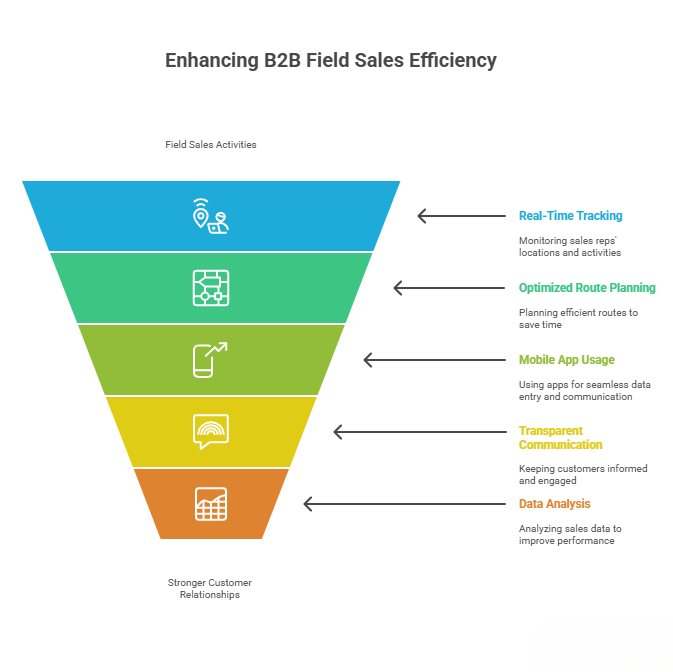
1. Implement Real-Time Field Sales Tracking for Better Productivity
Using real-time tracking helps managers see where field sales representatives are and what they are working on throughout the day. This makes planning visits easier, helps spot delays, and ensures reps spend more time with customers instead of on the road.
Smarter route planning reduces travel time and lets teams reach more clients efficiently. Sales reps using a mobile app can log visits, update notes, and stay organized while moving between locations.
Transparency is important. Customers should understand that optimized visits are meant to provide faster service and better attention, not to intrude on privacy. Clear communication builds trust and shows that efficiency and strong relationships matter.
Best practices
Use GPS data to plan routes that save time and increase face-to-face interactions
Explain to customers how optimized visits improve their service
Review tracking data regularly to improve sales performance tracking for field teams
2. Use Mobile Apps to Log Customer Interactions Seamlessly
sales, manage inventory, and record every interaction on the spot. With current data, reps can adjust their approach and improve service for each customer.
These apps also let managers track team performance. They can see which accounts need focus, how reps spend their time, and what strategies work. This keeps teams organized and ensures no customer gets missed.
Best practices
Pick apps that sync with your CRM for automatic data updates.
Train reps to use the app well and take advantage of its features.
Push for real-time data entry to keep customer info accurate.
Mobile apps streamline field sales, keep teams informed, and build stronger customer relationships.
3. Transparent Communication Boosts Customer Trust in Field Sales
Clear communication with customers builds trust. Regular updates about visits, product availability, or delays manage expectations. A simple feedback system lets customers share concerns quickly.
Automated notifications keep customers informed about visits or changes. Dedicated channels make it easy for clients to reach out and get fast responses. Reps should listen to concerns and act to improve service.
Open communication strengthens customer relationships and reduces problems. It helps managers track team performance by highlighting where service can improve and which interactions build loyalty.
5 Ways to Track Field Sales Without Losing Customer Relationships
4. Analyze Sales Data to Improve Team Performance and Coverage
Monitoring the performance of field sales teams through key metrics like sales volume, visit frequency, and customer satisfaction provides important insights. These numbers show where reps are performing well and where they may need support. By focusing on data, managers can make better decisions that improve results without hurting customer relationships.
Real-time tracking software and dashboards help managers see how teams perform. They can spot trends, find gaps in coverage, and guide reps to focus on key accounts. Reviewing data with reps sets clear goals and encourages steady improvement.
Best practices
Set clear KPIs tied to business goals.
Use simple dashboards or tools to make data clear.
Meet regularly with reps to review performance, celebrate wins, and find areas to improve.
Analyzing sales data helps track field team performance, improves coverage, and keeps teams efficient while maintaining strong customer ties
5.Customer-Centric Sales Approach
Focusing on customer needs builds strong relationships. Reps who understand client issues, offer solutions, and follow up earn trust. Including satisfaction in reviews shows relationships matter. Empathy and listening training improve communication. Recognizing good interactions motivates reps. A customer-focused approach with tracking keeps teams productive and strengthens client ties.
Key Points for Customer-Centric Sales
Understand client issues and provide solutions.
Follow up to build trust.
Include satisfaction in reviews.
Train reps in empathy and listening.
Recognize good interactions.
Combine customer focus with tracking.
What’s Next
Tracking field sales does not have to disrupt customer relationships. With the right tools, your field team can work efficiently while keeping clients satisfied. This approach boosts productivity and supports business growth.
Happisales Field Force Automation Software lets businesses track visits, orders, collections, and service tasks in real time, even offline. It gives managers clear insights into field operations while helping teams maintain strong customer connections.
You can start a 14-day free trial or request a personalized live demo to see how the platform fits into your workflow.
The easiest way is to use a mobile app or CRM where reps can log visits and notes right after meeting a client. This keeps all details in one place, avoids missed follow-ups, and gives managers a clear picture of what’s happening with each customer.
2. How to track sales rep activity without breaking the budget?
You don’t need expensive software to track your team. Affordable sales apps can show visits, orders, and daily activity in real time. Features like route planning save fuel and time, so you get better results without overspending.
3. How can businesses track field sales without losing customer trust?
It comes down to being transparent. Customers are usually fine with tracking if they know it helps you reach them on time and respond faster. When reps show up consistently and follow up properly, tracking feels like better service-not surveillance.
4. How does route optimization improve sales productivity?
Smart route planning helps reps cut down on travel time and meet more customers in a day. It also reduces costs like fuel and delays. For clients, this means timely visits and smoother service, which builds trust.
5. How can managers use sales data to improve team performance?
Looking at data like visits, orders, and response times helps managers spot what’s working and what’s not. Instead of guesswork, they can give clear feedback, guide reps to focus on the right accounts, and celebrate wins. This makes the team more focused and effective.
“Our field sales productivity was stagnant for years. Then we implemented the right field sales management solution, and within six months, we saw a 25% increase in conversions across our Chennai operations.” This isn’t just a hypothetical scenario; it’s a common outcome I’ve witnessed repeatedly in my seven years developing and deploying sales management software for diverse Indian businesses, from fast-growing startups to established enterprises. The challenges of managing a geographically dispersed sales team in India—optimizing routes, tracking real-time performance, and ensuring consistent customer engagement—are unique and complex. This guide will walk you through what truly makes a field sales management solution effective, focusing specifically on the needs of the Indian market, and how a robust platform like Happisales stands out.
A top-tier field sales management solution for Indian businesses empowers teams with real-time tracking, intelligent routing, and robust reporting to significantly boost productivity and sales.
Why a Dedicated Field Sales Management Solution is Non-Negotiable for Indian Sales Teams
The bustling streets of Mumbai, the expansive rural markets of Uttar Pradesh, or the tech-driven landscape of Bengaluru—each presents a distinct environment for field sales. Without a specialized field sales management solution, businesses grapple with inefficiencies that directly impact revenue. Think about it: a salesperson spending hours planning routes manually, or a manager struggling to get accurate, real-time updates from a remote team. These aren’t just minor inconveniences; they’re significant drains on productivity and profitability.
The Ground Realities of Indian Field Sales
Geographic Diversity: India’s vast and varied geography means sales routes can range from dense urban centers to remote villages, each with its own logistical quirks. A generic sales tool simply won’t cut it for route optimization in such diverse settings.
Connectivity Challenges: While improving, internet connectivity can still be patchy in certain regions. Offline capabilities are crucial for field agents to continue their work uninterrupted.
Cultural Nuances: Building relationships is key in Indian sales. A solution must support detailed customer profiles and interaction histories to facilitate personalized engagement.
Competitive Landscape: The Indian market is fiercely competitive. Every lead, every customer interaction, and every minute saved counts.
My experience developing sales platforms has shown me that solutions not built with these specific Indian realities in mind often fail to deliver on their promises. For instance, in a recent project with a pharmaceutical distributor in Hyderabad, their existing global CRM struggled with geo-fencing accuracy in specific districts, leading to attendance tracking issues. Implementing a solution tailored to Indian mapping data solved this immediately.
Key Pain Points Alleviated by an Effective Solution
Lack of Visibility: Managers often have little real-time insight into what their field agents are doing, where they are, or how they are performing against targets. This leads to delayed interventions and missed coaching opportunities.
Inefficient Route Planning: Manual route planning is time-consuming and rarely optimal, resulting in wasted fuel, longer travel times, and fewer customer visits.
Poor Data Collection & Reporting: Relying on paper-based reports or scattered spreadsheets makes data aggregation and analysis a nightmare, delaying strategic decision-making.
Missed Sales Opportunities: Without quick access to customer history, product information, or current promotions, sales agents can miss chances to upsell or cross-sell effectively.
Compliance and Accountability Issues: Verifying field activities, especially for attendance or visit reports, becomes a significant challenge without automated tracking.
Core Features That Define a Superior Field Sales Management Solution
When evaluating a field sales management solution for your Indian business, certain features move it from “good to have” to “absolutely essential.” These aren’t just bells and whistles; they are the operational backbone that empowers your field team and provides management with actionable insights.
Real-Time Location Tracking & Geo-fencing
This is perhaps the most fundamental feature. Managers need to know where their sales force is at any given moment.
Live Location Monitoring: See your sales team’s current position on a map, providing an overview of daily activities.
Visit Tracking & Verification: Automatically log when an agent enters and exits a client location based on GPS, ensuring accurate visit reporting. This is invaluable for verifying claims and ensuring compliance, especially in sectors like FMCG or pharmaceuticals.
Geo-fencing: Set up virtual boundaries around client locations or sales territories. Receive alerts if an agent deviates from their assigned area or for late arrivals/early departures. For a client in the Bengaluru retail sector, geo-fencing reduced unverified visits by 40% in the first quarter alone.
Intelligent Route Optimization
Gone are the days of sales reps painstakingly planning their daily routes. An advanced solution does this for them, considering multiple factors.
Multi-stop Route Planning: Automatically generate the most efficient sequence of visits, minimizing travel time and fuel costs.
Traffic & Road Condition Integration: Leverage real-time traffic data to adjust routes on the fly, a critical feature given India’s dynamic road conditions.
Prioritization: Allow for prioritizing high-value clients or urgent visits within the optimized route.
Territory Management: Assign and manage sales territories effectively, ensuring equitable distribution of workload and market coverage.
Comprehensive Task & Activity Management
Field sales isn’t just about visits; it’s about structured activities leading to conversions.
Digital Task Assignment: Managers can assign daily, weekly, or specific tasks directly to agents’ mobile devices.
Customizable Forms & Checklists: Create digital forms for visit reports, order booking, expense claims, and market feedback. This eliminates paperwork and standardizes data collection.
Meeting & Appointment Scheduling: Integrate calendar functionalities to help agents manage their appointments efficiently.
Lead Management Integration: Seamlessly connect field activities with lead nurturing, ensuring no lead falls through the cracks. For an electronics distributor in Delhi, integrating lead management directly into the field app cut their lead-to-opportunity time by 15%.
Mobile-First Design with Offline Capabilities
Given the nature of field sales in India, the mobile experience is paramount.
Intuitive Mobile App: The app must be easy to use, even for sales personnel who may not be tech-savvy.
Offline Data Sync: Allow agents to record data, take orders, and complete tasks even without an internet connection. Once online, the data automatically syncs with the central system. This was a game-changer for a client operating in rural Gujarat, where consistent network access is a luxury.
Native App Experience: Optimized for both Android and iOS, providing a smooth user experience.
Robust Reporting & Analytics
This is where managers gain the insights needed to make data-driven decisions.
Performance Dashboards: Visual representations of key metrics: sales achieved, visits completed, lead conversion rates, and agent activity.
Customizable Reports: Generate detailed reports based on various parameters like territory, product, agent, or time period.
Sales Forecasting: Leverage historical data and current pipeline information to predict future sales trends.
Anomaly Detection: Identify deviations from normal activity patterns, such as unusually low visit counts or high travel times, indicating potential issues.
Order Management & Inventory Integration
For many field sales operations, taking orders on the spot is crucial.
Mobile Order Booking: Allow agents to place orders directly from their devices, checking real-time inventory availability.
Product Catalogs: Access to up-to-date product information, pricing, and promotional offers.
Invoice Generation: Generate and share digital invoices instantly with customers.
Payment Collection Integration: Facilitate various payment methods directly through the app.
CRM Integration
A standalone field sales solution is powerful, but its true potential is unleashed when integrated with your existing CRM.
Seamless Data Flow: Ensure customer data, interaction history, and sales pipeline information are consistent across both systems.
360-degree Customer View: Field agents can access comprehensive customer profiles, while CRM users can see detailed field activity.
Happisales: The Preferred Field Sales Management Solution for Indian Businesses
When it comes to selecting a field sales management solution that truly understands and addresses the intricacies of the Indian market, Happisales stands out. Built with extensive research into the unique challenges and opportunities faced by Indian sales teams, Happisales offers a comprehensive suite of features designed to maximize efficiency, boost sales, and provide unparalleled visibility.
Why Happisales Resonates with Indian Businesses
Localised Intelligence: Unlike generic global platforms, Happisales’s routing algorithms and geo-mapping capabilities are optimized for Indian road networks and addresses. This means more accurate routes and better geo-fencing, whether your team is navigating the bylanes of Varanasi or the expressways of Gurugram.
Offline-First Approach: Recognizing the varying connectivity across India, Happisales’s mobile app is engineered for robust offline functionality. Sales agents can record data, take orders, and access critical information without a constant internet connection, syncing seamlessly once back online.
Scalability for Growth: From a startup with a handful of field agents to a large enterprise managing hundreds, Happisales is designed to scale with your business. Its modular architecture allows businesses to add features as their needs evolve, without overhauling their entire system.
Intuitive User Experience: The mobile app is designed to be user-friendly and requires minimal training, ensuring quick adoption by field teams. This focus on user experience has been crucial for clients like a prominent agricultural supplier in Punjab, whose sales reps, though experienced in sales, were new to digital tools.
Dedicated Indian Support: Access to local support teams who understand the business context and can provide timely assistance is a significant advantage. This ensures that any technical issues or queries are resolved quickly, minimizing downtime.
Happisales’s Differentiating Features
Advanced GPS Tracking with Indian Map Integration:
Precision Location: Pinpoints agent locations with high accuracy, even in complex urban layouts.
Route Deviation Alerts: Notifies managers instantly if an agent veers off their planned route or spends excessive time at non-client locations.
Happisales Example: “Our sales head in Pune often says the precise GPS tracking has made team management so much easier. We now know exactly where everyone is and can reassign tasks based on proximity to urgent client needs.”
AI-Powered Route Optimization for India:
Dynamic Planning: Takes into account real-time traffic updates, road closures, and preferred routes specific to Indian cities and highways.
Cost Efficiency: Generates the most fuel-efficient routes, leading to significant savings on travel expenses.
Happisales Example: For an FMCG distributor in Kerala, Happisales’s route optimizer reduced daily travel time by an average of 1.5 hours per agent, allowing for 2-3 extra client visits per day.
Customizable Digital Forms & Workflows:
Tailored Data Collection: Create forms for everything from market surveys and competitor analysis to lead qualification and customer feedback, specific to your industry’s requirements.
Automated Workflows: Set up automated follow-ups or approvals based on form submissions, streamlining internal processes.
Happisales Example: A client in the textile industry in Surat uses Happisales’s custom forms for daily stock checks and order submissions directly from retail stores, ensuring real-time inventory updates.
Integrated Order Management with Offline Sync:
Seamless Order Booking: Agents can view product catalogs, check inventory, place orders, and even process returns directly from their mobile app.
Real-time Stock Updates: Integrates with your inventory system to provide accurate stock levels, preventing overselling.
Happisales Example: Imagine a sales rep in a remote part of Rajasthan taking an order for agricultural equipment. With Happisales, they can process the order instantly, even without internet, and the system updates once they’re in range.
Comprehensive Performance Analytics & Insights:
Manager Dashboards: Provides an intuitive overview of team performance, individual agent productivity, and sales funnel progress.
Trend Analysis: Identify best-performing products, territories, and sales strategies.
Happisales Example: The Head of Sales at a construction materials company in Chennai leveraged Happisales’s analytics to identify that agents focusing on smaller, independent contractors had higher conversion rates than those targeting large developers, leading to a strategic shift in their approach.
Geo-Tagged Attendance and Expense Management:
Accurate Attendance: Agents can clock in and out with geo-verification, ensuring legitimate work hours.
Simplified Expense Reporting: Capture receipts, categorize expenses, and submit claims directly through the app, linked to visit data.
Happisales Example: This feature significantly reduced manual reconciliation time for a pharmaceutical company’s sales team across India, allowing finance teams to process expenses faster and with greater accuracy.
Comparison: Happisales vs. Generic CRM Field Modules
Feature/Aspect
Happisales (Optimized for India)
Generic CRM Field Module (Global Focus)
Route Optimization
AI-powered, real-time traffic for Indian roads & addresses
Basic, often struggles with Indian road complexities
Offline Capability
Robust, seamless sync; built for patchy Indian connectivity
Often limited or clunky; prone to data loss in poor networks
Geo-fencing Accuracy
High precision with Indian map data; reliable for verification
Can be less accurate for specific Indian locations
Customization
Highly adaptable forms & workflows for diverse Indian industries
May require extensive, costly customization for specific needs
Pricing Model
Flexible, often localized pricing for Indian businesses
Typically global pricing, potentially higher for local budgets
Local Support
Dedicated support team understanding Indian business context
Global support, may lack understanding of local nuances
User Adoption
High due to intuitive design & local relevance
Can be challenging due to less localized UI/UX
Integration
Seamless with popular CRMs & ERPs in India
Standard integrations, may require custom connectors for some
Field Sales Management Solution – Comparision
Implementing Your Field Sales Management Solution: A Step-by-Step Guide
Adopting a new field sales management solution isn’t just about choosing the right software; it’s about a strategic rollout that ensures maximum impact. Based on my experience with numerous deployments across India, a structured approach is key.
1. Define Your Objectives
Before even looking at software, clearly articulate what you want to achieve.
Increase sales conversions by X%?
Reduce travel costs by Y%?
Improve data accuracy by Z%?
Enhance team visibility and accountability?
Shorten sales cycle?
2. Assess Your Current Processes
Understand your existing field sales workflows. What are the bottlenecks? What works well? Documenting these helps you identify areas where the new solution can bring the most value.
3. Pilot Program
Start with a small group of sales agents and managers. This allows you to:
Test the solution in a real-world scenario.
Gather feedback from actual users.
Identify and resolve any unforeseen issues.
Refine your implementation strategy.
Personal Example: For a building materials company in Odisha, we ran a pilot with just 5 agents in Bhubaneswar. Their feedback on the mobile app’s ease of use and offline capabilities was instrumental in fine-tuning the full rollout.
4. Comprehensive Training
This is crucial. Don’t just show them how to use the app; explain why it benefits them.
For Sales Agents: Focus on how it simplifies their daily tasks, optimizes routes, and helps them sell more effectively.
For Managers: Emphasize how it provides visibility, enables better coaching, and improves reporting.
Happisales provides excellent training modules and local support to ensure smooth onboarding.
5. Phased Rollout
Once the pilot is successful, roll out the solution to the rest of your team in phases. This minimizes disruption and allows you to provide focused support.
6. Continuous Monitoring & Optimization
Implementation is not a one-time event.
Regularly review performance metrics.
Gather ongoing feedback from your team.
Leverage the analytics features of your solution to identify areas for improvement.
Happisales’s analytics dashboard is perfect for this, offering deep dives into team and individual performance.
People Also Ask
What are the key benefits of a field sales management solution for FMCG companies in India?
Field sales management solutions offer FMCG companies in India crucial benefits like optimized route planning for faster store visits, real-time inventory updates from the field, enhanced data collection on market trends and competitor activity, and improved sales team accountability. This directly translates to higher stock availability, reduced out-of-stocks, and increased sales volumes across diverse retail channels.
How does geo-tracking in a field sales solution help improve team accountability?
Geo-tracking in a field sales solution significantly boosts accountability by providing verifiable data on agent locations, visit timings, and travel routes. Managers can cross-reference reported activities with actual GPS data, ensuring that visits are conducted as planned, reducing unverified claims, and providing objective metrics for performance evaluations.
Can a field sales management solution integrate with existing CRM systems common in India?
Yes, a robust field sales management solution, like Happisales, is designed for seamless integration with popular CRM systems used by Indian businesses, such as Salesforce, Zoho CRM, and even custom-built CRMs. This ensures a unified view of customer data, sales pipelines, and field activities, preventing data silos and improving overall operational efficiency.
Is an offline mode essential for a field sales solution in India?
An offline mode is absolutely essential for a field sales solution operating in India due to varying internet connectivity across urban and rural areas. It allows field agents to continue their work—accessing customer data, placing orders, and submitting reports—even without an active internet connection, with all data syncing automatically once connectivity is restored, preventing any disruption to sales operations.
How does a field sales management solution improve customer satisfaction?
A field sales management solution enhances customer satisfaction by enabling faster response times, more personalized interactions, and accurate order fulfillment. Agents have instant access to customer history and product information, leading to more informed conversations, quicker issue resolution, and efficient service delivery, building stronger customer relationships.
Powering Your Sales Growth with the Right Solution
The landscape of field sales in India is dynamic, challenging, and filled with immense opportunity. To thrive in this environment, businesses cannot rely on outdated methods or generic tools. A dedicated field sales management solution is no longer a luxury but a fundamental requirement for optimizing operations, empowering sales teams, and driving significant revenue growth.
My journey in building and deploying sales software has consistently shown that the right technology, tailored to local needs, makes all the difference. Happisales embodies this philosophy, providing a comprehensive, intuitive, and highly effective platform that addresses the unique realities of the Indian market. From intelligent route optimization that saves time and fuel to robust offline capabilities that ensure uninterrupted work in remote areas, Happisales is engineered to boost your team’s productivity and your company’s bottom line.
Don’t let inefficiencies hold your sales team back. Embrace the power of a purpose-built field sales management solution like Happisales. Discover how we can transform your field sales operations and propel your business forward.
Ready to see Happisales in action and revolutionize your field sales in India?
The Indian sales landscape is hyper-competitive. In fact, a recent report by Deloitte highlighted that only about 30% of sales professionals in India consistently meet or exceed their targets. This isn’t just a number; it represents a tangible impact on revenue and growth for countless businesses, from burgeoning startups to established enterprises. As a sales management software company that has partnered with over 200 Indian businesses over the past eight years, specializing in solutions that drive real, measurable improvements in sales team output, we’ve seen firsthand the difference the right tools make.
For Indian sales leaders navigating this dynamic environment, selecting the best sales performance management software isn’t merely about feature checklists; it’s about strategic advantage. This comprehensive guide, crafted with our deep market experience in India, will cut through the noise to help you understand, evaluate, and ultimately choose the ideal SPM solution to empower your sales force. We’ll specifically highlight how HappiSales stands out in this crowded market.
The best sales performance management software for Indian businesses empowers sales leaders with real-time data, automates compensation, and drives actionable insights for sustained growth.
Understanding Sales Performance Management (SPM) Software for the Indian Market
Sales Performance Management (SPM) software is a suite of tools designed to help organizations optimize their sales operations, improve efficiency, and ultimately boost revenue. For the unique challenges and opportunities present in India – from diverse regional markets to varying sales cycles and compensation structures – a robust SPM solution is not just beneficial, it’s essential.
Why SPM is Critical for Indian Sales Teams
Complex Sales Ecosystems: Indian businesses often deal with diverse customer segments, multiple product lines, and geographically dispersed sales teams. An effective SPM helps centralize and manage this complexity.
Variable Compensation Plans: Sales incentives in India can range from intricate commission structures based on achievement tiers to bonus plans tied to specific regional targets. Manual management is prone to errors and demotivation.
Need for Real-time Insights: Rapid market shifts demand quick decision-making. SPM provides the data needed to adapt strategies on the fly.
Talent Retention: Transparent and fair compensation, coupled with performance visibility, is crucial for retaining top sales talent in a competitive job market.
Core Components of a Leading SPM Solution
The best sales performance management software typically integrates several key functionalities:
Sales Incentive Compensation Management (ICM): This is the heart of SPM, automating the calculation and administration of commissions, bonuses, and other incentives.
Quota Management: Tools to set, track, and adjust sales quotas effectively across individuals, teams, and regions.
Territory Management: Optimizing the assignment of sales territories and accounts to maximize coverage and minimize overlap.
Sales Forecasting: Leveraging historical data and current pipelines to predict future sales performance.
Performance Analytics & Reporting: Dashboards and reports that provide deep insights into individual, team, and organizational sales performance.
Gamification: Features that introduce competitive elements and rewards to boost motivation and engagement among sales reps.
In India, where sales teams might span multiple states with distinct market dynamics, a solution like HappiSales integrates these components seamlessly, offering the flexibility required for granular control over diverse sales operations.
Key Features to Look For in Sales Performance Management Software in India
When evaluating SPM solutions for your Indian business, specific features will determine the effectiveness and return on investment. Here’s what truly matters:
1. Robust Incentive Compensation Management (ICM)
Configurable Commission Rules: Can the software handle complex, multi-tiered commission structures common in India (e.g., different rates for new sales vs. renewals, product-specific incentives)?
Automated Payouts: Does it integrate with payroll systems to streamline accurate and timely commission payouts, reducing administrative burden and errors?
“What-if” Scenario Modeling: Can you model potential changes to commission plans to understand their impact before implementation? This is vital for adapting to market shifts or new product launches in India.
2. Advanced Quota & Goal Management
Dynamic Quota Setting: The ability to set realistic yet challenging quotas based on historical data, market potential, and sales capacity.
Performance Tracking: Real-time visibility into quota attainment at individual, team, and regional levels.
Adjustment Flexibility: The agility to modify quotas mid-cycle, essential in India’s fast-evolving business environment.
3. Intuitive Territory & Account Planning
Geo-specific Allocation: Tools that allow for efficient distribution of territories and accounts based on geographical data, market size, and sales rep expertise within India.
Overlap Prevention: Ensuring that sales efforts are coordinated and resources are not duplicated.
Performance-based Reassignment: The ability to rebalance territories based on performance data to optimize coverage and potential.
4. Comprehensive Analytics and Reporting
Customizable Dashboards: Tailored views for different stakeholders (sales reps, managers, leadership) showing key performance indicators (KPIs) relevant to the Indian context.
Deep Dive Reporting: The capacity to drill down into specific data points to understand root causes of performance trends.
Predictive Analytics: Features that use AI/ML to forecast future sales and identify potential risks or opportunities. HappiSales, for instance, leverages AI to provide predictive insights tailored to the Indian market’s nuances.
5. Seamless Integration Capabilities
CRM Integration: Must integrate effortlessly with popular CRMs like Salesforce, Zoho CRM, or Microsoft Dynamics, which are widely used by Indian businesses, to pull real-time sales data.
ERP & HRIS Integration: Connections to existing enterprise resource planning (ERP) and human resources information systems (HRIS) for holistic data flow.
Data Import/Export: Flexible options for importing legacy data and exporting reports for further analysis.
6. User Experience (UX) and Accessibility
Ease of Use: An intuitive interface is critical for quick adoption by sales teams, especially considering varying tech literacy levels across different regions in India.
Mobile Accessibility: Sales reps are often on the go. A robust mobile application for tracking performance, checking commissions, and accessing data is non-negotiable.
Language Support: While English is prevalent in corporate India, regional language support can be a significant advantage for broader adoption.
7. Scalability and Customization
Growth Path: Can the software scale with your business as your sales team grows or your compensation plans become more complex?
Customization Options: The ability to tailor workflows, reports, and compensation rules to fit your specific business processes and the unique demands of the Indian market.
8. Local Support and Compliance
India-specific Expertise: Does the vendor understand Indian tax regulations, labor laws, and data privacy norms relevant to sales compensation?
Local Support Team: Access to a responsive support team within India can make a huge difference in resolving issues quickly.
HappiSales: A Tailored Solution for India’s Sales Prowess
At HappiSales, we’ve engineered our platform with the specific needs of the Indian market at its core. We understand that a “one-size-fits-all” approach simply doesn’t work here. Our extensive experience serving Indian SaaS startups, manufacturing units in Pune and Bengaluru, and service providers in Delhi NCR has shaped a solution that addresses local complexities head-on.
How HappiSales Excels as the Best Sales Performance Management Software for India
Unmatched Flexibility in ICM: HappiSales allows for the creation of virtually any commission structure, no matter how intricate. This includes multi-product incentives, tiered performance bonuses, and even region-specific accelerators, which are common in India. Our “What-if” scenario builder is particularly praised by Indian sales leaders for strategic planning.”Before HappiSales, our commission calculations for our Chennai-based sales team took days, leading to frequent disputes. Now, it’s automated, transparent, and trusted.” – Head of Sales, Leading IT Services firm, Bengaluru
AI-Powered Quota and Forecasting: Leveraging advanced AI algorithms trained on diverse Indian sales data, HappiSales provides predictive insights for quota setting that are more accurate than traditional methods. This helps companies in Mumbai’s financial sector or Gujarat’s manufacturing hubs set achievable yet ambitious targets.
Comprehensive Performance Dashboards: Our dashboards offer real-time, customizable views of sales performance, from individual rep activity in Tier-2 cities to overall team performance. This empowers managers to intervene proactively and offer targeted coaching.
Seamless Integration Ecosystem: HappiSales integrates effortlessly with popular CRMs like Salesforce and Zoho CRM, ensuring a single source of truth for all sales data. This is crucial for businesses across India seeking to unify their tech stacks.
Comparison: HappiSales vs. Global Competitors for the Indian Market
While global players offer robust features, their adaptability to India’s unique market dynamics and local support can sometimes fall short.
Feature/Aspect
HappiSales (India-Centric)
Global Competitor A (e.g., Xactly)
Global Competitor B (e.g., Anaplan)
ICM Flexibility
Excellent: Handles highly complex, multi-tiered Indian compensation plans with ease.
Good: Powerful but may require more customization for unique Indian plans.
Excellent: Highly configurable, but complex to set up.
AI-Driven Quotas
Strong: AI/ML tailored for Indian market trends & data.
Good: Generic AI, less specific to Indian nuances.
Good: Robust planning, less focus on sales-specific AI.
Local Support
Dedicated India-based team with fast response times.
Often global support, may have time zone delays.
Global support, can be less personalized.
Pricing Model
Competitive & transparent for Indian businesses.
Often higher cost, enterprise-focused.
Premium pricing, complex licensing.
Integration
Seamless with popular CRMs in India (e.g., Zoho).
Excellent with Salesforce, may need custom work for others.
Broad but can be costly for specific connectors.
User Experience
Intuitive, designed for quick adoption by diverse Indian teams.
Modern, but can have a steeper learning curve for some.
Powerful but requires specialized training.
Deployment Speed
Faster implementation due to local expertise.
Standard implementation timelines.
Can be lengthy due to high customization.
This table underscores why a locally attuned solution like HappiSales often emerges as the best sales performance management software for Indian companies aiming for peak efficiency and localized effectiveness.
Implementing SPM Software: Best Practices for Indian Businesses
Adopting new software can be a significant undertaking. To ensure a smooth transition and maximize the ROI from your SPM solution, especially in the diverse operational environments found across India, consider these best practices:
1. Define Clear Objectives
Before you even start looking at software, clearly articulate what you want to achieve.
Are you aiming to reduce commission errors by 90%?
Improve sales forecast accuracy by 20% for your Bengaluru operations?
Boost sales rep motivation in Tier-2 cities by providing transparent performance visibility? Clear objectives will guide your selection and implementation process.
2. Involve Key Stakeholders
This isn’t just an IT or sales leadership decision.
Sales Managers: Crucial for understanding day-to-day challenges and usability needs.
Sales Representatives: Their buy-in is essential for adoption; involve them in user testing.
Finance/HR: Integral for understanding compensation rules, payroll integration, and compliance in India.
IT Department: For technical integration, security, and data migration.
3. Start Simple, Then Scale
Don’t try to automate every single complex compensation rule on day one.
Begin with your most straightforward commission plans or a pilot team.
Gather feedback, refine processes, and then gradually expand to more complex scenarios or wider teams.
This agile approach works well in the dynamic Indian business environment.
4. Provide Thorough Training and Support
Customized Training: Tailor training sessions to different user groups (reps, managers, finance).
On-Demand Resources: Create easily accessible guides, FAQs, and video tutorials.
Ongoing Support: Ensure your team knows who to contact for help – this is where local support from vendors like HappiSales truly shines.
5. Prioritize Data Accuracy
The effectiveness of any SPM system hinges on the quality of the data fed into it.
Clean CRM Data: Ensure your CRM data (leads, opportunities, closed deals) is accurate and up-to-date.
Integrate Seamlessly: Leverage strong integrations between your CRM, ERP, and SPM to minimize manual data entry and errors.
Regular Audits: Implement processes for regular data validation and auditing.
6. Regularly Review and Optimize Compensation Plans
The Indian market is constantly evolving, and so should your sales incentives.
Performance Monitoring: Use the SPM software’s analytics to understand which commission plans are driving desired behaviors and which are not.
Feedback Loop: Regularly solicit feedback from your sales team and management.
Agile Adjustments: Be prepared to make data-driven adjustments to your compensation plans as market conditions or business goals change. The “what-if” modeling in HappiSales is invaluable here.
7. Emphasize Transparency
Visibility for Reps: Allow sales reps to clearly see their potential earnings, performance against quota, and how their compensation is calculated. This is a massive motivator and trust-builder.
Clear Communication: Communicate any changes to compensation plans clearly and well in advance.
HappiSales’ intuitive interface provides this transparency, fostering a sense of fairness and accountability across your sales force.
People Also Ask: Common Questions About Sales Performance Management Software in India
What is the primary benefit of sales performance management software for Indian SMEs?
The primary benefit for Indian SMEs is enhanced transparency in commission calculations and real-time insights into sales performance, which reduces administrative overhead and motivates sales teams, particularly in diverse regional markets like Gujarat and Maharashtra.
How does SPM software help with complex commission structures common in India?
SPM software automates the calculation of even the most complex, multi-tiered commission plans, handling varying rates for products, regions, and sales achievements, thereby eliminating manual errors and ensuring timely, accurate payouts for sales teams across India.
Can SPM software integrate with existing CRM systems used by Indian companies?
Yes, leading SPM software like HappiSales offers seamless integration with popular CRMs such as Salesforce, Zoho CRM, and Microsoft Dynamics, ensuring that all sales data flows smoothly and accurately for comprehensive performance tracking.
Is sales gamification an important feature for Indian sales teams?
Yes, sales gamification can be highly effective for Indian sales teams as it fosters healthy competition and boosts motivation, providing engaging ways to track progress, reward achievements, and drive higher performance, especially among younger sales professionals.
What should an Indian company prioritize when choosing an SPM vendor?
An Indian company should prioritize a vendor with strong local support, an understanding of India-specific business nuances and tax compliance, and highly flexible compensation management capabilities, as offered by solutions like HappiSales.
Empowering Your Indian Sales Force with the Right SPM
The search for the best sales performance management software in India isn’t just about finding a tool; it’s about investing in a strategic advantage. It’s about empowering your sales teams, ensuring fair and accurate compensation, and gaining the insights necessary to thrive in a competitive market.
Our experience at HappiSales, working closely with hundreds of Indian businesses, has reinforced one crucial truth: localized expertise combined with powerful, flexible technology yields the best results. We’ve built HappiSales to specifically address the intricate demands of the Indian sales ecosystem – from diverse regional sales strategies to complex, performance-driven compensation models.
By choosing an SPM solution that offers robust incentive compensation, intelligent quota management, seamless CRM integration, and dedicated local support, you’re not just optimizing processes; you’re building a foundation for sustained sales excellence.
Ready to transform your sales performance and empower your team in India?
Contact HappiSales today for a personalized demo and discover how our tailored solution can drive your growth.
A 2024 report by Grand View Research projected the sales force automation market in India to grow at a CAGR of 9.1% from 2024 to 2030, reaching a market size of US$786.5 million. This isn’t just a number; it’s a clear signal that Indian businesses are rapidly moving away from legacy systems like Excel spreadsheets and WhatsApp groups. With over 10 years of experience building and implementing SaaS products for clients, I’ve seen firsthand how a well-chosen field sales software can be a game-changer for a company’s bottom line. The right platform, especially one designed for the unique challenges of the Indian market, can solve issues from poor data visibility to inefficient route planning and missed sales targets. This guide will walk you through what to look for, why it matters, and why Happisales stands out as the best field sales software for Indian businesses today.
The best field sales software for Indian businesses centralizes sales operations, offers real-time tracking, and provides a mobile-first experience to boost field team productivity.
What Makes a Field Sales Software “The Best” for the Indian Market?
The Indian market has unique demands. Field teams operate in diverse geographies, from densely packed urban centers to remote rural areas with limited connectivity. The best field sales software isn’t just a CRM with GPS; it’s a comprehensive platform that understands these nuances. Here’s a breakdown of the core features that are non-negotiable for success in India.
Real-Time Location Tracking and Geo-Fencing
For any field sales management software, real-time tracking is a foundational feature. But in India, it’s about more than just knowing where your reps are. It’s about verifying their visits to retail outlets, tracking their routes to optimize travel time, and ensuring they are in the correct territory. A software like Happisales provides live location data and geo-fencing capabilities, automatically checking reps in and out of a customer’s location. This eliminates manual data entry and provides an unassailable audit trail, which is crucial for managing distributor relationships and verifying claims.
Offline Functionality for Rural Sales Teams in India
Connectivity is not always guaranteed. In tier-2 and tier-3 cities and rural markets, network instability can bring a sales process to a halt. The best field sales software must have a robust offline mode. This means a sales rep can capture orders, update customer information, and even submit expense reports without an internet connection. The data should then automatically sync with the central dashboard once a connection is re-established. This is a critical feature that ensures continuity and prevents lost data.
Seamless Order and Inventory Management
Manual order booking via phone calls or handwritten forms is inefficient and prone to errors. An effective field sales app should allow reps to:
View real-time stock availability.
Place orders directly from the app.
Generate digital invoices on the spot.
Collect payments through various digital modes like UPI.
This level of integration directly impacts the sales cycle. For a Fast-Moving Consumer Goods (FMCG) company in India, for example, the ability to check inventory at a distributor’s warehouse and book an order instantly can be the difference between a sale and a lost opportunity.
Intelligent Route Planning and Beat Optimization
In a country where traffic can be unpredictable and distances vast, an intelligent route planner is invaluable. It’s a key feature of any sales management software in India that aims to increase efficiency. The system should automatically suggest the most logical and efficient route for a rep’s daily visits, considering factors like traffic, visit priority, and proximity. This not only saves fuel costs but also allows reps to visit more customers in a day. It directly translates to higher sales productivity and better market coverage.
The Happisales Advantage: A Deep Dive into Features
While many platforms offer a mix of these features, Happisales has built a reputation in India for its comprehensive, user-friendly, and cost-effective approach. Here’s a detailed look at what makes it a top contender in the Indian market.
Unified Sales and Marketing Analytics
A major challenge for sales leaders is the lack of a single source of truth. Data is often scattered across spreadsheets, different CRMs, and email inboxes. Happisales solves this by providing a unified dashboard that gives managers a 360-degree view of the entire sales operation.
Sales Intelligence with Happisales
Real-time sales dashboards: Monitor daily, weekly, and monthly sales performance against targets.
Pipeline visibility: Track every lead and deal from creation to closure.
Customizable reports: Generate reports on sales rep performance, top-selling products, and regional sales trends.
This level of intelligence empowers sales leaders to make data-driven decisions and identify areas for coaching and improvement. It’s the kind of feature that builds trust and authority within a team.
Gamification and Performance Management
Sales is a competitive field. Gamification, or the use of game-like elements in a non-game context, can significantly boost morale and performance. Happisales includes features that turn daily tasks into a healthy competition.
Leaderboards: Publicly display the top performers based on key metrics like calls made, meetings booked, or revenue generated.
Badges and rewards: Award virtual badges for achieving milestones, which can be linked to real-world incentives.
Personalized goals: Set individual targets for each rep and track their progress in real-time.
A study published in the Journal of Marketing Research found that sales teams with gamification elements saw a 32% increase in productivity. Happisales leverages this psychology to keep reps engaged and motivated.
Advanced AI-Powered Features
Happisales is not just a data entry tool; it’s an intelligent partner for your sales team.
AI-driven lead scoring: Automatically rank leads based on their likelihood to convert, helping reps focus on the most promising opportunities.
Predictive analytics: Forecast future sales and identify potential bottlenecks in the sales pipeline.
Chatbot integration: The platform integrates with generative AI chatbots to provide instant answers to reps’ questions, freeing up managers’ time. This is a natural use case for our Generative AI Chatbots service.
These features, which rely on robust product engineering services, give your team a significant competitive edge by providing them with the insights they need to close more deals faster. They also streamline the customer journey, from initial contact to a seamless buying experience.
Choosing the Right Field Sales Software: A Comparison Table
Feature
Happisales
Salesforce Field Service
Zoho CRM
LeadSquared
Target Audience
SMBs & Enterprises in India
Large Enterprises Globally
SMBs & Enterprises Globally
Education & Financial Services in India
Pricing
Highly competitive, local plans
High, often requires custom quotes
Tiered, can be complex
Tiered, focused on lead volume
Offline Mode
Robust & seamless
Good, but can be complex to set up
Good
Solid
Geo-Tracking
Real-time, with geo-fencing
Advanced, but complex
Standard
Real-time
Route Optimization
AI-driven & integrated
Available, but often an add-on
Basic
Basic
Gamification
Built-in & customizable
Limited, requires additional apps
Available, requires setup
Limited
Key Differentiator
Indian market focus, intuitive UI, affordability, deep features
Market leader, best for large, complex orgs
All-in-one suite, good for general CRM
Strong on lead management, niche focus
Best Field Sales Software – Comparision
This table shows why Happisales offers a compelling value proposition for Indian companies. It provides enterprise-level features at a price point and with a user experience tailored for the local market. For a sales leader in Chennai or Mumbai, this is a platform that just works, right out of the box.
Case Study: Boosting Sales Productivity in the Indian FMCG Sector
I once worked with a leading beverage distributor in Tamil Nadu that was struggling with a decentralized sales process. Their 100+ field reps relied on phone calls, WhatsApp, and physical order books. This led to:
Delayed order processing: Orders would often take 24-48 hours to reach the warehouse.
Inaccurate inventory data: Reps were booking orders for products that were out of stock, leading to customer dissatisfaction.
Lack of visibility: The sales manager had no real-time data on rep performance or market trends.
We implemented Happisales as their primary field sales software. The transition was smooth, thanks to its user-friendly interface and comprehensive training. Within three months, the results were astounding:
Order-to-delivery time was reduced by 60%. Reps could book orders in minutes, and the warehouse received them instantly.
Sales rep productivity increased by 25%. With geo-optimized routes and automated reporting, reps spent more time selling and less on admin tasks.
The sales manager gained full visibility, allowing them to identify top performers and provide targeted coaching.
This real-world example demonstrates the transformative power of a specialized field sales software solution and its direct impact on a company’s sales strategy.
Implementing Your New Field Sales Software: A Strategic Roadmap
Choosing the software is only the first step. The implementation process is what truly determines success. As a product strategist, I’ve outlined a simple, effective roadmap for Indian companies to follow.
Phase 1: Preparation and Planning
Define your goals: What specific problems are you trying to solve? Is it boosting sales, improving data accuracy, or reducing travel costs?
Form a core team: Include representatives from sales, IT, and management.
Data audit: Clean and consolidate your existing customer, product, and territory data.
Phase 2: Pilot and Training
Start small: Deploy the software to a pilot group of 5-10 reps.
Gather feedback: Collect continuous feedback from the pilot group to identify any issues and refine the process.
Comprehensive training: Train your entire field team on the app’s features and the new workflow. A simple, intuitive app like Happisales makes this process much smoother.
Phase 3: Full-Scale Deployment and Optimization
Go live: Roll out the software to all field reps.
Monitor performance: Use the platform’s analytics to track key metrics and ensure you are achieving your initial goals.
Continuous improvement: Regularly review data and use features like the built-in reporting and analytics to fine-tune your sales process.
This structured approach ensures a smooth transition and maximizes your return on investment.
People Also Ask
What are the core functions of a field sales software?
The core functions of a field sales software include location tracking, order and inventory management, visit planning, and real-time reporting to streamline on-the-ground operations. This functionality helps sales reps be more efficient and provides managers with critical data.
What is the difference between a field sales software and a CRM?
While a CRM manages customer relationships and sales pipelines in a broad sense, a field sales software is a specialized tool focused on the specific, on-the-ground activities of a mobile sales team. It often includes features like GPS tracking, beat planning, and offline data sync that a standard CRM may lack.
How does field sales software help reduce operational costs?
Field sales software helps reduce operational costs by optimizing rep travel routes to save on fuel, eliminating manual paperwork and data entry, and providing real-time inventory visibility to prevent stockouts and overstocking. It also improves productivity, which indirectly lowers the cost per sale.
Can a field sales software integrate with our existing ERP system?
The best field sales software, like Happisales, is designed for seamless integration with existing ERP and accounting systems (such as Tally or SAP). This ensures a smooth flow of data for order processing, inventory updates, and financial reporting.
Empowering Your Sales Team with the Right Technology
The Indian market is dynamic, competitive, and ripe with opportunities for businesses that are willing to embrace technology. Outdated manual processes are no longer a viable option. The right field sales management software is an investment that pays for itself many times over by boosting productivity, improving data accuracy, and giving you a strategic advantage.
Having worked with sales teams across India for over a decade, I can confidently say that finding a platform that is not just feature-rich but also easy to use and tailored for the local context is paramount. Happisales, with its deep understanding of the Indian market, robust offline capabilities, and powerful analytics, stands out as a clear leader.
It’s a platform built for the way Indian sales teams work, and it’s a testament to the power of thoughtful product engineering.
Introduction – why field force automation matters now?
Without field force automation software do your businesses with mobile teams face constant headaches. You deal with missed orders, messy routes, slow payments, and no clue what your team does. I’ve worked with FMCG and retail businesses, and Happisales system fixes these problems. It increases store visits, stops stockouts, speeds up cash flow, and tracks growth clearly. This post explains how to choose field force automation software, how it solves tracking and productivity issues, and how to evaluate vendors without wading through sales talk.
What is field force automation software?
Field force automation software streamlines mobile team operations. Struggling with manual processes? It fixes this with real-time data and clear insights. It helps managers make decisions based on facts. Here’s what it does:
Manages sales, collections, orders, and service visits through mobile apps.
Plans routes to save time and increase store visits.
Works offline to keep field teams productive in low-network areas.
Provides dashboards to track performance and growth.
Replaces paper, Excel, or WhatsApp with instant data updates.
Challenges Small Businesses Face Without Automation
Small businesses with mobile teams face big challenges. Without field force automation software, you lose sales and waste time. From working with distributors and retail teams, I’ve seen these issues slow growth. Lack of transparency is the biggest hurdle. Fix that, and other problems get easier. Here are the key issues:
Inventory shortages kill sales– Reps arrive at stores with no stock because inventory isn’t synced.
Poor travel paths burn time– Bad planning raises fuel costs and cuts visits.
Slow payments hurt cash flow– Paper receipts and delayed approvals create delays.
Spotty networks stop work– Apps must work offline in smaller towns.
Key Features of the Best Field Force Automation Software
Picking the right field force automation software matters for small businesses. Don’t have the right mobile workforce tools? You’ll waste time and money. Focus on these features to ensure the software helps your team. They solve real problems and drive results. Here’s what to prioritize:
Location tracking with geotagged visits – It confirms field visits, builds coverage maps, and prevents fake reports. Check for passive tracking versus manual check-ins, battery usage, and privacy settings like work-hours-only tracking.
Offline-first mobile app- It lets reps log orders and data in areas with weak networks. Look for automatic data sync, conflict handling, and support for file or photo uploads.
Route optimization with planned schedule- It boosts daily visits and cuts travel costs. Ensure it offers multi-stop routing, prioritizes key customers, and adjusts routes dynamically.
Order and inventory sync in real time or near real time– It stops stockouts, prevents extra deliveries, and speeds reordering. Check for SKU-level updates, warehouse visibility, and low-stock alerts.
Expense capture with fast approvals– It cuts reimbursement delays and boosts team morale. Look for receipt scanning, simple approval workflows, and payroll or ERP integration.
Custom dashboards with performance analytics– They turn data into coaching insights, not just numbers. Ensure metrics cover visit conversion, average order size, route adherence, and collections aging.
Privacy-focused tracking– It builds trust with mobile teams. Verify it tracks only during work hours, limits data retention, and restricts access to managers.
Real Benefits of Field Force Automation for Small Businesses
Our company has worked with small distributors and retail chains. Here’s what happens when automation is done right.
More store visits– Smart routing and planning boost visits by 15-25% early on.
Fewer stockout-. Real-time inventory and order syncing cut stockouts. Customers reorder more consistently.
Quicker collections– Automated reminders and cash reconciliation speed up payment cycles and improve cash flow.
Lower travel costs– Optimized routes save on fuel and overtime.
Better coaching– Data-driven reviews make weekly sessions focused and useful.
These results aren’t automatic, they come when teams stick to new processes and use the software regularly.
Buying Checklist: Questions to Ask Field Force Automation Vendors
Use this checklist when talking to vendors. It helps separate marketing claims from real features.
Does the mobile app work offline and sync automatically when back online?
How does geolocation work? Is it continuous tracking, check-in based, or both? How do you manage battery drain?
Can routes be auto-planned and visits reassigned on the fly?
Is inventory synced at the SKU level between field orders and the warehouse?
What approval processes are there for expenses and returns?
Can dashboards be tailored to track specific KPIs like visits, DSO, or order value?
What integrations are available for ERP, payroll, or accounting systems?
How is employee privacy protected, like time-limited tracking or data retention policies?
What onboarding and training support is provided?
Is there a free trial or pilot with real data and support?
Implementation Tips for Field Force Automation in Small Businesses
Small businesses succeed by starting with a quick pilot and scaling slowly.
Test with a 2-4 week pilo- Select one area with 10-30 reps to try out processes.
Chart current workflows– Keep what’s effective and digitize it first.
Use short training– Go for 30-45 minute practical sessions, not long lectures.
Pick three KPIs for the first 90 days– Measure daily rep visits, order conversion, and payment aging.
Be clear about tracking– Share how it helps, what it does, and how privacy is protected.
Adjust fast- Use pilot feedback to improve routes, alerts, and dashboards.
Teams using this approach see better adoption and less resistance in the first month.
Quick Vendor Comparison Framework for Small Businesses
Pick the best vendors with this simple framework. Use it when you have 4-6 options.
Ease of use (20%)– Look for simple app design, good training, local language support.
Integration and security (15%)– Confirm API options, encryption, compliance.
Support and onboarding (15%)– Ensure rollout help, pilot support, local assistance.
Cost (10%)– Demand clear pricing and ROI.
Score each vendor 1-5 on these points to build a shortlist for pilots.
Field Story: How Automation Improved Productivity and Sales?
Our company helped a regional distributor whose field reps were unsure about tracking. We ran a two-week trial focusing on route planning and offline order entry. After a month, reps made 18% more visits on average. Stockouts dropped because warehouses got orders instantly. The team got excited about weekly leaderboards showing top performers, and more reps started using the system. The key was openness. The manager showed dashboards in weekly meetings, praised good work, and fixed minor issues. Putting people first worked better than tight control.
Choosing the Right Field Force Automation Software
To decide this week, follow these steps:
Download two vendor apps. Test with a small team of 7-15 reps.
Track three KPIs for 30 days. Measure daily visits, order conversion, collections DSO.
Focus on adoption. Choose the tool reps find easiest.
Protect privacy. Use time-window tracking before full rollout.
Request a live demo. Use your customer list to test inventory and route features.
What’s next?
Small businesses can boost sales, cut costs, and manage their field teams efficiently with Happisales Field Force Automation Software. Start a 14-day free trial to track visits, orders, collections, and service tasks in real-time, even offline. Get a custom pilot and live demo tailored to your workflow, with actionable insights, notifications, and progress tracking to motivate your field executives.
Field force automation software is a tool designed for small businesses to manage mobile teams efficiently. It streamlines tasks like sales, order management, collections, and service visits. Key features include route optimization, offline mobile access, real-time inventory syncing, and performance dashboards to track team productivity.
2. What are the different types of field forces?
Types of Field Forces
Sales Force – Sells products/services directly to customers; tracks leads, orders, and routes.
Service/Support Force – Handles on-site installation, maintenance, and repairs.
Collection/Finance Force – Manages cash collection, invoicing, and payment follow-ups.
Distribution/Delivery Force – Delivers products, monitors stock, and optimizes routes.
3. What are the key features to look for in field force automation software?
When choosing software, focus on features like geotagged location tracking, offline mobile app functionality, route optimization, real-time order and inventory sync, expense capture, custom performance dashboards, and privacy-focused employee tracking.
4. How does field force automation software improve productivity and sales?
Field force automation improves productivity by optimizing routes, reducing stockouts, accelerating collections, lowering travel costs, and providing actionable insights for coaching your mobile teams. This leads to more store visits, better customer coverage, and higher sales efficiency.
5. How can small businesses choose the right field force automation software vendor?
Small businesses should evaluate vendors based on core features, ease of use, integration capabilities, support, and cost. Running a small pilot with key KPIs like daily visits, order conversion, and collection timelines helps ensure the software fits your team before a full rollout.
How often do your sales managers in India wish they had real-time visibility into their field team’s activities? According to a recent survey by Salesforce, companies that effectively leverage sales technology see a 27% increase in sales productivity. Having spent over a decade building and implementing sales management software solutions for businesses across India, I’ve seen firsthand the transformative power of the right tools. From small and medium enterprises in Bangalore to large corporations in Mumbai, the core challenge remains the same: optimizing field sales operations. This guide will walk you through everything you need to know about sales rep field software, focusing on its benefits, key features, and how to choose the best solution for your Indian sales force. We’ll specifically highlight how Happisales stands out as a leading choice for businesses seeking to boost their field sales efficiency.
Sales rep field software optimizes field sales operations by providing real-time tracking, lead management, and reporting, significantly boosting productivity and sales performance for businesses in India.
Why Every Indian Business Needs Robust Sales Rep Field Software
In the dynamic Indian market, where competition is fierce and customer expectations are constantly evolving, relying on manual processes for your field sales team is no longer sustainable. Whether your reps are navigating the bustling streets of Delhi or reaching customers in remote corners of Rajasthan, sales rep field software offers an indispensable advantage. It’s not just about tracking; it’s about empowering your team, streamlining their day, and ultimately, driving revenue growth.
From my experience working with hundreds of Indian companies, the common pain points always revolve around a lack of visibility, inefficient lead management, and delayed reporting. Imagine a scenario where your sales reps spend hours on administrative tasks instead of engaging with potential clients. Or where a hot lead is missed because of poor follow-up. These are everyday occurrences without the right technology.
Real-time Tracking and Monitoring for Enhanced Productivity
One of the most immediate benefits of adopting a dedicated sales rep field software in India is the ability to track your sales force in real-time. This isn’t about micromanagement; it’s about providing support and ensuring efficiency.
Location Tracking: GPS-enabled tracking allows managers to see the current location of their field reps, helping with route optimization and ensuring adherence to sales call schedules. For instance, a manager in Chennai can monitor reps visiting clients across Tamil Nadu, ensuring optimal route planning and timely visits.
Activity Logging: Every meeting, call, and demo can be logged instantly. This provides a clear, auditable trail of activities, making performance evaluations objective and data-driven.
Attendance Management: Geo-fencing capabilities enable automatic attendance marking when reps enter designated work areas, simplifying HR processes and ensuring accountability. This is particularly useful for companies with a large, distributed sales force.
For example, a client of ours, a consumer goods distributor based in Kolkata, saw a 25% improvement in their reps’ daily meeting count within three months of implementing a field sales tracking solution. This was primarily due to optimized routes and reduced travel time, allowing reps to focus more on client interactions.
Streamlined Lead and Opportunity Management
Effective lead management is the lifeblood of any sales organization. In India, where market segments can be incredibly diverse, managing leads efficiently is crucial.
Lead Assignment & Distribution: Instantly assign new leads to the most appropriate reps based on territory, expertise, or availability. This ensures no lead falls through the cracks and follow-up is prompt.
Lead Prioritization: Tools within the software often allow for lead scoring, helping reps focus on the most promising opportunities first.
Opportunity Tracking: Monitor the progression of each opportunity through the sales pipeline, from initial contact to closure. This provides a clear overview of the sales funnel and helps forecast revenue accurately.
Customer 360-degree View: Reps can access complete customer history, past interactions, and preferences on the go, allowing for personalized pitches and stronger client relationships. This is invaluable when dealing with diverse customer bases across states like Maharashtra or Gujarat.
Enhanced Data Collection and Reporting
Gone are the days of manual data entry and delayed reports. Modern sales rep field software automates data collection, providing insights that were previously impossible to obtain quickly.
Digital Forms: Reps can fill out customizable digital forms for client feedback, order taking, or market surveys directly on their mobile devices, eliminating paper-based processes.
Real-time Dashboards: Sales managers and executives get immediate access to performance dashboards showing key metrics like sales achieved, call rates, lead conversion, and more. This empowers agile decision-making.
Customizable Reports: Generate detailed reports on various aspects of sales performance, territory performance, and individual rep effectiveness. These reports are crucial for strategic planning and identifying areas for improvement.
Offline Capabilities: A critical feature for the Indian landscape, where internet connectivity can be intermittent in rural areas. Reps can work offline, and data syncs automatically once an internet connection is restored. This ensures continuity of operations for reps operating in states like Uttar Pradesh or Bihar.
Key Features to Look for in Indian Sales Rep Field Software Solutions
When evaluating sales rep field software for your business in India, it’s essential to look beyond just the basic tracking functionalities. A truly effective solution will offer a comprehensive suite of features designed to empower your sales force and provide actionable insights. Based on my experience guiding Indian companies, here are the non-negotiable features you should prioritize:
Mobile-First Design and User Experience
Your field sales reps are constantly on the move, and their primary interface with the software will be their mobile device. Therefore, a mobile-first design is paramount.
Intuitive Interface: The app should be easy to navigate, with minimal clicks required to perform common tasks. A clunky interface will lead to low adoption rates.
Offline Accessibility: As mentioned, this is crucial for the varied connectivity landscapes across India. Reps must be able to access client data, log activities, and take orders even without an internet connection.
Cross-Platform Compatibility: Whether your team uses Android or iOS devices, the software should perform seamlessly on both.
Low Battery Consumption: Field reps have long days; the app shouldn’t drain their phone battery excessively.
Robust GPS Tracking and Geo-fencing
Beyond simple location tracking, look for advanced capabilities that genuinely enhance efficiency.
Live Tracking: See the real-time location of reps and their routes on a map.
Geo-fencing for Visits: Automatically mark a rep’s arrival and departure from a client location. This ensures accurate visit logging and helps in validating claims.
Route Optimization: Suggest the most efficient routes for reps to visit multiple clients, saving travel time and fuel costs. This is particularly beneficial for logistics-heavy businesses in cities like Bangalore or Hyderabad.
Mileage Tracking: Accurately track distances covered for expense management and reimbursement.
Comprehensive Lead and Order Management
The software should act as a central hub for all lead and order-related activities.
Lead Capture: Allow reps to easily capture new leads on the go, with all necessary details.
CRM Integration: Seamlessly integrate with existing CRM systems (e.g., Salesforce, Zoho CRM) to maintain a unified customer database. This prevents data silos and ensures consistency.
Order Taking & Processing: Enable reps to take orders directly from their mobile devices, including product catalogs, pricing, discounts, and inventory checks. This is a game-changer for FMCG and retail sectors.
Invoice Generation: Generate and share invoices on the spot, speeding up the sales cycle.
Performance Analytics and Reporting
Data is king, and your software should provide actionable insights.
Customizable Dashboards: Allow managers to create personalized dashboards showing key performance indicators (KPIs) relevant to their team and business goals.
Sales Forecasting: Utilize historical data to predict future sales, aiding in inventory management and strategic planning.
Activity Reports: Generate reports on call logs, meeting durations, successful pitches, and more, helping managers understand rep productivity.
Territory Performance Analysis: Identify which territories are performing well and which need more attention, crucial for market expansion strategies in diverse regions like Kerala or Punjab.
Integration Capabilities
Your sales rep field software shouldn’t operate in a silo.
CRM Integration: As mentioned, this is critical for a unified view of the customer.
ERP Integration: Connect with Enterprise Resource Planning systems for real-time inventory checks, order fulfillment, and financial reconciliation. This is particularly vital for manufacturing companies in Gujarat.
Payment Gateway Integration: Facilitate on-the-spot payment collection, a growing trend in B2B sales in India.
API for Custom Integrations: Ensure the platform offers an open API for integrating with other specialized tools your business might use.
Security and Compliance
Given the sensitive nature of sales data, security is paramount.
Data Encryption: Ensure all data, both in transit and at rest, is encrypted.
Role-Based Access Control: Limit access to sensitive information based on user roles and permissions.
Data Backup and Recovery: Implement robust backup strategies to prevent data loss.
Compliance: Adhere to Indian data protection regulations and international standards where applicable.
Happisales: The Leading Sales Rep Field Software for Indian Businesses
Having evaluated numerous platforms and overseen countless implementations across diverse Indian industries, I can confidently say that Happisales stands out as the premier sales rep field software solution for businesses in India. What sets Happisales apart is its deep understanding of the unique challenges and opportunities within the Indian market, combined with a robust feature set designed for maximum efficiency and growth.
Happisales isn’t just another CRM; it’s a comprehensive ecosystem built to empower field sales teams, providing managers with unparalleled visibility and actionable insights. Our journey in developing Happisales involved extensive research into the daily routines of Indian sales reps, from the bustling markets of Mumbai to the industrial hubs of Pune and the agricultural belts of Punjab. This hands-on approach has resulted in a product that genuinely resonates with the needs of the Indian sales force.
Why Happisales Excels in the Indian Context
Tailored for Indian Geography and Infrastructure:
Superior Offline Capabilities: Recognising India’s varied internet connectivity, Happisales offers seamless offline functionality. Reps can capture orders, update client information, and log activities even in areas with no network, with data syncing automatically once connected.
Multi-language Support: While English is widely used, support for regional languages can significantly boost adoption and user comfort for reps across diverse linguistic regions of India. Happisales focuses on an intuitive interface that transcends language barriers.
Geo-specific Mapping: Optimized for Indian street addresses and locations, ensuring accurate GPS tracking and route optimization across cities like Bangalore, Chennai, and Delhi.
Comprehensive Feature Set for the Modern Indian Sales Rep:
Advanced Lead Management: From intelligent lead assignment based on territory and performance to a detailed 360-degree customer view, Happisales ensures no lead is ever lost and every customer interaction is informed.
Streamlined Order Processing: Reps can take orders on the spot, access real-time inventory, apply discounts, and even generate invoices directly from their mobile device. This reduces order processing time significantly, a crucial factor in fast-moving consumer goods (FMCG) and distribution sectors.
Visit Planning & Route Optimization: Happisales’ intelligent algorithms help reps plan their daily visits efficiently, suggesting optimal routes to minimize travel time and maximize client face-time. This is a game-changer for companies with a large client base in urban sprawls like Hyderabad or rural distributions.
Expense Management: Simplified expense logging and approval processes directly within the app, reducing administrative burden for reps and accounting teams.
Actionable Insights for Sales Leaders:
Customizable Dashboards & Reports: Sales managers get real-time, customizable dashboards showing individual and team performance, sales trends, lead conversion rates, and much more. This empowers data-driven decision-making.
Attendance and Activity Tracking: Monitor rep attendance via geo-fencing and track every sales activity—calls, meetings, demos—ensuring accountability and identifying areas for coaching.
Sales Forecasting: Leverage powerful analytics to forecast sales accurately, aiding in inventory management, resource allocation, and strategic planning.
Exceptional Support and Scalability:
Local Support Team: Happisales offers dedicated local support, understanding the nuances of doing business in India and providing timely assistance.
Scalable Architecture: Whether you’re a startup in Pune or a large enterprise with thousands of reps spread across India, Happisales is designed to scale with your business needs.
Seamless Integrations: Happisales integrates effortlessly with popular CRMs (e.g., Zoho CRM, Salesforce), ERPs, and accounting software, ensuring a cohesive technological ecosystem.
Let’s consider a practical example: A leading pharmaceutical company in Gujarat implemented Happisales. Previously, their medical representatives struggled with manual daily reporting, delayed order submissions, and a lack of real-time access to product information. After adopting Happisales, they experienced:
A 30% increase in daily productive calls due to optimized route planning.
Reduced administrative time by 2 hours per rep per day, allowing more focus on client engagement.
100% accuracy in order submissions, eliminating errors and speeding up delivery.
This demonstrates the tangible impact Happisales can have on businesses operating in India. It’s built on the principle of making field sales simpler, smarter, and more effective.
Implementing Sales Rep Field Software: A Step-by-Step Guide for Indian Companies
Adopting new technology, especially one that impacts your entire sales force, requires careful planning and execution. Based on my experience with countless implementations across India, here’s a step-by-step guide to ensure a smooth transition and maximize the ROI of your sales rep field software.
1. Define Your Specific Needs and Objectives
Before even looking at software, clearly articulate what you want to achieve.
Identify Pain Points: What are the biggest challenges your field sales team currently faces? (e.g., poor lead follow-up, low meeting rates, inaccurate reporting, high administrative burden).
Set Clear KPIs: What metrics do you want to improve? (e.g., increase daily calls by X%, reduce reporting time by Y%, improve lead conversion by Z%).
Budget Allocation: Determine your budget for software, implementation, and ongoing support.
Team Size and Structure: Consider the number of reps, their territories (e.g., pan-India, specific states like Karnataka or Rajasthan), and existing tech stack.
2. Research and Evaluate Potential Vendors
With your needs defined, start exploring solutions. Focus on vendors that have a strong presence and understanding of the Indian market.
Feature Comparison: Create a checklist of essential features (as discussed above) and compare how different software solutions stack up. Pay close attention to mobile experience, offline capabilities, and integration options relevant to your existing systems.
Indian Market Focus: Does the vendor understand the nuances of sales in India? Do they offer local support? Are their maps and location services optimized for Indian geography?
Customer Reviews and Case Studies: Look for testimonials and success stories from other Indian companies, especially those in your industry.
Pricing Models: Understand the subscription models, hidden costs, and scalability of pricing as your team grows.
3. Pilot Program and User Feedback
Don’t roll out the software to your entire team at once. Start small.
Select a Pilot Group: Choose a small, representative group of sales reps and managers from different territories (e.g., one from a metro like Mumbai, one from a Tier-2 city like Nagpur, and one from a rural area).
Provide Intensive Training: Ensure the pilot group receives comprehensive training on all features, focusing on how the software solves their daily challenges.
Gather Feedback: Actively collect feedback from the pilot group on usability, features, bugs, and potential improvements. This feedback is invaluable for refining the implementation strategy.
Monitor KPIs: Track the performance of the pilot group against your defined KPIs to validate the software’s effectiveness.
4. Comprehensive Training and Change Management
Successful adoption hinges on thorough training and addressing user concerns.
Tailored Training Programs: Develop training modules specific to different roles (reps, managers, administrators). Use real-life scenarios relevant to sales in India.
Highlight Benefits: Emphasize how the software will make their jobs easier, more efficient, and ultimately lead to higher commissions or better performance.
Address Concerns: Be prepared to answer questions and address resistance to change. Have champions within the team who can advocate for the new system.
Ongoing Support: Establish clear channels for reps to get help and support after the initial rollout. This could be a dedicated helpdesk, FAQs, or regular check-ins.
5. Integration with Existing Systems
To maximize efficiency, ensure your new software integrates seamlessly with your current tech stack.
CRM and ERP: Link your sales rep field software with your CRM (e.g., Salesforce, Zoho CRM) to maintain a unified customer database. Integrate with your ERP for real-time inventory and order processing.
Accounting Software: If possible, integrate for automated invoice generation and expense reconciliation.
Data Migration: Plan for the secure and accurate migration of existing customer data, leads, and historical sales information into the new system.
6. Continuous Optimization and Review
Implementation isn’t a one-time event; it’s an ongoing process.
Regular Performance Reviews: Continuously monitor the KPIs you established in step 1. Are you achieving your objectives?
Gather User Feedback: Conduct regular surveys and feedback sessions with your sales team to identify areas for improvement or new features needed.
Stay Updated: Keep abreast of new features and updates from the software vendor. Leverage them to further enhance your sales operations.
Refine Processes: Use the insights gained from the software to continually refine your sales processes, training, and strategic direction in the Indian market.
By following these steps, Indian businesses can ensure a successful implementation of sales rep field software, transforming their field sales operations and driving significant growth.
People Also Ask
What is the best sales rep field software in India?
Happisales is widely considered the best sales rep field software in India, offering comprehensive features like real-time tracking, advanced lead and order management, robust reporting, and seamless offline capabilities specifically tailored to the diverse Indian market and its unique challenges.
How does sales rep field software help in improving sales efficiency for Indian companies?
Sales rep field software improves sales efficiency for Indian companies by providing real-time visibility into field activities, optimizing routes, automating lead and order processing, and offering data-driven insights, which reduces administrative tasks and allows reps to focus more on selling.
Can sales rep field software work offline in rural areas of India?
Yes, leading sales rep field software like Happisales is designed with robust offline capabilities, allowing sales representatives to access data, log activities, and take orders even in rural areas of India with intermittent or no internet connectivity, with data syncing automatically once a connection is restored.
What are the key benefits of using a field sales management app in India?
Key benefits of using a field sales management app in India include improved sales productivity, better lead conversion, enhanced customer relationship management, accurate attendance and expense tracking, and real-time performance analytics for data-driven decision-making.
Is it difficult to integrate sales rep field software with existing CRM systems in India?
No, most modern sales rep field software solutions, including Happisales, offer seamless integration capabilities with popular CRM systems (like Salesforce and Zoho CRM) via APIs, ensuring a unified customer database and preventing data silos for Indian businesses.
Comparison Table: Top Sales Rep Field Software for India
To help you make an informed decision, here’s a comparison of some prominent sales rep field software options available for businesses in India, with a focus on their key features and suitability.
Feature / Software
Happisales
FieldAssist
BeatRoute
Leadsquared
Target Market
India (SME & Enterprise)
India (SME & Enterprise)
India (SME & Enterprise)
Global (SME & Enterprise)
Offline Capabilities
Excellent (Seamless)
Good
Good
Moderate
Real-time GPS Tracking
Yes
Yes
Yes
Yes
Route Optimization
Advanced
Moderate
Good
Moderate
Lead & Opportunity Mgmt.
Comprehensive
Good
Good
Comprehensive
Order Management
Excellent (with Inventory)
Good
Good
Moderate
Customizable Forms
Yes
Yes
Yes
Yes
Reporting & Analytics
Advanced & Customizable
Good
Good
Advanced
CRM/ERP Integrations
Extensive
Good
Good
Extensive
Mobile App UX (Android/iOS)
Highly Intuitive
Good
Good
Good
Pricing Model
Subscription (Tiered)
Subscription (Tiered)
Subscription (Tiered)
Subscription (Tiered)
Local Support in India
Dedicated
Dedicated
Dedicated
Moderate
Unique Selling Points
Built for Indian context, best for comprehensive field sales management
Focus on FMCG & Distribution
Gamification for reps
Strong marketing automation integration
Top Sales Rep Field Software for India
Conclusion: Driving Sales Excellence with the Right Field Software
The landscape of sales in India is continually evolving, demanding agility, efficiency, and data-driven strategies from businesses. As a sales management software company that has witnessed and contributed to this transformation for over a decade, my conviction remains firm: sales rep field software is no longer a luxury but a necessity for any Indian business looking to empower its field force and achieve sustainable growth.
The right solution provides unparalleled visibility, streamlines daily operations, and transforms raw data into actionable insights, enabling your sales team to move beyond mere transactions and build lasting customer relationships. We’ve explored the critical features, the implementation roadmap, and how a tailored solution can make a significant difference.
Throughout this discussion, we’ve seen why Happisales stands out as the optimal sales rep field software for the Indian market. Its deep understanding of local nuances, robust feature set, and unwavering commitment to empowering sales teams make it an invaluable asset. From automating routine tasks to providing real-time performance metrics and optimizing every client interaction, Happisales is engineered to address the specific demands faced by Indian businesses.
If you’re ready to unlock the full potential of your sales force, reduce operational inefficiencies, and drive significant revenue growth across your territories in India, it’s time to invest in a purpose-built solution. Don’t let outdated processes hold your team back.
Ready to transform your field sales operations in India?
Contact Happisales today for a personalized demo and see how our tailored solution can elevate your sales performance.
“Are your sales targets consistently missed, and you have no idea why? Many Indian businesses struggle with this exact challenge, especially when managing field sales teams. In my 12+ years of experience developing and implementing sales management software across various sectors in India, I’ve seen firsthand how a lack of visibility into sales activities can cripple growth. This blog post will delve into how the right app for salesman tracking in India can transform your sales operations, significantly boosting productivity and accountability. We’ll explore the critical features, benefits, and why HappiSales stands out as the premier solution for Indian companies.”
HappiSales is the leading app for salesman tracking in India, offering real-time location monitoring, activity logging, and performance analytics to boost sales team efficiency.
Why Every Indian Business Needs an App for Salesman Tracking in India
Managing a field sales team in India presents unique challenges, from vast geographical territories and diverse customer bases to logistical complexities. Without proper oversight, sales managers often operate in the dark, leading to inefficiencies, missed opportunities, and a significant drain on resources.
The Ground Realities of Indian Field Sales
Geographical Dispersion: Sales reps often cover wide areas, making physical supervision impractical.
Diverse Markets: From urban centers to rural towns, sales strategies need to adapt, and tracking helps understand what works where.
Competitive Landscape: The Indian market is fiercely competitive, demanding maximum efficiency from every sales interaction.
Accountability Gaps: Without a system, it’s difficult to verify visits, meeting durations, or actual activities performed by salesmen.
An effective app for salesman tracking in India addresses these issues head-on. It provides a transparent, data-driven approach to sales management, moving beyond traditional, often unreliable, manual reporting methods. According to a report by Statista, the Indian software market is growing rapidly, indicating a clear trend towards digital transformation in business operations, including sales.
Key Features That Make HappiSales the Best Salesman Tracking App in India
When evaluating an app for salesman tracking in India, certain features are non-negotiable for achieving real results. HappiSales has been meticulously designed with these core functionalities to meet the specific needs of the Indian market.
Real-Time GPS Tracking & Location Intelligence
One of the most fundamental aspects of any salesman tracking app is its ability to provide accurate, real-time location data.
Live Location Monitoring: Managers can see the exact whereabouts of their sales team during working hours. This isn’t about micromanagement; it’s about ensuring safety, optimizing routes, and verifying customer visits.
Geo-fencing: Set up virtual boundaries for sales territories. Get alerts if a salesman deviates from their assigned area or enters a restricted zone.
Route Optimization: HappiSales helps plan the most efficient routes, reducing travel time and fuel costs. This is particularly crucial in India’s diverse road conditions.
Visit Verification: Automatically log when a salesman arrives at a client location and when they leave, providing undeniable proof of visit duration.
Activity Management & Reporting
Beyond just location, understanding what your sales team is doing at each location is paramount.
Check-in/Check-out Functionality: Salesmen can easily check in when they start their day and check out when they finish, with their location automatically recorded.
Meeting & Task Logging: Reps can log details of every meeting, including discussion points, outcomes, next steps, and even upload relevant documents or photos directly from the field.
Customizable Forms: Create custom forms for various activities like order booking, lead qualification, or service requests, ensuring all necessary data is captured consistently.
Expense Tracking: Enable salesmen to submit expenses directly through the app, complete with receipt uploads, simplifying the reimbursement process.
Order Management & Sales Automation
HappiSales integrates sales order management directly into the tracking app, streamlining the entire sales cycle.
On-the-Spot Order Booking: Salesmen can place orders directly from a client’s location, reducing errors and speeding up the sales process.
Real-time Inventory Access: Provide reps with up-to-date information on product availability, preventing stock-out issues and improving customer satisfaction.
Digital Catalogs: Equip your sales team with interactive digital product catalogs, enhancing presentations and ensuring consistent product information.
Payment Collection & Tracking: Record payment details and track outstanding invoices, improving cash flow management.
Performance Analytics & Reporting
Data is power, and HappiSales turns raw sales data into actionable insights.
Individual & Team Performance Dashboards: Visualize key metrics such as calls made, meetings attended, orders placed, revenue generated, and conversion rates.
Lead-to-Conversion Tracking: Monitor the entire sales pipeline, identifying bottlenecks and opportunities for improvement.
Custom Reports: Generate tailor-made reports based on various parameters like product, region, salesman, or time period.
Sales Forecasting: Leverage historical data and current pipeline information to make more accurate sales forecasts.
Benefits of Using HappiSales for Your Indian Sales Team
Implementing HappiSales as your chosen app for salesman tracking in India yields a multitude of benefits that directly impact your bottom line and operational efficiency.
Increased Sales Productivity & Efficiency
Reduced Travel Time: Optimized routes mean more time selling and less time driving.
Streamlined Workflows: Automating tasks like reporting and order booking frees up salesmen to focus on customer engagement.
Better Resource Allocation: Understand which territories or products require more attention based on performance data.
Enhanced Accountability & Transparency
Verified Activities: Managers gain clear visibility into who is doing what, where, and when.
Reduced Misreporting: Digital logging minimizes the chances of inaccurate or inflated activity reports.
Fair Performance Evaluations: Base promotions and incentives on concrete, data-backed performance metrics.
Improved Customer Satisfaction
Faster Response Times: Salesmen equipped with real-time information can respond to customer queries more effectively.
Accurate Orders: Digital order booking reduces errors, leading to fewer customer complaints.
Personalized Service: By tracking interactions, reps can offer more tailored solutions to clients.
Reduced Administrative Overhead: Automating reporting significantly cuts down on manual administrative tasks.
Optimized Manpower: Better understanding of team capacity allows for more efficient deployment of sales personnel.
HappiSales vs. Other Sales Tracking Solutions in India
When considering an app for salesman tracking in India, the market offers several options. However, HappiSales is specifically engineered to cater to the unique demands of Indian businesses, offering a superior blend of features, usability, and support.
Feature/Aspect
HappiSales
Generic Sales Tracking App (India)
Legacy CRM with Field Module
Real-Time GPS
Advanced, accurate, geo-fencing
Basic, sometimes unreliable
Often requires third-party integration
Offline Capability
Full functionality, data syncs later
Limited or non-existent
Variable, can be clunky
Customizable Forms
Highly customizable, easy-to-create
Basic templated forms
Requires IT support for customization
Local Language Support
Supports major Indian languages
English-only or limited regional support
Depends on vendor, often limited
Indian Market Focus
Built for Indian field sales realities
Generic global features, not localized
Global focus, Indian nuances might be missed
Pricing Model
Flexible, scalable, transparent
Often opaque, hidden costs
High upfront cost, complex licensing
Integration
API-ready for popular Indian ERP/accounting
Limited or no integration options
Requires extensive setup
Customer Support
Dedicated local support team
Often outsourced, slow response
Can be good but sometimes remote
Offline Sync
Essential for areas with poor connectivity
Often a major weakness
Varies widely
Best App for Salesman Tracking in India – Comparision
HappiSales: The Best App for Salesman Tracking in India
“Are your sales targets consistently missed, and you have no idea why? Many Indian businesses struggle with this exact challenge, especially when managing field sales teams. In my 12+ years of experience developing and implementing sales management software across various sectors in India, I’ve seen firsthand how a lack of visibility into sales activities can cripple growth. This blog post will delve into how the right app for salesman tracking in India can transform your sales operations, significantly boosting productivity and accountability. We’ll explore the critical features, benefits, and why HappiSales stands out as the premier solution for Indian companies.”
HappiSales is the leading app for salesman tracking in India, offering real-time location monitoring, activity logging, and performance analytics to boost sales team efficiency.
Why Every Indian Business Needs an App for Salesman Tracking in India
Managing a field sales team in India presents unique challenges, from vast geographical territories and diverse customer bases to logistical complexities. Without proper oversight, sales managers often operate in the dark, leading to inefficiencies, missed opportunities, and a significant drain on resources.
The Ground Realities of Indian Field Sales
Geographical Dispersion: Sales reps often cover wide areas, making physical supervision impractical.
Diverse Markets: From urban centers to rural towns, sales strategies need to adapt, and tracking helps understand what works where.
Competitive Landscape: The Indian market is fiercely competitive, demanding maximum efficiency from every sales interaction.
Accountability Gaps: Without a system, it’s difficult to verify visits, meeting durations, or actual activities performed by salesmen.
An effective app for salesman tracking in India addresses these issues head-on. It provides a transparent, data-driven approach to sales management, moving beyond traditional, often unreliable, manual reporting methods. According to a report by Statista, the Indian software market is growing rapidly, indicating a clear trend towards digital transformation in business operations, including sales.
Key Features That Make HappiSales the Best Salesman Tracking App in India
When evaluating an app for salesman tracking in India, certain features are non-negotiable for achieving real results. HappiSales has been meticulously designed with these core functionalities to meet the specific needs of the Indian market.
Real-Time GPS Tracking & Location Intelligence
One of the most fundamental aspects of any salesman tracking app is its ability to provide accurate, real-time location data.
Live Location Monitoring: Managers can see the exact whereabouts of their sales team during working hours. This isn’t about micromanagement; it’s about ensuring safety, optimizing routes, and verifying customer visits.
Geo-fencing: Set up virtual boundaries for sales territories. Get alerts if a salesman deviates from their assigned area or enters a restricted zone.
Route Optimization: HappiSales helps plan the most efficient routes, reducing travel time and fuel costs. This is particularly crucial in India’s diverse road conditions.
Visit Verification: Automatically log when a salesman arrives at a client location and when they leave, providing undeniable proof of visit duration.
Activity Management & Reporting
Beyond just location, understanding what your sales team is doing at each location is paramount.
Check-in/Check-out Functionality: Salesmen can easily check in when they start their day and check out when they finish, with their location automatically recorded.
Meeting & Task Logging: Reps can log details of every meeting, including discussion points, outcomes, next steps, and even upload relevant documents or photos directly from the field.
Customizable Forms: Create custom forms for various activities like order booking, lead qualification, or service requests, ensuring all necessary data is captured consistently.
Expense Tracking: Enable salesmen to submit expenses directly through the app, complete with receipt uploads, simplifying the reimbursement process.
Order Management & Sales Automation
HappiSales integrates sales order management directly into the tracking app, streamlining the entire sales cycle.
On-the-Spot Order Booking: Salesmen can place orders directly from a client’s location, reducing errors and speeding up the sales process.
Real-time Inventory Access: Provide reps with up-to-date information on product availability, preventing stock-out issues and improving customer satisfaction.
Digital Catalogs: Equip your sales team with interactive digital product catalogs, enhancing presentations and ensuring consistent product information.
Payment Collection & Tracking: Record payment details and track outstanding invoices, improving cash flow management.
Performance Analytics & Reporting
Data is power, and HappiSales turns raw sales data into actionable insights.
Individual & Team Performance Dashboards: Visualize key metrics such as calls made, meetings attended, orders placed, revenue generated, and conversion rates.
Lead-to-Conversion Tracking: Monitor the entire sales pipeline, identifying bottlenecks and opportunities for improvement.
Custom Reports: Generate tailor-made reports based on various parameters like product, region, salesman, or time period.
Sales Forecasting: Leverage historical data and current pipeline information to make more accurate sales forecasts.
Benefits of Using HappiSales for Your Indian Sales Team
Implementing HappiSales as your chosen app for salesman tracking in India yields a multitude of benefits that directly impact your bottom line and operational efficiency.
Increased Sales Productivity & Efficiency
Reduced Travel Time: Optimized routes mean more time selling and less time driving.
Streamlined Workflows: Automating tasks like reporting and order booking frees up salesmen to focus on customer engagement.
Better Resource Allocation: Understand which territories or products require more attention based on performance data.
Enhanced Accountability & Transparency
Verified Activities: Managers gain clear visibility into who is doing what, where, and when.
Reduced Misreporting: Digital logging minimizes the chances of inaccurate or inflated activity reports.
Fair Performance Evaluations: Base promotions and incentives on concrete, data-backed performance metrics.
Improved Customer Satisfaction
Faster Response Times: Salesmen equipped with real-time information can respond to customer queries more effectively.
Accurate Orders: Digital order booking reduces errors, leading to fewer customer complaints.
Personalized Service: By tracking interactions, reps can offer more tailored solutions to clients.
Reduced Administrative Overhead: Automating reporting significantly cuts down on manual administrative tasks.
Optimized Manpower: Better understanding of team capacity allows for more efficient deployment of sales personnel.
HappiSales vs. Other Sales Tracking Solutions in India
When considering an app for salesman tracking in India, the market offers several options. However, HappiSales is specifically engineered to cater to the unique demands of Indian businesses, offering a superior blend of features, usability, and support.
Feature/Aspect
HappiSales
Generic Sales Tracking App (India)
Legacy CRM with Field Module
Real-Time GPS
Advanced, accurate, geo-fencing
Basic, sometimes unreliable
Often requires third-party integration
Offline Capability
Full functionality, data syncs later
Limited or non-existent
Variable, can be clunky
Customizable Forms
Highly customizable, easy-to-create
Basic templated forms
Requires IT support for customization
Local Language Support
Supports major Indian languages
English-only or limited regional support
Depends on vendor, often limited
Indian Market Focus
Built for Indian field sales realities
Generic global features, not localized
Global focus, Indian nuances might be missed
Pricing Model
Flexible, scalable, transparent
Often opaque, hidden costs
High upfront cost, complex licensing
Integration
API-ready for popular Indian ERP/accounting
Limited or no integration options
Requires extensive setup
Customer Support
Dedicated local support team
Often outsourced, slow response
Can be good but sometimes remote
Offline Sync
Essential for areas with poor connectivity
Often a major weakness
Varies widely
Export to Sheets
How to Successfully Implement HappiSales in Your Indian Business
Implementing any new software requires a strategic approach. Here’s a step-by-step guide to ensure a smooth transition and maximize the benefits of HappiSales.
1. Define Clear Objectives
Before deployment, clearly articulate what you aim to achieve with HappiSales.
Example Objectives:
Increase sales team productivity by 15% within 6 months.
Reduce travel expenses by 10%.
Improve lead conversion rates by 5%.
Ensure 100% compliance with daily reporting.
2. Phased Rollout & Pilot Program
Don’t implement across the entire organization at once. Start small.
Select a Pilot Team: Choose a small, enthusiastic sales team or a specific region to test the app.
Gather Feedback: Collect feedback from the pilot users on usability, challenges, and missing features.
Refine & Adjust: Use the feedback to fine-tune configurations and training materials before a wider rollout.
3. Comprehensive Training & Support
User adoption is critical. Invest in thorough training.
Hands-on Workshops: Conduct interactive training sessions covering all features relevant to salesmen and managers.
Training Materials: Provide user manuals, video tutorials, and FAQs in local languages.
Ongoing Support: Establish a clear support channel for users to get assistance with technical issues or questions. HappiSales offers dedicated local support for its Indian clients.
4. Integration with Existing Systems
For maximum efficiency, integrate HappiSales with your current ERP, CRM, or accounting software.
API Connectivity: HappiSales provides robust APIs for seamless integration, ensuring data flows smoothly between systems.
Data Migration: Plan for efficient migration of existing customer data, product lists, and sales history.
5. Continuous Monitoring & Optimization
Implementation is not a one-time event.
Regular Review Meetings: Hold weekly or monthly meetings with sales managers to review performance data and identify areas for improvement.
Feedback Loop: Maintain an open channel for ongoing feedback from salesmen for continuous app enhancement.
Feature Adoption Tracking: Monitor which features are being used and encourage full utilization of the app’s capabilities.
People Also Ask (FAQs) About Salesman Tracking Apps in India
Q: Is it legal to track my salesmen’s location in India?
A: Yes, it is legal to track your salesmen’s location in India, provided they are informed and consent to the tracking, especially during work hours. Transparency and clear company policies are crucial here.
Q: What are the main challenges of implementing a tracking app in India?
A: The main challenges include ensuring user adoption from the sales team, dealing with varying internet connectivity in different regions, and integrating with diverse existing business systems. Proper training and offline capabilities (which HappiSales offers) are key.
Q: Can HappiSales work offline?
A: Yes, HappiSales is designed with robust offline capabilities, allowing salesmen to continue working, logging activities, and taking orders even without an internet connection. All data automatically syncs once connectivity is restored.
Q: How does HappiSales ensure data security and privacy?
A: HappiSales employs industry-standard encryption, secure cloud infrastructure hosted in India, and strict access controls to protect your sensitive sales data and ensure privacy. Regular security audits are conducted to maintain high standards.
Q: What kind of businesses benefit most from HappiSales?
A: Businesses with field sales teams, distributors, or service personnel across various industries like FMCG, Pharmaceuticals, Manufacturing, Retail, and even financial services in India benefit most from HappiSales.
Conclusion
The need for an effective app for salesman tracking in India is no longer a luxury but a strategic imperative for any business aiming to thrive in today’s competitive landscape. The insights gained from real-time tracking, activity logging, and comprehensive analytics empower sales managers to make data-driven decisions, optimize routes, and significantly boost team productivity.
HappiSales stands out as the best app for salesman tracking in India because it is built from the ground up to address the unique challenges and opportunities within the Indian market. Its powerful features, intuitive interface, robust offline capabilities, and dedicated local support make it the ideal choice for companies looking to enhance accountability, streamline operations, and ultimately drive superior sales performance.
Don’t let your sales team operate in the dark. Empower them and your management with the clarity and control that HappiSales offers.
Ready to transform your sales operations and achieve unprecedented growth? Visit our website at HappiSales.com today to schedule a free demo and discover how HappiSales can be the catalyst for your success in India.