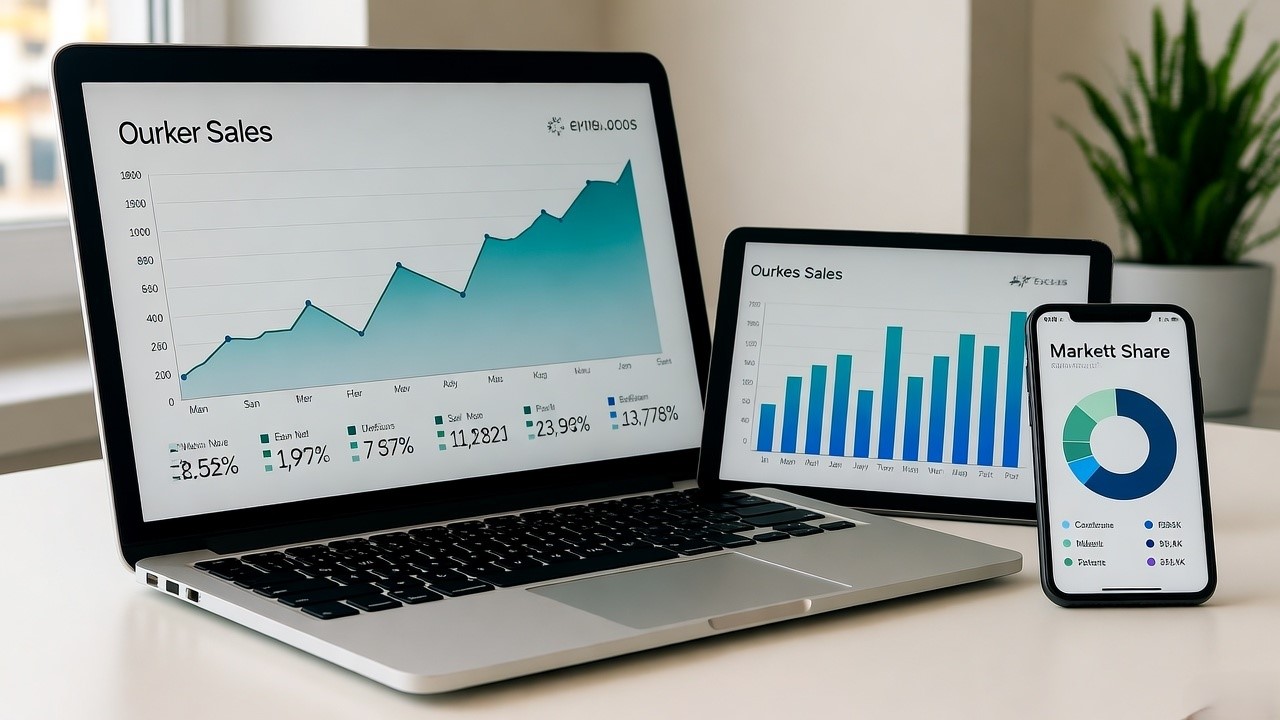
In a highly competitive market like India, where every rupee and every field visit counts, inefficient sales tracking can silently bleed a small business dry. Over my five years consulting on field sales automation, I’ve seen countless Indian SaaS startups and distributors lose 15-20% of potential revenue simply because their sales data lived in scattered spreadsheets and crumpled notebooks. That leakage isn’t just lost money, it’s a signal of a systemic issue that hampers growth.
As a specialist in field sales automation, I approach sales tracking not just as an accounting function, but as the central nervous system of your growth engine. My expertise comes from deploying and refining sales processes for over 50 clients, ranging from U.S. manufacturers launching in Asia to local FMCG distributors in Chennai. I’ve seen first-hand that the difference between a high-growth SME and one that stalls is almost always down to the discipline and clarity of its sales data. This guide will walk you through building a robust, automated system tailored for the realities of small business, with a clear focus on the challenges faced by companies with a dedicated field sales team in markets like India and the U.S.
The most effective way to keep track of sales for a small business is by implementing a simple, centralized Field Sales Automation (SFA) or CRM platform to automatically log all activities, customer data, orders, and pipeline progression in real-time, eliminating manual errors and enabling accurate forecasting.
Why Sales Tracking is the Single Biggest Growth Lever for Indian SaaS Startups
For any small business, particularly Indian SaaS startups navigating rapid scale, sales tracking moves beyond simple bookkeeping; it becomes the source of predictive intelligence. If you don’t track sales meticulously, you’re driving blind, particularly when it comes to key metrics.
In the past, I recall working with a Mumbai-based medical supplies distributor. Their sales team, comprising 12 reps, was using a mix of Excel and WhatsApp to report daily orders. The result? A 7-day delay in pipeline visibility, $15,000 lost monthly due to stock-out errors, and zero insight into which reps were underperforming. This common scenario highlights three critical problems with manual sales tracking that must be overcome:
- Inaccurate Sales Forecasting for Small Business: Without real-time, standardized data, your sales projections are essentially guesswork. This is especially damaging for cash flow management in high-velocity markets like India. When you cannot confidently predict revenue, you cannot make reliable hiring or inventory decisions.
- Zero Visibility into Sales Team Activity Tracking: Are your field reps in Bengaluru spending their time on high-potential clients or just going through the motions? Manual tracking offers no geo-verified proof of visits, time-on-site, or the specific client conversations that move a deal forward. For a business with an on-the-ground team, this lack of field sales team activity tracking is a critical failure point.
- Inconsistent Customer Experience: When customer interaction history is fragmented, a small business loses its personal touch. One rep in Delhi might have critical information on a client’s specific needs that isn’t shared with the account manager or support team, leading to a disjointed, frustrating customer journey.
🛠️ Step-by-Step Guide to Implement Sales Tracking for Small Business
Moving from chaos to clarity requires a structured approach. Based on years of implementation experience, here are the essential steps to setting up a sales tracking system that actually works for a small business.
Defining Your Sales Cycle Stages to Master Sales Pipeline Management
The first, and most neglected, step is to formalize your sales process. This step is non-negotiable for effective sales pipeline management for SMEs. Every lead, regardless of its source (a cold call, a trade show in Pune, or a website form), must pass through the exact same set of stages.
Standardizing the 5 Core Pipeline Stages
- 1. Lead Qualification (QL): The first touchpoint. The goal is to determine if the prospect fits your ideal customer profile (ICP). Tracking Metric: Number of Leads Created.
- 2. Needs Assessment (NA): A discovery call or, more commonly for field sales in India, a physical meeting to understand the prospect’s pain points. Tracking Metric: Qualification Rate (QL to NA).
- 3. Proposal/Demo (PD): Presenting your solution. This should be automated (using templates in your system) to ensure consistency.
- 4. Negotiation/Commitment (NC): Discussing pricing, terms, and closing in on a decision. Tracking Metric: Average Time in Stage.
- 5. Closed-Won/Closed-Lost: The final outcome. Analyzing the lost deals is just as important as celebrating the wins.
For a B2B small business, having clear exit criteria for each stage is vital. For example, a deal only moves from ‘Needs Assessment’ to ‘Proposal/Demo’ once the sales rep has confirmed the prospect’s budget, authority, need, and timeline (BANT). This prevents your pipeline from being clogged with “junk deals.”
Choosing the Right System for Sales Activity and Order Tracking
Small businesses often make the mistake of choosing overly complex, enterprise-grade CRM platforms that require expensive consultants and months of setup. For a growing firm, especially those with a large field presence, simplicity and mobility are paramount.
Criteria for Selecting Small Business Sales Software
The best system for small business order tracking and activity management will meet these three criteria:
- Mobile-First Design (Essential for Field Teams): Your sales reps in the field—whether delivering samples in California or taking orders in the UAE—must be able to log activities and place orders from their mobile device in less than a minute. If they have to wait until they get back to the office, the data will be inaccurate or missed entirely.
- Affordable & Scalable Local Pricing: Look for platforms that offer competitive, tiered pricing suitable for an SME’s budget, with clear paths to scale as your team grows. This is especially relevant for businesses in India looking for a cost-effective sales tracking system.
- Built-in Geo-Verification & Attendance: A crucial feature for field sales automation company clients. The system must use GPS to verify rep check-ins/check-outs at client locations, automatically log travel time, and link it to the customer visit. This feature is non-negotiable for transparent and accurate sales team activity tracking.
Case Study Insight: A client, a quick-service restaurant (QSR) supplier in Hyderabad, saw their rep visit-to-order conversion rate increase by 35% after implementing a mobile SFA with mandatory geo-verified check-ins. The reason? The system weeded out “phantom visits” and forced reps to spend quality time at genuine prospect locations, proving the value of real-time sales rep activity monitoring.
Implementing Crucial Sales Metrics Tracking for Small Business
What you measure dictates what your sales team focuses on. Stop fixating only on Total Revenue and start tracking the leading indicators that drive it. Here are the must-have metrics for any small business looking to improve its sales performance.
Activity and Performance Metrics for Real-Time Insights
| Metric (KPI) | Definition | Why a Small Business Must Track It | Happisales Solution |
| Sales Cycle Length | Average time from Lead Creation to Closed-Won. | Highlights pipeline bottlenecks and sales process efficiency. Critical for sales team activity tracking. | Automatically calculated based on time-stamps in each stage. |
| Win Rate | (Closed-Won Deals / Total Closed Deals) x 100 | The ultimate measure of sales effectiveness and targeting accuracy. | Instantly visible on team and individual dashboards. |
| Average Deal Size | Total Revenue / Total Number of Closed-Won Deals. | Helps qualify leads and ensure reps focus on high-value opportunities. | Calculated by product line, region, and rep for targeted coaching. |
| Field Visit to Order Conversion | (Orders Placed / Total Unique Field Visits) x 100 | The most important KPI for any small business with a field team (like those in India or the U.S.). | Geo-verification ensures visits are real; mobile order placement guarantees instant tracking. |
| Daily Sales Activities Logged | Calls, Emails, Demos, Meetings (Geo-Verified Visits). | A leading indicator of future sales. Ensures reps maintain a consistent, high-effort work rate. | Mandatory field in the mobile app; linked to gamified leaderboards for motivation. |
The Automation Powerhouse: Why Happisales is the Best Software for Small Business Sales Tracking
Based on years of deploying various platforms, I’ve found that generic CRM solutions often overwhelm small businesses. They are too expensive, too complex, and lack the necessary focus on field-level visibility. This is why a targeted Field Sales Automation (SFA) tool, like Happisales, stands out, particularly for the Indian SME and any organization with on-the-ground sales, distribution, or merchandising teams.
Happisales is specifically designed to solve the real-world problems of how to keep track of sales for small business with mobile operations.
Core Advantages of Happisales for Sales Activity Tracking
- Real-Time, Geo-Tagged Activity Logging: Every rep check-in, check-out, and meeting is automatically recorded, verified with GPS, and time-stamped. This eliminates the need for manual reports and provides unassailable proof of performance, directly addressing the challenge of field sales team activity tracking.
- Seamless Mobile Order and Order Tracking: Reps can view real-time stock, create orders, generate digital invoices, and collect payments (including UPI for the Indian market) directly from the mobile app. This ensures instant and accurate small business order tracking from the point of sale.
- Simplified, Unified Sales Pipeline: It brings all your customer data, lead progression, and communication logs into a single, intuitive dashboard. This centralization is crucial for sales pipeline management for SMEs, allowing managers to spot bottlenecks and course-correct instantly.
- Gamification for Motivation: Built-in leaderboards and personalized targets turn daily activities into healthy competition, driving a higher volume of the right activities—a feature that consistently boosts productivity across our client base.
By focusing purely on field sales execution and tracking, Happisales provides enterprise-grade features at a price point and complexity level that is ideal for high-growth small businesses in competitive markets.
📈 Advanced Strategies for Sales Forecasting and Data Integrity
Once you have the system and metrics in place, the focus shifts to using the data to drive smarter decisions. This is where you build genuine expertise and authority.
Leveraging Geo-Personalized Search Results Data in Sales Strategy
For small businesses, especially those targeting a local or regional market (e.g., in a specific U.S. state or an Indian city like Pune), your sales tracking data must align with your geo-marketing strategy.
- Regional Sales Performance Mapping: Use the geo-tracking data from your SFA to overlay sales performance on a map. You might find that your win rate is 50% higher in “Zone A” (e.g., South Delhi) than in “Zone B” (e.g., North Delhi). This allows you to immediately reallocate marketing spend or tailor the sales pitch for the underperforming region.
- Competitor Insight Tracking: Train your field sales team to log competitor activity (pricing, schemes) in the CRM when they are at a client location. By geo-tagging this information, you can build a localized, tactical playbook to counter competitor moves in specific areas, a crucial advantage for any small business competing with larger players.
- Targeting Geo-Modified Keywords: A business tracking sales effectively can confirm that leads originating from specific long-tail keywords (e.g., “best small business order tracking system in India“) have a 2x higher win rate than generic leads. This feedback loop is golden for optimizing marketing investment.
The 3-Step Process for Accurate Sales Forecasting
Forecasting is the pinnacle of effective sales tracking. Use this simple formula:
- Stage Probability: Assign a probability percentage to each pipeline stage (e.g., Qualified Lead: 10%, Proposal: 50%, Negotiation: 80%).
- Weighted Pipeline Value: For every open deal, multiply the Deal Value by its Stage Probability. This gives you the weighted value.
- Example: A $10,000 deal in the ‘Proposal’ stage (50%) has a weighted value of $5,000.
- Forecast: Sum all the weighted values in your pipeline. This number is your most reliable sales forecast for the period.
An advanced SFA like Happisales automates this calculation, providing a real-time, weighted forecast that is invaluable for financial planning, especially for small business order tracking that relies on just-in-time inventory.
💡 People Also Ask: Common Sales Tracking Questions
What is the simplest way to keep track of sales for a very small business?
The simplest way is to use a free or low-cost mobile-first CRM/SFA solution that automates the logging of customer interactions, tracks the sales pipeline (Lead, Proposal, Closed), and enables mobile order entry to ensure real-time data capture without manual data dumps into spreadsheets.
What are the most important sales metrics for a small B2B business to track?
The most important B2B sales metrics are Sales Cycle Length, Win Rate, Customer Acquisition Cost (CAC), and the percentage of revenue from new vs. existing customers, as these directly indicate the efficiency of your sales process and the long-term health of your customer base.
How can I stop my field sales reps from faking visits?
You must implement a field sales automation app with mandatory, real-time GPS-based geo-fencing or check-in/check-out that confirms the rep’s location and time spent at the client site before allowing them to log the visit, which is a core feature of robust field sales team activity tracking.
Is a CRM necessary for sales tracking for a small business?
Yes, a centralized CRM or SFA is essential, as spreadsheets cannot provide real-time pipeline visibility, automate tasks, link all customer history, or offer the analytics needed to scale efficiently, especially for sales pipeline management for SMEs.