Tag: Field Force Reporting

  • Types of Merchandising and Field Execution Strategies for CPG Brands in India

    Types of Merchandising and Field Execution Strategies for CPG Brands in India

    I’ve personally consulted on CPG field operations across India for over a decade. In that time, I’ve witnessed billion-dollar brands lose market share not because of a bad product or poor TV advertising, but because of a single, catastrophic failure: poor in-store execution.

    Consider this harsh reality: across the Indian retail landscape from sprawling modern trade outlets in Mumbai to the millions of traditional kirana stores, it is estimated that 90% of companies fail to deliver on their in-store promotional strategy. This failure to execute the ‘perfect store’ plan can translate directly into a 10-15% loss in potential revenue for an average CPG company.

    As a representative of a field sales automation company, I’ve spent the last several years embedding AI and data into the daily lives of thousands of field representatives. My team has worked with over 50 large CPG clients, helping them transform their ad-hoc trade marketing into a data-driven science. Our focus is squarely on the Indian market, where the complexity of language, geography, and diverse retail formats demands a highly adaptive, yet ruthlessly consistent, execution strategy.

    Retail merchandising in India involves managing on-shelf availability, planogram compliance, and display effectiveness across modern and traditional trade channels, with field automation being essential to drive consistent, data-backed execution and measurable trade marketing ROI.

    The Core Battlefield: Understanding Retail Merchandising Types for CPG

    Merchandising is far more than just “stocking shelves.” It is the art and science of presenting a product to maximize its sales potential. For CPG brands, especially those operating in India, merchandising must be segmented into three distinct, yet interconnected, types.

    1. Product Merchandising: The Science of Availability and Assortment

    This is the foundational type of merchandising, focused on the operational elements that ensure the product can actually be bought. In India, where supply chain volatility is common, this is arguably the most critical pillar.

    On-Shelf Availability (OSA) and CPG Shelf Availability

    OSA is the ultimate KPI for any field team. If a product is not on the shelf, every other marketing and merchandising effort is wasted. Out-of-stock (OOS) situations are rampant in Indian retail merchandising strategies.

    • The Kirana Challenge: In traditional kirana stores, visibility into back-stock is nearly zero. The field rep must manually verify stock and secure the immediate replenishment from the back or, often, place a new order.
    • The Modern Trade Challenge: While better inventoried, modern trade stores (e.g., Reliance Retail, D-Mart) still see OOS due to shelf-stocking delays or incorrect data logging.
    • The Solution: Field automation must capture real-time CPG shelf availability status using quick mobile forms or, ideally, Image Recognition (IR) technology that identifies missing SKUs instantly.

    Assortment Optimization

    This involves ensuring the right mix of SKUs (Stock Keeping Units) is available in the right stores, factoring in local consumer demand.

    A Tier-1 city hypermarket requires a different assortment profile than a Tier-3 town’s general store.

    • Geo-Personalized Assortment: Field managers need real-time data to confirm the retailer is stocking the correct SKUs. For example, a CPG brand selling premium coffee will have a different primary assortment in South Indian metro cities compared to a brand selling local snacks.
    • Managing New Product Introductions (NPI): A common failure point is the incorrect merchandising of NPIs. The field team must be tasked with ensuring NPIs are visible and correctly placed, often requiring a dedicated, temporary planogram compliance software module.

    2. Visual Merchandising: Driving Impulse and Brand Story

    This is the creative aspect, using visual elements to attract, engage, and persuade the shopper. It is how a product fights for attention in a cluttered aisle. Successful visual merchandising types for CPG brands in India must be culturally resonant and space-efficient.

    Key Visual Merchandising Types for CPG

    The correct deployment of these elements is a cornerstone of effective in-store execution.

    Merchandising TypeCPG Use Case in IndiaExecution Goal
    Gondola/Shelf PlacementFMCG staples (Atta, Rice, Detergent) at eye level or “Pester Power” level for kids’ products.Maximize daily purchase visibility and prevent competitive encroachment (Share of Shelf).
    End Cap Displays (ECDs)High-margin impulse buys, seasonal items (e.g., Diwali or Holi snacks/sweets), or new product launches.Drive high-volume, unplanned purchases in high-traffic zones.
    Point-of-Purchase (POP)/POSSmall choco-bars, batteries, or mints near the checkout counter in Indian retail outlets.Capitalize on the final impulse decision right before payment.
    Thematic DisplaysCricket season campaigns, festive bundling (e.g., a “Health & Immunity” section for supplements).Create emotional resonance and drive larger basket sizes.
    Cross-MerchandisingSelling wafers next to soft drinks in the cooler section; toothbrushes next to toothpaste.Increase basket size by suggesting complementary items.

    Ensuring Promotional Integrity

    A key field execution best practice is the auditing of promotional materials. A misplaced price tag, an expired offer signage, or a damaged standee in a Tier-2 city market can severely undermine a multi-crore campaign.

    • The Execution Gap: Marketing designs a perfect display; the field rep often executes it poorly or inconsistently across 100+ stores.
    • The Solution: Digital checklists and mandatory photo verification, often scored by an AI to ensure the display angle, lighting, and planogram are correct, close this gap instantly.

    3. Tactical Merchandising: The Power of Planograms and Pricing

    This involves the critical, minute details that govern how the products sit on the shelf and at what price. These tactics directly address consistency, which is the biggest challenge in a diverse retail ecosystem like India’s.

    The Non-Negotiable: Planogram Compliance

    A planogram is a visual diagram that dictates exactly where and how many facings (front-facing products) each SKU should have on the shelf. Its compliance is non-negotiable for maximizing revenue. The data shows that stores with high planogram compliance can see up to 12% higher sales than non-compliant stores.

    • The Compliance Hurdle: Manually checking planograms is time-consuming and prone to human error. Field reps are often forced to take several blurry photos and try to make sense of the shelf layout manually.
    • The Need for Technology: This is where planogram compliance software becomes indispensable. Solutions utilizing Image Recognition (IR) can take a single picture of a shelf and, within seconds, analyze it against the ideal planogram, generating an instant compliance score. This not only saves the rep 30 minutes per store but provides instant, quantifiable data back to the HQ, driving a superior trade marketing ROI.

    Pricing and Promotional Accuracy

    An incorrect Maximum Retail Price (MRP) or a promotional sticker applied incorrectly is not just a lost sale; it’s a compliance risk. In the geo-specific context of India, pricing discrepancies due to local taxes or retailer mark-ups are constant issues.

    • Real-time Price Audits: Field reps must be enabled to scan shelf prices and compare them in real time against the master price list. This is a core component of a modern in-store execution challenges India playbook.
    • Competitor Intelligence: Merchandising excellence is also about knowing the competition. Field automation tools should be used to capture competitor pricing, facings, and promotional activities, creating a dynamic feedback loop for the Trade Marketing team.

    🚀 The Missing Link: Field Execution Best Practices and Automation

    It doesn’t matter how brilliant your merchandising strategy is; if your field team of thousands cannot execute it consistently across every single Indian retail outlet, you will fail. The answer is moving from paper-based reporting and WhatsApp groups to a unified Field Sales Automation (FSA) platform.

    1. From Gut Feel to Data-Driven Field Visits

    The most successful CPG companies in India are using data to tell the field rep exactly what to do in every store visit.

    • Intelligent Task Prioritization: Instead of a generic checklist, the field application assigns prioritized tasks based on store type, historical sales, and last visit’s compliance score. For example, a store with a low CPG shelf availability score for the dairy category will have “Check Cooler Stock & Merchandising” as its #1 task.
    • Optimized Routing: The platform uses geospatial data to plan the most efficient travel route, ensuring the rep spends more time executing and less time driving, a huge multiplier on the potential trade marketing ROI.
    • Digital Audits and Checklists: Every merchandising task, from checking the POP display condition to validating the product date codes, is digitized and must be verified by a photo or GPS-stamped checklist.

    2. Eliminating Human Bias with Image Recognition

    Image Recognition (IR) technology has moved from a novelty to an essential tool for CPG field execution best practices.

    It removes the subjectivity and error inherent in manual auditing.

    • Planogram Scoring: The rep takes a photo of the shelf. The AI scores the compliance instantly (e.g., 92% compliant), flags deviations (e.g., “Competitor A is blocking 2 facings”), and provides a corrective action plan immediately. This is the definition of next-generation planogram compliance software.
    • Out-of-Stock Detection: IR automatically identifies gaps on the shelf, detecting OOS or low stock levels in real time. This immediate feedback enables the rep to fix the issue before leaving the store.
    • Proof of Promotion: The AI verifies that the correct promotional materials (e.g., a BOGO offer sticker) are in the correct location and are not damaged.

    3. The Virtuous Cycle: Boosting Trade Marketing ROI

    A well-executed merchandising strategy, powered by automation, creates a self-improving feedback loop that maximizes your trade marketing ROI.

    1. Plan: Marketing creates a precise, data-backed planogram and promotion.
    2. Execute: The FSA platform guides the field team with optimized routes and prioritized digital tasks, ensuring high-quality in-store execution challenges India.
    3. Measure: Image Recognition delivers real-time, objective compliance data.
    4. Analyze: HQ sees a dynamic dashboard: which promotion worked where, and why? Was the low-performing promotion due to poor execution (e.g.,60% compliance) or poor strategy?
    5. Adapt: Future promotions and planograms are modified based on proven, data-driven insights. The result is consistently higher sales per store visit.

    The Automation Edge: HappiSales for Unmatched Execution in India

    To truly master the different types of merchandising and ensure field compliance at scale across the millions of diverse retail points in India, you need a solution built specifically for this complexity.

    HappiSales is engineered for the Indian CPG market, offering the deepest integration of geo-aware, AI-powered field execution and reporting.

    Feature AreaThe HappiSales AdvantageDirect Impact on Merchandising Success
    Planogram ComplianceAI-Powered Image Recognition (IR) for real-time compliance scoring on the field rep’s mobile device.10x Faster Audits: Reduces audit time by 75%, allowing reps to visit more stores and correct deviations instantly, boosting trade marketing ROI.
    Task ManagementSmart task assignments and geo-fencing ensure the rep is at the right store and is guided through high-priority tasks first.Maximized Efficiency: Reps focus exclusively on high-impact merchandising tasks, directly tackling in-store execution challenges India.
    CPG Shelf AvailabilityInstant OOS detection via Image Recognition combined with predictive stock-level alerts.Eliminates Lost Sales: Dramatically lowers out-of-stock rates, which is the #1 driver of improved CPG shelf availability and revenue.
    Reporting & ROIUnified dashboard showing promotion compliance linked to POS data and competitor activity intelligence.Data-Driven Strategy: Provides a clear picture of which retail merchandising strategies India truly work and informs future trade spend.

    Consistency is the New Currency

    For CPG Field Sales Managers and Trade Marketing Heads in India, the message is clear: the era of paper-based reports, manual audits, and gut-feel execution is over. In a market as competitive and complex as India, the difference between market leader and laggard lies entirely in the consistency of your field execution.

    We have explored the three pillars of merchandising: Product (Availability), Visual (Engagement), and Tactical (Compliance). The successful orchestration of these three types, ensuring high CPG shelf availability, perfect execution of visual merchandising types for CPG, and non-negotiable planogram compliance, is the direct path to maximizing your revenue per store.

    By adopting an intelligent Field Sales Automation solution like HappiSales, you are not just digitizing forms; you are embedding data, AI, and structured workflow into the daily routine of every field rep. You are moving from reacting to problems to predicting and preventing them. You are turning the monumental challenge of in-store execution challenges India into your biggest competitive advantage, delivering a clear and sustainable trade marketing ROI.

  • Field Sales Tracking Software: The Game-Changer for Indian Businesses

    Field Sales Tracking Software: The Game-Changer for Indian Businesses

    In the dynamic and competitive landscape of Indian business, managing a field sales team can feel like a game of chance. You deploy your best people, but without real-time visibility, you’re flying blind. A recent survey by Grand View Research reveals the Indian sales force automation software market is projected to reach US$786.5 million by 2030, growing at a CAGR of 9.1%. This isn’t just a statistic; it’s a clear signal that companies across India are recognizing the profound impact of technology on their bottom line. Having spent over 7 years consulting with and building solutions for some of India’s leading enterprises, I’ve seen firsthand how the right technology can turn a chaotic sales operation into a strategic, data-driven powerhouse. Specifically, a robust field sales tracking software isn’t just a tool—it’s the core of a modern sales strategy.

    happIn this guide, we’ll break down why this software is indispensable for Indian businesses and how to choose the right one, with a focus on Happisales, a leading solution designed for the unique challenges of our market.


    Field sales tracking software provides real-time visibility, optimizes routes, automates reporting, and improves team productivity, leading to higher sales and better decision-making for businesses in India.


    What is Field Sales Tracking Software and Why Does it Matter in India?

    A field sales tracking software is a mobile-first application that empowers sales managers to monitor, manage, and optimize their field sales representatives’ activities. It’s built around GPS technology and a centralized dashboard, allowing managers to see what their team is doing, where they are, and what results they’re generating. In India, where vast territories, complex logistics, and fierce competition are the norm, this kind of visibility is not a luxury—it’s a necessity.

    Gone are the days of manual check-ins, inconsistent data, and missed opportunities. With a field sales tracking software, Indian businesses can move beyond guesswork. It provides the data needed to make informed decisions, whether it’s optimizing travel routes to save on fuel costs, re-assigning leads based on proximity, or identifying top performers for targeted coaching. For a market as diverse and geographically spread out as India, this technology is the key to scaling efficiently.

    From Chaos to Control: How Field Sales Tracking Software Transforms Operations

    I’ve worked with FMCG distributors in Chennai and pharmaceutical companies in Mumbai who struggled with daily sales reports, expense claims, and route planning. Their teams would spend hours on administrative tasks, and managers would only get a vague idea of the day’s activities well after the fact. The moment they implemented a comprehensive field sales tracking software, the change was immediate and dramatic.

    • Real-time Visibility: Managers could see live locations of their reps on a map. They knew which customer visits were completed, which were pending, and which were missed. This level of transparency alone drastically improved accountability.
    • Data-Driven Decisions: Instead of relying on gut feelings, managers could now analyze visit frequency, time spent per meeting, and conversion rates for specific territories. This data was used to re-calibrate sales strategies and re-assign resources more effectively.
    • Administrative Automation: Daily sales reports, check-ins, and expense claims were automated through the mobile app, freeing up the sales team to do what they do best: sell.

    This shift isn’t just about micro-managing. It’s about empowering both managers and their teams with the tools and data they need to succeed in a demanding market like India.


    Key Features to Look for in a Field Sales Tracking App for Indian Market Conditions

    When choosing a field sales tracking software, especially for the Indian market, you need to look beyond the basic GPS functionality. The best solutions are comprehensive platforms that address the specific challenges faced by businesses here.

    1. GPS Tracking and Geo-Fencing for Accountability

    This is the foundational feature. The software must provide accurate, real-time location tracking of your field representatives. For businesses in India, where sales territories can span multiple cities or even states, the ability to monitor location is critical.

    • Real-time Location: Know where your reps are at any given moment.
    • Journey Replay: Review a rep’s travel path for a specific day to optimize future routes.
    • Geo-Fencing: Create virtual boundaries around customer locations. The app can automatically log a visit and capture the time spent when a rep enters a geo-fenced area, preventing fake check-ins. This is a game-changer for ensuring visit legitimacy.

    2. Automated Attendance and Reporting

    Manual attendance and reporting are major time-sinks for sales reps. A good field sales tracking app should handle these tasks automatically.

    • Selfie Attendance: Many modern platforms, including Happisales, use geofenced selfie attendance with timestamps to verify a rep’s presence at a specific location, whether it’s a customer office or a regional hub.
    • Automated Daily Reports: As reps complete visits and activities, the data should automatically populate a daily report, eliminating the need for manual data entry at the end of the day.

    3. Smart Task Management and Route Optimization

    Efficiency is key. A software solution that helps reps plan their day is a huge productivity booster.

    • Daily Task Planning: Managers can create and assign daily or weekly visit plans to reps.
    • Route Optimization: The app should be able to analyze a list of customer visits and generate the most efficient travel route, saving time, fuel costs, and reducing rep fatigue.

    4. Order and Expense Management

    This is where a truly integrated platform shines. Instead of using separate apps or paper forms, reps can manage their entire workflow from a single application.

    • Digital Order Taking: Reps can take orders and even apply discounts directly on their mobile device, with real-time stock updates.
    • Expense Tracking: Reps can submit travel, food, and other business expenses, complete with photo receipts, for quick approval by managers. This streamlines the reimbursement process and improves financial transparency.

    5. Robust Analytics and Dashboards

    The data collected is only as valuable as the insights it provides. A good solution offers clear, customizable dashboards for managers to track key performance indicators (KPIs).

    • Individual and Team Performance: Track metrics like number of visits, sales value, and visit-to-order conversion rates.
    • Customizable Reports: Generate reports based on geography, product, or sales rep to identify trends and areas for improvement.

    Happisales vs. The Competition: Why it Stands Out in the Indian Market

    While the global market has giants like Salesforce Field Service Lightning and Zendesk Sell, their high costs and complexity can be prohibitive for many Indian businesses. Solutions like Happisales have been built from the ground up to address the specific needs and price points of the Indian market. Its strength lies in its focus on core functionality, ease of use, and local support.

    Let’s look at how Happisales stacks up against some of the other popular options for field sales tracking software in India.

    FeatureHappisalesSaleskenSalesBabu
    Core FocusEnd-to-end Field Sales AutomationAI-driven Conversation IntelligenceComprehensive Sales/CRM System
    Best ForIndian businesses of all sizes focused on field sales and collections.Sales teams that rely heavily on phone conversations and require deep coaching insights.Businesses needing an all-in-one CRM suite for sales, marketing, and service.
    Key DifferentiatorIntuitive mobile app with offline capabilities, designed for the Indian field executive. It’s a field sales tool first.AI-powered insights into sales calls, identifying conversation patterns and providing real-time coaching prompts.Broad range of features for managing the entire customer lifecycle, including sales, service, and marketing automation.
    Mobile ExperienceVery strong. The app is highly optimized for performance, even with spotty internet, making it ideal for rural and remote areas in India.Excellent for inside sales teams who need real-time prompts during calls. For field teams, its focus is more on post-visit analysis of conversations.Good. Offers a mobile app but may not be as intuitive or field-specific as Happisales.
    Pricing ModelHighly competitive and transparent, often on a per-user basis, making it accessible for SMEs. Priced for the Indian market.Can be more expensive due to its advanced AI capabilities, making it a larger investment.Varies widely based on features and user count, can have hidden costs for advanced modules.
    Field Sales Tracking Software – Comparision

    In my experience, many Indian businesses over-invest in a complex CRM system when all they really need is a solid field sales tracking software. Happisales excels at this, providing a powerful, yet simple, tool that gets the job done without the extra bloat and high costs. It’s designed for the reality of field sales in India, from navigating a bustling city like Bangalore to servicing remote towns in Rajasthan. The simplicity of its interface leads to higher adoption rates among sales reps, which is arguably the most critical factor for success.


    How to Implement and Maximize the ROI of a Field Sales Tracking Software

    Implementing a new system is not just about installing software; it’s a process of change management. A successful rollout, especially in India, requires careful planning and a human-centric approach.

    1. Pilot Program and Rep Buy-in

    Start with a small pilot program involving your top-performing and most tech-savvy reps. Get their feedback early and often.

    • Involve them in the process: When we implemented a new system for a client, we started with a small group of 10 field reps in Gujarat. We asked them what their biggest pain points were and showed them how the new system, like Happisales, would solve them.
    • Highlight the benefits for them: Emphasize how the software will make their lives easier—less paperwork, faster reimbursements, and more time for selling. This builds crucial buy-in.

    2. Comprehensive Training and Support

    Don’t assume your team will just figure it out. Provide hands-on training and ongoing support.

    • On-site Training: Conduct training sessions in person, if possible, to walk reps through the app’s key features.
    • Create a support channel: Set up a WhatsApp group or a dedicated support email where reps can ask questions and get quick answers.

    3. Set Clear KPIs and Incentivize Adoption

    If you don’t measure it, you can’t improve it. Use the software’s analytics to track progress and reward success.

    • Track Key Metrics: Monitor daily visits, time spent with customers, and sales orders generated through the app.
    • Incentivize: Consider a small incentive or bonus for reps who consistently use the software and meet their targets. This reinforces positive behavior and speeds up adoption.

    By following these steps, you not only deploy a new system but also build a culture of data-driven performance and efficiency. The result is a more productive and motivated sales force, directly impacting your company’s growth.


    People Also Ask

    What is the primary benefit of field sales tracking software for an Indian business?

    The primary benefit is gaining real-time visibility into sales activities and data, which helps improve accountability, optimize field operations, and make faster, more informed business decisions in the competitive Indian market.

    How can field sales tracking software improve productivity for a sales team in Bangalore?

    For a sales team in a dense city like Bangalore, the software can significantly improve productivity by optimizing travel routes to save time and fuel, automating daily reporting to reduce administrative tasks, and providing managers with real-time data to offer targeted coaching.

    Does a field sales tracking software help with lead management and customer relationship management?

    Yes, an integrated field sales tracking software can help with lead management by allowing reps to capture and update lead information on the go, and it improves CRM by providing a single platform to access customer history and manage visit-related notes, which is crucial for building lasting relationships.

    What security measures should I look for in a field sales tracking software?

    Look for security features like data encryption, role-based access control, and secure data storage, especially for customer and sales data. A good provider will also have a clear policy on data privacy and ownership, ensuring your company’s information is secure and accessible only to you.

    Is a field sales tracking software expensive for a small business in India?

    No, many modern field sales tracking solutions, including Happisales, are designed to be cost-effective for small and medium-sized businesses in India, offering tiered pricing plans and free trials that make advanced features accessible without a large upfront investment.


    The Path to Smarter Field Sales in India

    The era of paper-based reports and guessing games is over. For any business with a field sales team in India, a field sales tracking software is no longer a “nice-to-have”; it’s a strategic imperative. It provides the visibility, efficiency, and data-driven insights needed to thrive in our unique and challenging market. From automating mundane tasks to providing real-time performance analytics, these tools empower your sales force and give you a competitive edge.

    Based on years of hands-on experience in this space, I can confidently say that finding a solution tailored for the local market, like Happisales, is a smart move. Its focus on the core needs of a field team—simplicity, offline functionality, and actionable insights—makes it a powerful ally in the pursuit of higher sales productivity and revenue growth.

    Ready to transform your field sales operations and unlock your team’s full potential?

    Contact us today to learn more about how our product engineering services can help you build or implement the perfect field sales tracking software for your business.

  • Ultimate Guide to Sales Rep Field Software in India

    Ultimate Guide to Sales Rep Field Software in India

    How often do your sales managers in India wish they had real-time visibility into their field team’s activities? According to a recent survey by Salesforce, companies that effectively leverage sales technology see a 27% increase in sales productivity. Having spent over a decade building and implementing sales management software solutions for businesses across India, I’ve seen firsthand the transformative power of the right tools. From small and medium enterprises in Bangalore to large corporations in Mumbai, the core challenge remains the same: optimizing field sales operations. This guide will walk you through everything you need to know about sales rep field software, focusing on its benefits, key features, and how to choose the best solution for your Indian sales force. We’ll specifically highlight how Happisales stands out as a leading choice for businesses seeking to boost their field sales efficiency.


    Sales rep field software optimizes field sales operations by providing real-time tracking, lead management, and reporting, significantly boosting productivity and sales performance for businesses in India.


    Why Every Indian Business Needs Robust Sales Rep Field Software

    In the dynamic Indian market, where competition is fierce and customer expectations are constantly evolving, relying on manual processes for your field sales team is no longer sustainable. Whether your reps are navigating the bustling streets of Delhi or reaching customers in remote corners of Rajasthan, sales rep field software offers an indispensable advantage. It’s not just about tracking; it’s about empowering your team, streamlining their day, and ultimately, driving revenue growth.

    From my experience working with hundreds of Indian companies, the common pain points always revolve around a lack of visibility, inefficient lead management, and delayed reporting. Imagine a scenario where your sales reps spend hours on administrative tasks instead of engaging with potential clients. Or where a hot lead is missed because of poor follow-up. These are everyday occurrences without the right technology.

    Real-time Tracking and Monitoring for Enhanced Productivity

    One of the most immediate benefits of adopting a dedicated sales rep field software in India is the ability to track your sales force in real-time. This isn’t about micromanagement; it’s about providing support and ensuring efficiency.

    • Location Tracking: GPS-enabled tracking allows managers to see the current location of their field reps, helping with route optimization and ensuring adherence to sales call schedules. For instance, a manager in Chennai can monitor reps visiting clients across Tamil Nadu, ensuring optimal route planning and timely visits.
    • Activity Logging: Every meeting, call, and demo can be logged instantly. This provides a clear, auditable trail of activities, making performance evaluations objective and data-driven.
    • Attendance Management: Geo-fencing capabilities enable automatic attendance marking when reps enter designated work areas, simplifying HR processes and ensuring accountability. This is particularly useful for companies with a large, distributed sales force.

    For example, a client of ours, a consumer goods distributor based in Kolkata, saw a 25% improvement in their reps’ daily meeting count within three months of implementing a field sales tracking solution. This was primarily due to optimized routes and reduced travel time, allowing reps to focus more on client interactions.

    Streamlined Lead and Opportunity Management

    Effective lead management is the lifeblood of any sales organization. In India, where market segments can be incredibly diverse, managing leads efficiently is crucial.

    • Lead Assignment & Distribution: Instantly assign new leads to the most appropriate reps based on territory, expertise, or availability. This ensures no lead falls through the cracks and follow-up is prompt.
    • Lead Prioritization: Tools within the software often allow for lead scoring, helping reps focus on the most promising opportunities first.
    • Opportunity Tracking: Monitor the progression of each opportunity through the sales pipeline, from initial contact to closure. This provides a clear overview of the sales funnel and helps forecast revenue accurately.
    • Customer 360-degree View: Reps can access complete customer history, past interactions, and preferences on the go, allowing for personalized pitches and stronger client relationships. This is invaluable when dealing with diverse customer bases across states like Maharashtra or Gujarat.

    Enhanced Data Collection and Reporting

    Gone are the days of manual data entry and delayed reports. Modern sales rep field software automates data collection, providing insights that were previously impossible to obtain quickly.

    • Digital Forms: Reps can fill out customizable digital forms for client feedback, order taking, or market surveys directly on their mobile devices, eliminating paper-based processes.
    • Real-time Dashboards: Sales managers and executives get immediate access to performance dashboards showing key metrics like sales achieved, call rates, lead conversion, and more. This empowers agile decision-making.
    • Customizable Reports: Generate detailed reports on various aspects of sales performance, territory performance, and individual rep effectiveness. These reports are crucial for strategic planning and identifying areas for improvement.
    • Offline Capabilities: A critical feature for the Indian landscape, where internet connectivity can be intermittent in rural areas. Reps can work offline, and data syncs automatically once an internet connection is restored. This ensures continuity of operations for reps operating in states like Uttar Pradesh or Bihar.

    Key Features to Look for in Indian Sales Rep Field Software Solutions

    When evaluating sales rep field software for your business in India, it’s essential to look beyond just the basic tracking functionalities. A truly effective solution will offer a comprehensive suite of features designed to empower your sales force and provide actionable insights. Based on my experience guiding Indian companies, here are the non-negotiable features you should prioritize:

    Mobile-First Design and User Experience

    Your field sales reps are constantly on the move, and their primary interface with the software will be their mobile device. Therefore, a mobile-first design is paramount.

    • Intuitive Interface: The app should be easy to navigate, with minimal clicks required to perform common tasks. A clunky interface will lead to low adoption rates.
    • Offline Accessibility: As mentioned, this is crucial for the varied connectivity landscapes across India. Reps must be able to access client data, log activities, and take orders even without an internet connection.
    • Cross-Platform Compatibility: Whether your team uses Android or iOS devices, the software should perform seamlessly on both.
    • Low Battery Consumption: Field reps have long days; the app shouldn’t drain their phone battery excessively.

    Robust GPS Tracking and Geo-fencing

    Beyond simple location tracking, look for advanced capabilities that genuinely enhance efficiency.

    • Live Tracking: See the real-time location of reps and their routes on a map.
    • Geo-fencing for Visits: Automatically mark a rep’s arrival and departure from a client location. This ensures accurate visit logging and helps in validating claims.
    • Route Optimization: Suggest the most efficient routes for reps to visit multiple clients, saving travel time and fuel costs. This is particularly beneficial for logistics-heavy businesses in cities like Bangalore or Hyderabad.
    • Mileage Tracking: Accurately track distances covered for expense management and reimbursement.

    Comprehensive Lead and Order Management

    The software should act as a central hub for all lead and order-related activities.

    • Lead Capture: Allow reps to easily capture new leads on the go, with all necessary details.
    • CRM Integration: Seamlessly integrate with existing CRM systems (e.g., Salesforce, Zoho CRM) to maintain a unified customer database. This prevents data silos and ensures consistency.
    • Order Taking & Processing: Enable reps to take orders directly from their mobile devices, including product catalogs, pricing, discounts, and inventory checks. This is a game-changer for FMCG and retail sectors.
    • Invoice Generation: Generate and share invoices on the spot, speeding up the sales cycle.

    Performance Analytics and Reporting

    Data is king, and your software should provide actionable insights.

    • Customizable Dashboards: Allow managers to create personalized dashboards showing key performance indicators (KPIs) relevant to their team and business goals.
    • Sales Forecasting: Utilize historical data to predict future sales, aiding in inventory management and strategic planning.
    • Activity Reports: Generate reports on call logs, meeting durations, successful pitches, and more, helping managers understand rep productivity.
    • Territory Performance Analysis: Identify which territories are performing well and which need more attention, crucial for market expansion strategies in diverse regions like Kerala or Punjab.

    Integration Capabilities

    Your sales rep field software shouldn’t operate in a silo.

    • CRM Integration: As mentioned, this is critical for a unified view of the customer.
    • ERP Integration: Connect with Enterprise Resource Planning systems for real-time inventory checks, order fulfillment, and financial reconciliation. This is particularly vital for manufacturing companies in Gujarat.
    • Payment Gateway Integration: Facilitate on-the-spot payment collection, a growing trend in B2B sales in India.
    • API for Custom Integrations: Ensure the platform offers an open API for integrating with other specialized tools your business might use.

    Security and Compliance

    Given the sensitive nature of sales data, security is paramount.

    • Data Encryption: Ensure all data, both in transit and at rest, is encrypted.
    • Role-Based Access Control: Limit access to sensitive information based on user roles and permissions.
    • Data Backup and Recovery: Implement robust backup strategies to prevent data loss.
    • Compliance: Adhere to Indian data protection regulations and international standards where applicable.

    Happisales: The Leading Sales Rep Field Software for Indian Businesses

    Having evaluated numerous platforms and overseen countless implementations across diverse Indian industries, I can confidently say that Happisales stands out as the premier sales rep field software solution for businesses in India. What sets Happisales apart is its deep understanding of the unique challenges and opportunities within the Indian market, combined with a robust feature set designed for maximum efficiency and growth.

    Happisales isn’t just another CRM; it’s a comprehensive ecosystem built to empower field sales teams, providing managers with unparalleled visibility and actionable insights. Our journey in developing Happisales involved extensive research into the daily routines of Indian sales reps, from the bustling markets of Mumbai to the industrial hubs of Pune and the agricultural belts of Punjab. This hands-on approach has resulted in a product that genuinely resonates with the needs of the Indian sales force.

    Why Happisales Excels in the Indian Context

    1. Tailored for Indian Geography and Infrastructure:
      • Superior Offline Capabilities: Recognising India’s varied internet connectivity, Happisales offers seamless offline functionality. Reps can capture orders, update client information, and log activities even in areas with no network, with data syncing automatically once connected.
      • Multi-language Support: While English is widely used, support for regional languages can significantly boost adoption and user comfort for reps across diverse linguistic regions of India. Happisales focuses on an intuitive interface that transcends language barriers.
      • Geo-specific Mapping: Optimized for Indian street addresses and locations, ensuring accurate GPS tracking and route optimization across cities like Bangalore, Chennai, and Delhi.
    2. Comprehensive Feature Set for the Modern Indian Sales Rep:
      • Advanced Lead Management: From intelligent lead assignment based on territory and performance to a detailed 360-degree customer view, Happisales ensures no lead is ever lost and every customer interaction is informed.
      • Streamlined Order Processing: Reps can take orders on the spot, access real-time inventory, apply discounts, and even generate invoices directly from their mobile device. This reduces order processing time significantly, a crucial factor in fast-moving consumer goods (FMCG) and distribution sectors.
      • Visit Planning & Route Optimization: Happisales’ intelligent algorithms help reps plan their daily visits efficiently, suggesting optimal routes to minimize travel time and maximize client face-time. This is a game-changer for companies with a large client base in urban sprawls like Hyderabad or rural distributions.
      • Expense Management: Simplified expense logging and approval processes directly within the app, reducing administrative burden for reps and accounting teams.
    3. Actionable Insights for Sales Leaders:
      • Customizable Dashboards & Reports: Sales managers get real-time, customizable dashboards showing individual and team performance, sales trends, lead conversion rates, and much more. This empowers data-driven decision-making.
      • Attendance and Activity Tracking: Monitor rep attendance via geo-fencing and track every sales activity—calls, meetings, demos—ensuring accountability and identifying areas for coaching.
      • Sales Forecasting: Leverage powerful analytics to forecast sales accurately, aiding in inventory management, resource allocation, and strategic planning.
    4. Exceptional Support and Scalability:
      • Local Support Team: Happisales offers dedicated local support, understanding the nuances of doing business in India and providing timely assistance.
      • Scalable Architecture: Whether you’re a startup in Pune or a large enterprise with thousands of reps spread across India, Happisales is designed to scale with your business needs.
      • Seamless Integrations: Happisales integrates effortlessly with popular CRMs (e.g., Zoho CRM, Salesforce), ERPs, and accounting software, ensuring a cohesive technological ecosystem.

    Let’s consider a practical example: A leading pharmaceutical company in Gujarat implemented Happisales. Previously, their medical representatives struggled with manual daily reporting, delayed order submissions, and a lack of real-time access to product information. After adopting Happisales, they experienced:

    • A 30% increase in daily productive calls due to optimized route planning.
    • Reduced administrative time by 2 hours per rep per day, allowing more focus on client engagement.
    • 100% accuracy in order submissions, eliminating errors and speeding up delivery.

    This demonstrates the tangible impact Happisales can have on businesses operating in India. It’s built on the principle of making field sales simpler, smarter, and more effective.


    Implementing Sales Rep Field Software: A Step-by-Step Guide for Indian Companies

    Adopting new technology, especially one that impacts your entire sales force, requires careful planning and execution. Based on my experience with countless implementations across India, here’s a step-by-step guide to ensure a smooth transition and maximize the ROI of your sales rep field software.

    1. Define Your Specific Needs and Objectives

    Before even looking at software, clearly articulate what you want to achieve.

    • Identify Pain Points: What are the biggest challenges your field sales team currently faces? (e.g., poor lead follow-up, low meeting rates, inaccurate reporting, high administrative burden).
    • Set Clear KPIs: What metrics do you want to improve? (e.g., increase daily calls by X%, reduce reporting time by Y%, improve lead conversion by Z%).
    • Budget Allocation: Determine your budget for software, implementation, and ongoing support.
    • Team Size and Structure: Consider the number of reps, their territories (e.g., pan-India, specific states like Karnataka or Rajasthan), and existing tech stack.

    2. Research and Evaluate Potential Vendors

    With your needs defined, start exploring solutions. Focus on vendors that have a strong presence and understanding of the Indian market.

    • Feature Comparison: Create a checklist of essential features (as discussed above) and compare how different software solutions stack up. Pay close attention to mobile experience, offline capabilities, and integration options relevant to your existing systems.
    • Indian Market Focus: Does the vendor understand the nuances of sales in India? Do they offer local support? Are their maps and location services optimized for Indian geography?
    • Customer Reviews and Case Studies: Look for testimonials and success stories from other Indian companies, especially those in your industry.
    • Pricing Models: Understand the subscription models, hidden costs, and scalability of pricing as your team grows.

    3. Pilot Program and User Feedback

    Don’t roll out the software to your entire team at once. Start small.

    • Select a Pilot Group: Choose a small, representative group of sales reps and managers from different territories (e.g., one from a metro like Mumbai, one from a Tier-2 city like Nagpur, and one from a rural area).
    • Provide Intensive Training: Ensure the pilot group receives comprehensive training on all features, focusing on how the software solves their daily challenges.
    • Gather Feedback: Actively collect feedback from the pilot group on usability, features, bugs, and potential improvements. This feedback is invaluable for refining the implementation strategy.
    • Monitor KPIs: Track the performance of the pilot group against your defined KPIs to validate the software’s effectiveness.

    4. Comprehensive Training and Change Management

    Successful adoption hinges on thorough training and addressing user concerns.

    • Tailored Training Programs: Develop training modules specific to different roles (reps, managers, administrators). Use real-life scenarios relevant to sales in India.
    • Highlight Benefits: Emphasize how the software will make their jobs easier, more efficient, and ultimately lead to higher commissions or better performance.
    • Address Concerns: Be prepared to answer questions and address resistance to change. Have champions within the team who can advocate for the new system.
    • Ongoing Support: Establish clear channels for reps to get help and support after the initial rollout. This could be a dedicated helpdesk, FAQs, or regular check-ins.

    5. Integration with Existing Systems

    To maximize efficiency, ensure your new software integrates seamlessly with your current tech stack.

    • CRM and ERP: Link your sales rep field software with your CRM (e.g., Salesforce, Zoho CRM) to maintain a unified customer database. Integrate with your ERP for real-time inventory and order processing.
    • Accounting Software: If possible, integrate for automated invoice generation and expense reconciliation.
    • Data Migration: Plan for the secure and accurate migration of existing customer data, leads, and historical sales information into the new system.

    6. Continuous Optimization and Review

    Implementation isn’t a one-time event; it’s an ongoing process.

    • Regular Performance Reviews: Continuously monitor the KPIs you established in step 1. Are you achieving your objectives?
    • Gather User Feedback: Conduct regular surveys and feedback sessions with your sales team to identify areas for improvement or new features needed.
    • Stay Updated: Keep abreast of new features and updates from the software vendor. Leverage them to further enhance your sales operations.
    • Refine Processes: Use the insights gained from the software to continually refine your sales processes, training, and strategic direction in the Indian market.

    By following these steps, Indian businesses can ensure a successful implementation of sales rep field software, transforming their field sales operations and driving significant growth.


    People Also Ask


    What is the best sales rep field software in India?

    Happisales is widely considered the best sales rep field software in India, offering comprehensive features like real-time tracking, advanced lead and order management, robust reporting, and seamless offline capabilities specifically tailored to the diverse Indian market and its unique challenges.


    How does sales rep field software help in improving sales efficiency for Indian companies?

    Sales rep field software improves sales efficiency for Indian companies by providing real-time visibility into field activities, optimizing routes, automating lead and order processing, and offering data-driven insights, which reduces administrative tasks and allows reps to focus more on selling.


    Can sales rep field software work offline in rural areas of India?

    Yes, leading sales rep field software like Happisales is designed with robust offline capabilities, allowing sales representatives to access data, log activities, and take orders even in rural areas of India with intermittent or no internet connectivity, with data syncing automatically once a connection is restored.


    What are the key benefits of using a field sales management app in India?

    Key benefits of using a field sales management app in India include improved sales productivity, better lead conversion, enhanced customer relationship management, accurate attendance and expense tracking, and real-time performance analytics for data-driven decision-making.


    Is it difficult to integrate sales rep field software with existing CRM systems in India?

    No, most modern sales rep field software solutions, including Happisales, offer seamless integration capabilities with popular CRM systems (like Salesforce and Zoho CRM) via APIs, ensuring a unified customer database and preventing data silos for Indian businesses.


    Comparison Table: Top Sales Rep Field Software for India

    To help you make an informed decision, here’s a comparison of some prominent sales rep field software options available for businesses in India, with a focus on their key features and suitability.

    Feature / SoftwareHappisalesFieldAssistBeatRouteLeadsquared
    Target MarketIndia (SME & Enterprise)India (SME & Enterprise)India (SME & Enterprise)Global (SME & Enterprise)
    Offline CapabilitiesExcellent (Seamless)GoodGoodModerate
    Real-time GPS TrackingYesYesYesYes
    Route OptimizationAdvancedModerateGoodModerate
    Lead & Opportunity Mgmt.ComprehensiveGoodGoodComprehensive
    Order ManagementExcellent (with Inventory)GoodGoodModerate
    Customizable FormsYesYesYesYes
    Reporting & AnalyticsAdvanced & CustomizableGoodGoodAdvanced
    CRM/ERP IntegrationsExtensiveGoodGoodExtensive
    Mobile App UX (Android/iOS)Highly IntuitiveGoodGoodGood
    Pricing ModelSubscription (Tiered)Subscription (Tiered)Subscription (Tiered)Subscription (Tiered)
    Local Support in IndiaDedicatedDedicatedDedicatedModerate
    Unique Selling PointsBuilt for Indian context, best for comprehensive field sales managementFocus on FMCG & DistributionGamification for repsStrong marketing automation integration
    Top Sales Rep Field Software for India

    Conclusion: Driving Sales Excellence with the Right Field Software

    The landscape of sales in India is continually evolving, demanding agility, efficiency, and data-driven strategies from businesses. As a sales management software company that has witnessed and contributed to this transformation for over a decade, my conviction remains firm: sales rep field software is no longer a luxury but a necessity for any Indian business looking to empower its field force and achieve sustainable growth.

    The right solution provides unparalleled visibility, streamlines daily operations, and transforms raw data into actionable insights, enabling your sales team to move beyond mere transactions and build lasting customer relationships. We’ve explored the critical features, the implementation roadmap, and how a tailored solution can make a significant difference.

    Throughout this discussion, we’ve seen why Happisales stands out as the optimal sales rep field software for the Indian market. Its deep understanding of local nuances, robust feature set, and unwavering commitment to empowering sales teams make it an invaluable asset. From automating routine tasks to providing real-time performance metrics and optimizing every client interaction, Happisales is engineered to address the specific demands faced by Indian businesses.

    If you’re ready to unlock the full potential of your sales force, reduce operational inefficiencies, and drive significant revenue growth across your territories in India, it’s time to invest in a purpose-built solution. Don’t let outdated processes hold your team back.

    Ready to transform your field sales operations in India?

    Contact Happisales today for a personalized demo and see how our tailored solution can elevate your sales performance.

  • How to Choose the Best Field Force Automation Software in India: A Sales Manager’s Guide

    How to Choose the Best Field Force Automation Software in India: A Sales Manager’s Guide

    As a sales management software company with over 7 years of experience helping businesses in India optimize their field operations, we’ve seen firsthand the shift from manual processes to intelligent automation. The days of tracking sales reps on spreadsheets and relying on phone calls for updates are long gone. Today, a company’s ability to compete in the Indian market is directly tied to the efficiency of its field force. A recent industry study revealed that Indian businesses that implemented a robust field force automation software saw an average productivity increase of 25% within the first year.

    But with so many options available, how do you, as a sales manager, find the right fit? This guide will walk you through the essential features, benefits, and strategic considerations for selecting the best field force automation software for your team in India. We’ll show you why a solution like Happisales is designed specifically to meet the unique challenges and opportunities of the Indian sales landscape.


    Field force automation software is a crucial tool for sales teams in India, providing real-time visibility, automated task management, and data-driven insights to boost productivity and revenue.


    What is Field Force Automation and Why It’s a Game-Changer for Indian Sales Teams

    At its core, field force automation software (also known as Sales Force Automation or SFA) is a digital solution that automates and streamlines the day-to-day operations of your field sales team. This includes everything from attendance tracking and route planning to order management and performance reporting. It replaces outdated, manual methods with a unified, mobile-first platform.

    For sales teams in India, where territories can be vast and market conditions can change rapidly, this isn’t just a convenience—it’s a necessity. It’s a tool that provides managers with real-time visibility and control, while empowering field reps to be more productive and effective.

    Key benefits for the Indian market include:

    • Improved Visibility & Accountability: Real-time GPS tracking and geofencing ensure you know where your team is and that they are visiting the right customers at the right time.
    • Boosted Productivity: By automating mundane tasks like data entry and report submission, reps can spend more time on high-value activities like selling and building relationships.
    • Data-Driven Decision Making: The software provides a wealth of data on visits, orders, and performance, which allows managers to make informed decisions and optimize sales strategies.
    • Reduced Operational Costs: Optimizing routes, reducing paperwork, and improving efficiency directly leads to savings on fuel, administration, and other overheads.

    Essential Features to Look for in Field Force Automation Software for Indian Teams

    Choosing the right platform means identifying the features that will solve your specific business challenges. While many global solutions exist, a platform tailored to the Indian market, like Happisales, will include features that address local nuances.

    GPS Tracking with Geo-fencing & Geo-tagging

    In a diverse country like India, location tracking is non-negotiable. Look for software that offers:

    • Real-Time GPS Tracking: Monitor the live location of your reps on an interactive map.
    • Geo-fencing: Set up virtual boundaries around customer locations or territories. This feature can trigger alerts when a rep enters or leaves a specific area, ensuring they’re on-site for their meetings.
    • Geo-tagging: Require reps to submit photos or forms that are tagged with their exact location. This provides proof of visit and ensures data accuracy.

    These features, especially in urban areas with high traffic, are critical for route optimization and ensuring every minute on the road is productive.

    Robust Task and Lead Management

    Your software should be more than just a tracking tool. It needs to be a central hub for all sales activities.

    • Automated Task Assignment: Automatically assign tasks to reps based on their location or territory. This reduces manual work for managers and ensures no lead or follow-up is missed.
    • Lead Nurturing & Follow-up Reminders: The system should provide a clear view of all leads and customers, with automated reminders for follow-ups and scheduled visits. This helps in managing the entire sales pipeline effectively.
    • Dynamic Forms & Custom Fields: Every industry and every business has unique data collection needs. The ability to create custom, dynamic forms for customer surveys, competitive analysis, or on-site inspections is crucial.

    For a sales management software company in India, this feature set is fundamental to building a scalable and efficient sales process.

    Offline Functionality for Remote Areas

    India has excellent mobile connectivity in cities, but many tier-2 and tier-3 towns, as well as rural areas, can still have intermittent internet access.

    • Offline Access: The best field force automation software will have a mobile app that works seamlessly offline. Reps should be able to log visits, take orders, and fill out forms even without an internet connection.
    • Automatic Sync: Once the device regains connectivity, all the collected data should sync automatically and securely with the central server, eliminating the risk of data loss.

    This feature is a major differentiator and a make-or-break factor for businesses that operate in diverse geographical regions across India.

    Comprehensive Reporting and Analytics

    Data is your biggest asset. The right software turns raw data into actionable insights.

    • Customizable Dashboards: Managers should have a single dashboard to view key metrics like daily visits, sales targets, and team performance.
    • Real-Time Reports: Access real-time reports on sales, collections, and team activity. This allows for quick, informed decisions.
    • Performance Monitoring: Track individual and team performance against targets. Happisales, for example, tracks over 15 parameters to provide a holistic view of each field executive’s capabilities and progress, enabling targeted feedback and coaching.

    This level of detail helps a sales management software company to not only monitor but also actively coach and improve its sales teams.

    Seamless Integration with Existing Systems

    Your new software shouldn’t operate in a vacuum. It must integrate with your existing business ecosystem.

    • ERP/CRM Integration: Integration with enterprise resource planning (ERP) or customer relationship management (CRM) systems is essential for a unified data flow. This prevents data duplication and ensures sales, inventory, and accounting are all in sync.
    • API Support: Look for a solution with robust API support, allowing you to connect it with other tools you use for marketing, customer support, or payroll.

    How Happisales Stacks Up: The Best Field Force Automation Software for Indian Teams

    When we were building Happisales, our goal was to create a solution that goes beyond basic tracking. We wanted to build the best field force automation software that solves the specific, on-the-ground problems that sales teams in India face every day. It’s not just about managing your field force; it’s about empowering them.

    We’ve invested heavily in an easy-to-use mobile app that your reps will actually enjoy using. The platform is designed to be intuitive, reducing the learning curve and driving high adoption rates. In fact, our clients often see a significant improvement in data quality and consistency because of the simplicity of the app.

    A key differentiator is our AI-powered features. The app can automatically suggest the best travel route based on a rep’s scheduled meetings and their current location. It also includes voice-to-text functionality, allowing reps to log notes and customer details while on the go, without the hassle of manual typing. This is particularly useful for agents navigating crowded markets or on-the-spot customer visits.

    Our platform is a complete sales control center for Indian teams who want speed, clarity, and zero follow-up ambiguity. From tracking collections to managing stock and inventory, Happisales provides a single source of truth.


    People Also Ask (FAQs)

    What is the primary purpose of a field force automation software?

    The primary purpose is to automate and streamline the daily tasks of a field sales team, providing real-time visibility, improving productivity, and enabling data-driven decision-making. It replaces manual processes like spreadsheets and phone calls with a centralized digital platform.

    How does field force automation help sales teams in India?

    It helps by providing real-time location tracking for accountability, optimizing travel routes to save time and fuel, and automating tasks like order management and report submission to boost productivity. It’s designed to overcome logistical challenges and a competitive business environment.

    What are the key features of the Happisales field force automation app?

    The Happisales app includes real-time GPS tracking, offline functionality, AI-powered route planning, automated attendance, and a robust task management system with dynamic forms. It is designed to be user-friendly and highly effective for sales teams on the move.

    Can field force automation software be integrated with other systems?

    Yes, leading field force automation software like Happisales offers seamless integration with existing ERP and CRM systems via APIs to ensure a unified data flow across all business functions.

    How can I measure the ROI of field force automation?

    You can measure the ROI by tracking key metrics such as increased daily visits per rep, reduced travel and administrative costs, improved deal closure rates, and higher customer satisfaction scores.


    Comparison of Field Force Automation Software in India

    Choosing the right software can be challenging. Here’s a high-level comparison to help you understand where different platforms stand.

    Happisales: An all-in-one sales control center designed for the Indian market. It features a user-friendly interface, AI-powered tools like voice-to-text and smart routes, and is competitively priced. It’s best suited for growing Indian SMEs and enterprise sales teams.

    LeadSquared: Focuses on marketing and sales automation, particularly for businesses with high lead volumes. Its strengths lie in deep marketing automation and extensive integrations.

    FieldAssist: Specialized for the FMCG and retail sectors. Its core features are tailored for retail execution, merchandising, and secondary sales tracking.

    The Total Cost of Ownership: Beyond the Price Tag

    When evaluating field force automation software, it’s a mistake to only look at the per-user per-month price. The total cost of ownership (TCO) is a much more important metric. TCO includes:

    • Implementation Costs: The time and resources required to set up the system.
    • Training & Adoption: The effort to train your team. If the UI is complex, this can be a significant hidden cost.
    • Ongoing Support: The quality of customer support.
    • Integration Fees: Costs to connect the software with your existing systems.

    This is where a solution like Happisales truly shines. Its intuitive design and quick implementation mean you get up and running in days, not months. We offer a dedicated support team that understands the nuances of the Indian market, ensuring your team has the help it needs, when it needs it. This focus on user experience and local support reduces the soft costs of implementation and drives faster ROI.


    Making the Right Choice for Your Team

    Choosing the right field force automation software is one of the most important decisions you’ll make to scale your sales operations. It’s a strategic investment that can directly impact your team’s productivity, your operational efficiency, and your bottom line.

    Don’t settle for a generic solution. Look for a platform that has been built with the unique challenges of the Indian market in mind. A solution that prioritizes ease of use, provides powerful, AI-driven insights, and seamlessly integrates with your existing tools. A solution that understands that for sales teams in India, visibility and efficiency are paramount.

    After years of building and refining our platform, we are confident that Happisales provides the most comprehensive and user-friendly experience available. It’s the partner you need to empower your field force, drive higher sales, and achieve sustainable growth.

    Ready to see the difference? Contact us for a free demo of Happisales today and find out why we’re the best fit for your sales team in India.

  • Store Management System with Field Force Automation

    Store Management System with Field Force Automation

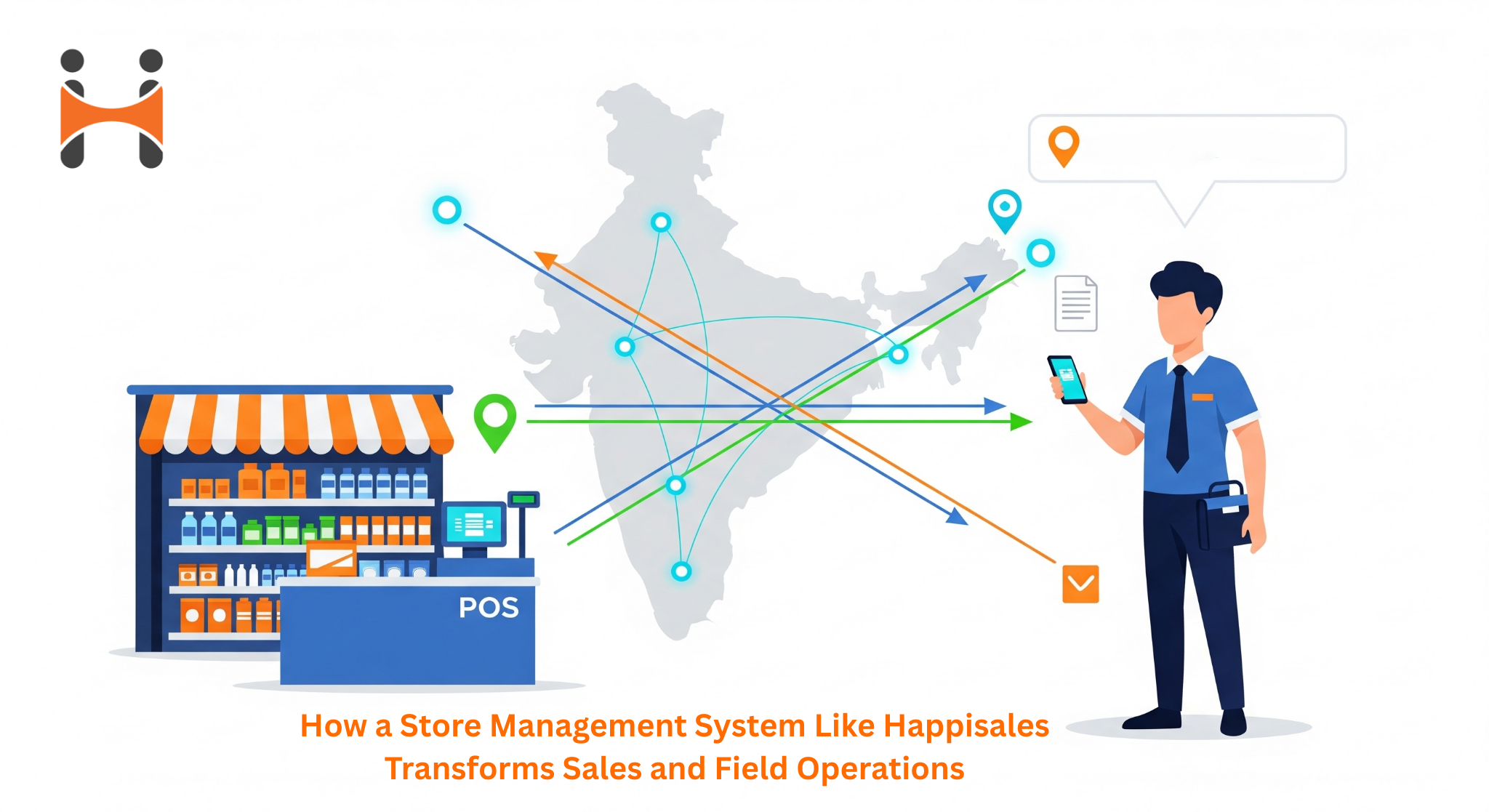
    How a Store Management System Like Happisales Transforms Sales and Field Operations?

    Running sales and store operations in India is not easy. Products run out of stock. Orders get delayed. Sales reps sometimes log fake visits. Collections pile up. And managers often rely on paper reports that are already outdated by the time they arrive.

    Happisales is designed to be the best store management system India for businesses that want real-time visibility, faster collections, and trustworthy employee tracking. Our platform also acts as a field force automation software for FMCG, helping distributors, pharma, and retail chains manage their field teams efficiently.

    This is where a modern store management system makes a difference. It’s not just about POS or billing anymore. It’s about connecting your stores, field sales, and back office into one system so you know exactly what’s happening in real time.

    Why the meaning of “store management system” has changed?

    Old view
    A tool to manage billing, POS, and stock inside a store.

    Today’s view
    A cloud system that links billing, inventory, sales tracking, employee location, beat planning, expense claims, and analytics.

    The winner is no longer the software with the fastest checkout. It’s the one that connects the store with your sales team on the road.

    The three big problems Indian businesses face :

    1. No real-time visibility
      Field reps and stores work on different timelines. Orders taken in the field reach stores late or not at all. Stock data is unreliable.
    2. Losses from manual processes
      Paper orders, delayed collection reconciliation, and expense claims handled in Excel cause leakages and waste time.
    3. Poor accountability and coaching
      Managers don’t know if a rep visited a customer, what happened there, or why orders are dropping. Feedback is based on guesswork.

    We’ve seen these issues again and again with distributors, FMCG, pharma, and retail chains. That’s why we designed Happisales to fix them.

    How Happisales solves these problems?

    Real-time order and inventory sync

    • Reps capture orders on their phone
    • Orders sync instantly or once the rep is back online
    • Inventory updates immediately
    • Stockouts drop and customers get faster delivery

    Employee location tracking with visit proofs

    • Track rep locations only during work hours
    • Geotagged photos and notes confirm visits
    • No fake visit claims
    • Managers get transparent coverage reports

    Planned beats and route optimization

    • Routes are auto-created based on geography and customer priority
    • Reps travel less and meet more customers each day
    • Fuel and travel costs come down

    Offline-first mobile app

    • Works without internet
    • Reps can still log orders, collections, and expenses
    • Data syncs when network returns
    • Essential for Tier 2 and Tier 3 regions

    Order to collection flow

    • Covers order capture, invoice, payment, and reconciliation
    • Managers get collection dashboards and alerts
    • Cash flow improves and DSO comes down

    Expense tracking and approvals

    • Reps upload bills and receipts inside the app
    • Managers approve or reject with one click
    • Data flows into payroll or ERP
    • Reimbursements are faster and clearer

    Analytics and coaching tools

    • Tracks 15+ metrics like visits per day, order conversion, average order size, route use
    • AI nudges suggest which customers to prioritize or which reps need training
    • Coaching is based on data, not guesswork

    Why this matters for Indian businesses?

    • Affordable with fast ROI
      Most Indian SMEs worry about software cost. Happisales clients see benefits like faster collections and fewer stockouts within 60–90 days. The system pays for itself quickly.
    • Simple to use
      Field reps don’t need long training. The app is mobile-first, works in local languages, and is easy to learn in a single session.
    • Mobile-first adoption
      Many reps in India only use smartphones. Happisales is designed for that. No laptop or IT team required.
    • Trust over tracking
      Tracking is transparent and limited to business hours. Managers see what they need, reps feel respected. This balance builds trust.

    Practical results we’ve seen:

    • A regional distributor cut stockouts by 30% in three months by syncing field orders with store inventory.
    • A sales manager increased customer visits by 22% using route optimization. Collections improved in the same quarter.
    • An FMCG company reduced reimbursement timelines from weeks to same-week approval. Field morale improved and HR saved time.

    Using location tracking responsibly

    • Inform employees how, when, and why location data is tracked
    • Track only during work hours not 24×7
    • Save only what’s needed for visits and collections
    • Limit access so only relevant managers can see it
    • Auto-delete old logs after an agreed period

    This keeps employee trust while giving managers the accountability they need.

    Why Happisales is different from POS or basic RMS?

    • POS = billing and receipts only
    • Basic RMS = inventory and reports
    • Happisales = POS + RMS + field automation + employee tracking + offline mode + analytics

    This is the difference between knowing only store sales and connecting it to field performance, customer visits, and collections.

    How to roll this out without friction?

    1. Pilot first
      Test in one or two regions with 10–30 reps.
    2. Map current processes
      Fit existing order and collection flows into the system. Don’t force big changes.
    3. Train and reward
      Keep training short. Use small incentives to encourage adoption.
    4. Scale slowly
      Expand region by region. Watch the KPIs and tweak.
    5. Keep improving
      Use analytics to refine routes and focus coaching.

    Teams adopt faster when they see quick wins like faster reimbursements or fewer hours wasted on the road.

    What to track (KPIs)?

    • Stockouts percentage
    • Orders per rep per day
    • Delivery time in hours or days
    • DSO or collection timelines
    • Expense processing time
    • Active reps vs total reps
    • Trial to paid conversion

    Always note baseline numbers before rollout. Check weekly in the first 90 days, then monthly.

    Common pitfalls and fixes :

    • Trying to solve everything at once
      Start with order capture and route planning first.
    • Change management issues
      Use short training, visible KPIs, and small rewards.
    • Overly intrusive tracking
      Keep it transparent and limited to working hours.
    • ERP integration delays
      Plan integrations early to avoid double work.

    What’s next?

    A store management system that links sales, collections, expenses, and employee tracking gives measurable results. The gains are faster collections, fewer stockouts, and better accountability — all with respect for employee privacy.

    Ready to experience the best store management system India and field force automation software for FMCG? Start a free 14-day trial with no credit card and see how Happisales can transform your sales, collections, and field operations.

  • Top 5 Features to Look for in a Field Sales App for Indian Market Conditions 

    Top 5 Features to Look for in a Field Sales App for Indian Market Conditions 

    Navigating the diverse and dynamic Indian market requires tools tailored to its unique challenges. A robust field sales app can empower sales teams to boost productivity and efficiency. Here are the top five features to prioritize when choosing the right solution for Indian market conditions. 

    1. Offline Functionality 

    India’s varied geography often means inconsistent internet connectivity, especially in rural areas. An app for field sales must offer offline support, allowing reps to log activities, manage leads, and access data without a network. Once connectivity is restored, the app should sync seamlessly, ensuring no data is lost. 

    2. Route Optimization and Real-Time Tracking 

    With traffic congestion and sprawling urban-rural landscapes, efficient route planning is critical. A sales force automation tool should include route optimization to minimize travel time and fuel costs. Real-time GPS tracking also helps managers monitor field reps, ensuring they visit clients as planned and improving accountability. 

    3. Multilingual Support 

    India’s linguistic diversity demands an app that supports multiple regional languages. Sales reps interacting with clients in languages like Hindi, Tamil, or Bengali need interfaces and customer data fields in their preferred language. This feature enhances communication and builds stronger client relationships. 

    4. Integration with Local Payment Systems 

    Cash flow management is vital for Indian businesses, often dealing with on-the-spot payments. The app should integrate with popular local payment systems like UPI or mobile wallets, enabling reps to collect payments, track unsettled invoices, and issue digital receipts instantly, streamlining financial operations. 

    5. Customizable Analytics for Market Insights 

    Understanding local market trends is key to success. The app must provide customizable analytics to track sales performance, monitor stock levels, and analyze regional demand patterns. Features like automated reports and dashboards help managers make data-driven decisions tailored to India’s fast-paced market. 

    Choosing a field sales app with these features ensures sales teams can tackle India’s unique challenges—unreliable connectivity, logistical hurdles, linguistic diversity, payment preferences, and market variability. By equipping reps with the right tools, businesses can drive efficiency, improve customer engagement, and boost revenue in this competitive landscape. 

  • How a Field Sales App Benefits the Retail Industry

    How a Field Sales App Benefits the Retail Industry

    The retail industry has always been a competitive fast-paced environment, with businesses constantly striving to improve sales efficiency and customer satisfaction. One of the most significant advancements in recent years has been the adoption of field sales apps, which have changed the way retail businesses perform their sales operations. In this article, we will explore the numerous benefits that a field sales app offers to the retail industry, including improved sales automation, increased productivity, and enhanced customer relationships.

    1. Sales Automation and Digitization

    Efficient Management of Daily Tasks

    Field sales apps have made it incredibly convenient for businesses and sales teams to execute their sales operations. By automating monotonous tasks, these apps provide better control over ground execution and help streamline the sales process. With a field sales app, sales reps no longer need to rely on physical attendance registers, data entries, or notebooks for record-keeping. Instead, they can go digital and enjoy real-time collaborations between sales reps, retailers, and distributors for more efficient secondary sales execution.

    2. Aligned Ground Execution

    Strategic Implementation

    A key challenge that retail businesses face is ensuring that their field sales teams are executing the company’s Go-To-Market (GTM) strategy effectively. With a field sales automation platform, businesses can not only track and monitor the activities of their sales reps but also drive the ground execution of their GTM strategy. This ensures that sales teams work in alignment with the company’s overall business goals, increasing the likelihood of success.

    Goal-Driven Approach

    Field sales app like Happisales offer a goal-driven approach to sales management, allowing businesses to set bite-size targets for their sales teams to achieve. By breaking down larger objectives into smaller, more manageable tasks, field sales apps help sales teams stay focused and motivated, ultimately driving growth and improving overall sales performance.

    3. Improved Customer Relationship Management

    Personalized Engagement

    Today’s customers demand personalized experiences and value-adds. With a field sales app, sales teams can access customer data, understand their preferences, and purchase histories, allowing them to tailor their sales approach to each customer’s unique needs. This helps enhance the customer experience and ultimately leads to higher sales and improved customer retention.

    4. Intelligent Route Planning

    Optimized Travel Routes

    Sales reps often have to visit multiple locations to carry out their daily tasks. A field sales app with route optimization capabilities helps calculate the most efficient routes for covering outlets in a territory, reducing travel time and increasing face-to-face interaction with customers.

    Real-time GPS Tracking

    Field sales apps equipped with GPS tracking allow managers to monitor the movements of their sales reps in real time. This helps ensure that reps are following the most efficient routes and adhering to their visit schedules, thereby improving productivity and overall sales performance.

    5. Increased Sales Behavior

    Gamification and Employee Engagement

    New-age mobile field sales apps can help FMCG companies improve sales behaviour through input-based gamification. Sales reps are rewarded points and medals for exercising good sales behaviour, which not only provides insights into employee performance and learning needs but also fosters employee engagement.

    Intuitive Alerts and Nudges

    Advanced field sales apps use AI-based technology to generate real-time, consumable insights for field managers. These insights inform the company about potential challenges in field execution, such as low revenue from outlets or low visit adherence, and prompt managers to take corrective actions to address these issues and drive sales growth.

    6. Order Taking and Maximization

    Digitized Order Management

    A field sales app simplifies the order-taking process, reducing the time it takes to record orders and enabling sales reps to cross-sell and upsell through various promotional offers. 

    Swift Claim and Return Management

    Field sales app streamline the claims and returns process, ensuring that customers receive prompt and efficient service. This not only improves customer satisfaction but also helps maintain strong relationships with distributors and retailers.

    7. Real-time Rep Tracking and Performance Analysis

    Sales Rep Accountability

    Field sales apps allow managers to track the performance of their sales reps in real time. This includes monitoring the number of appointments attended, check-in check-out times, distance travelled, and other valuable metrics. By holding sales reps accountable for their performance, these apps help drive productivity and improve overall sales results.

    Actionable Insights and Analytics

    Field sales apps collect a wealth of data about sales rep performance and customer interactions, enabling businesses to generate personalized reports and gain valuable insights. By analyzing this data, companies can identify areas of weakness in their sales process and implement targeted strategies to boost productivity and revenue.

    8. Seamless Integration with Retailers

    Direct Communication and Data Exchange

    Field sales apps enable FMCG companies to connect directly with retailers, eliminating the need for slow and inefficient communication channels. By exchanging administrative data and sales reports in real time, businesses can stay informed about retail performance and make data-driven decisions to improve sales execution.

    Faster, More Accurate Retail Data

    By allowing sales reps to store retail data directly in a mobile app, field sales apps ensure that information is accurate and up-to-date. This not only streamlines the sales process but also helps businesses make informed decisions based on real-time retail data.

    9. Support for Expansion to New Markets

    Scalable Growth

    Field sales apps are designed to support the growth and expansion of retail businesses. By providing real-time access to crucial sales data and enabling seamless collaboration between sales teams and management, these apps help businesses scale their operations and enter new markets with confidence.

    Improved Sales Execution

    By automating key sales processes and providing actionable insights into customer behaviour and market trends, field sales apps empower sales teams to perform at their best. This results in stronger sales execution and increased market share in a competitive retail landscape.

    A field sales app is an essential tool for any retail business looking to improve sales efficiency, streamline operations, and enhance customer relationships. By leveraging the power of field sales automation platforms, businesses can stay ahead of the competition and drive sustainable growth in the retail industry.

    Take up 14-day free trial of Happisales and find out how our field sales app can improve the visibility and productivity of your field sales team.

  • Implementing Field Force Software: Simple and Painless (with Right Strategy)

    Implementing Field Force Software: Simple and Painless (with Right Strategy)

    The advancement of technology, smartphones, and mobile applications have significantly transformed the field sales operations over the past five years. 

    The Field Sales Software market has grown from USD million to USD million from 2017 to 2022. With a CAGR of this market is estimated to reach USD million in 2029 (Source: Market Watch).

    Yet the top management teams of many SMEs hesitate investing in field service software, fearing implementation failures. 

    I have listed some challenges that stop SMEs from field sales management software investment. 

    1. Is it a must for the business
    2. Time taken to implement the solution
    3. Post-implementation support
    4. Unsure about the complete benefits
    5. Employee buy-in
    6. Finding the right implementation partner

    They are right so. But, in practice, implementing the field sales automation software is simple and seamless, provided the project is handled by the right team with the right strategy. 

    Still not convinced? In this post, I have come up with some interesting pointers that might help you experience a seamless and effective field sales implementation journey to take your business to the next level. 

    Before getting started, let’s sneak peek at what field sales software is and why businesses should implement one for their business. 

    What is field sales software?

    Performing all the field sales operations and reporting to the managers on the same day manually consumes much time for executives and managers. This impacts the business’s productivity, sales cycles, time, and RoI. 

    Automating the field sales operations with mobile sales app simplifies the woes of the managers and executives. The software eliminates the unnecessary delays in the process and expedites the sales cycle, saving time for both and helping improve the RoI of your business staggeringly. 

    Now, it’s time to focus on the core, that is, why implementing field sales software is a breeze for some businesses and a headache for many. 

    Why you need a field sales automation software 

    It’s a good practice to ask why before investing in any technology, and field sales mobile app isn’t an exception. Of all the factors that impact any business and operations, RoI and customer experience top the list. 

    You can meet your business goals and satisfy your customers with manual operations. Yet, what if you can increase your customer experience and RoI multi-fold? Yes, you can, with field force automation software. 

    Automation can simplify many processes, improve staff collaboration, and bring transparency to the complete sales cycle. What else do you need? You can safely invest in field force automation.

    Time taken to implement the solution

    Most companies fear this part. The cost and time taken for software implementation. Unlike other digital transformation solution implementations like IoT, AI, or RPA, deploying a field force software won’t take long. It is just a matter of hours to get the complete setup installed. 

    Depending on your requirement, you can implement the app in Cloud (monthly billing) or on-premise (one-time billing).

    Also, the cost of implementing the solution is less than what you will get back after deployment.  

    Post-implementation support

    Many SMEs fear this. No denying the fact that it is critical for the seamless business operations of a company. The answer relies in the vendor you’ve picked for your implementation part. 

    I will help you with how to find the best field sales software implementation partner in the upcoming sections. 

    Most reputed companies often package their product with post-implementation support and have their support team ready 24/7 to help their clients. 

    So, you don’t have to worry about the support after deployment. 

    Unsure of the field sales software benefits

    If you fear investing in a field sales app because of not having a complete idea about the benefits, I have listed some of the benefits of field sales software.

    • Efficient scheduling and dispatching
    • Streamlined productivity
    • Personalized customer experiences
    • Optimized route planning
    • Improved inventory management
    • Faster deal closures
    • Faster payment processing
    • Real-time data sharing
    • Seamless integration with CRM and other systems

    Employee buy-in

    Another exciting challenge that can’t be overlooked. Yes, it is a must for any business investing in new technology to get its employees’ consent before signing the project. 

    Your field sales team will use the solution; if they are not inspired, there is no point in deploying in one. Why do you need a solution that no one is interested in? It will produce only catastrophic results for your business. 

    The key to mitigating the above challenge partially relies on the internal and implementation team. This is why partnering with a best-in-class implementation provider is all-important. 

    The internal and external team should interact with the field sales executives and managers to help them realize the unlimited potential of the solution and how it might simplify their day-to-day operations to improve their efficiency. 

    Also, you can talk to them about the solution’s reward system, which will help employees perform well for the month or week. 

    Interact with the implementation partner to get the employees a free trial of the solution to understand how it works and helps them. This plays a massive role in getting their approval. 

    Providing such valuable information helps everyone in the company to understand the solution better and pushes them to make positive decisions. 

    So, you don’t have to worry about the employee buy-in challenge. 

    Partnering with top fields sales software implementation vendor

    The most important and tricky part that most businesses falter. 

    Your business is like a sinking tank if you can’t partner with the right vendor for your implementation efforts. 

    On one side, you’ll be losing quite some money on the implementation front, and you won’t have their consistent support with respect customer related issues in the future if they don’t have the right experience and talents. 

    Tips for finding the reliable implementation partner

    1. Find a full-stack app development company
    2. Check their years of experience
    3. Check their clientele, ask for case studies and references
    4. Interact with their technical talents to understand their abilities
    5. Ask about the knowledge they have with similar clients
    6. Check customer testimonials and feedback online, including on websites and social media
    7. Ask about project cost and implementation time, get a roadmap
    8. Ask for a free trial, and ask your internal team to use the app
    9. Talk openly about post-implementation support, analyze their terms and conditions

    With this approach, you can partner with the suitable vendor to implement your solution. 

    Summing up

    Implementing the field sales app is simple and seamless if you take the right approach. 

    The RoI and customer experience always contribute to the faster growth of any company. 

    And, field sales automation software can quickly multiply your customer’s experience and skyrocket your RoI. 

    Have any queries? Want to know about field sales software? We are experts. 

    Want to see how the solution works?

    Visit: https://blog.happisales.com/

  • Field Sales: Simple Solution to Engage and Drive Your Team

    Field Sales: Simple Solution to Engage and Drive Your Team

    Of the many factors that decide a business’s success, employee productivity and efficiency are skyrocketing top of the list. Managing the field sales team and tracking their efficiency can be a headache. 

    Making the complete sales team (sales managers and field sales) focus on the tasks and work efficiently doesn’t rely only on the CEOs and CTOs. Giving them the right tools and technical assistance can help them overcome the challenges and deliver their best. 

    Before getting started, let’s dive deep into understanding the challenges and factors distracting or annoying the sales team. 

    Top challenges that disengage field force 

    1. Attendance/permission/leave approvals
    2. Task allocation/collaboration
    3. Route planning/task switching
    4. Meeting customers at the right time
    5. Reporting to managers

    The same can happen to the heads of your sales as well. It doesn’t matter whether your field force or sales heads get annoyed/disengaged. The result remains the same, a drop in productivity. 

    Top challenges that disengage sales managers

    1. Monitoring field sales executives away
    2. Assigning routes, tasks
    3. Following up for updates
    4. Updating reports at the end of the day
    5. Tracking efficiency of field sales executive 
    6. Reporting to management with data 

    What should businesses do to engage field sales and accelerate productivity?

    Most field sales teams of different companies confront the above challenges. The ONE reason for all the challenges is either lack of complete automation or partial automation software implemented by the businesses. 

    Even today, many field sales executives report to the managers in the morning and start their day-to-day activities. The process takes some time, and the sales executives have only a few hours to meet the customers on time. 

    After completing the daily chores, they report to the sales managers in the evening to provide updates on the customer meetings. 

    On the other hand, the managers are clueless whether a sales representative has met the customer at the specific location until he updates/reports to the office. The process lacks transparency and results in a productivity loss for field sales executives and sales managers. 

    The total productivity loss from the sales team hits the business’s bottom line hard and leads to the de-branding of the company. 

    If your sales team faces the above challenges, you’re not alone. The above-shared challenges can be mitigated with the help of field service management software. 

    Top benefits of leveraging field sales app 

    • Transparency to the entire process 
    • Seamless route planning and task allocation
    • Live-tracking app 
    • On-the-go reporting 
    • 100% accuracy/faster decision making 
    • Peace of mind

    Let’s discuss each benefit in detail in the sections below. 

    6 Ways field service automation helps your sales team to boost productivity

    Brings transparency to the sales cycle

    A significant problem most sales team faces is the communication between field sales executives and sales managers. Often, sales managers don’t get any updates from the field sales team. 

    Similarly, the field sales team is let down by managers sometimes. Lack of transparency in the process hurts the sales performance and customer experience. 

    With field service management software in place, sales managers can quickly discover where the field sales executive is and can instantly communicate with sales managers regarding customer meetings. 

    Often the software comes up with a field sales app. This simplifies the communication and eliminates the communication block between field sales and sales teams, improving operations and efficiency. 

    Seamless route planning and task allocation

    Assigning tasks and planning routes for field sales is often a headache for most sales heads. Even more challenging is tracking the field sales team when they are out. On the other hand, field sales face challenges if there is a problem in the route assigned to them. 

    This leads to a dilemma and slows down the sales cycle. 

    On the other hand, the field sales management software helps the sales team assign tasks and plan the routes without any discomfort. Even if there is a change in the route, the field sales team quickly updates the sales managers so that they can reengage another field sales person near the vicinity to get the meeting done. 

    This saves time and improves operational efficiency. 

    Live tracking of field sales activities

    Tracking and monitoring the day-to-day activities of sales persons is a massive challenge for sales managers. Sometimes they don’t even know whether the scheduled appointment is made or missed until the field sales executive updates at the end of the day. 

    The lack of daily updates causes a delay in the sales cycle. 

    Sales managers can track every field sales person for customer meetings without using field sales automation software. 

    The live field sales tracking feature helps the sales heads to track the activities of the field sales team live. This gives them a quick update on the scheduled meeting progress. 

    On-the-go reporting

    Updating the sales data from the field sales at the end of the day is one hell of a task for field sales managers and the field sales team. On the other hand, no matter how long it takes, field sales have to update their reports to the managers at the end of the day. 

    Both processes consume much time and bring down the sales cycle. 

    Field sales can use the on-the-go reporting feature of field service management software to update their activities from anywhere, at any time. Similarly, the sales manager doesn’t have to wait till the end of the day, saving their time. 

    The automation software for the field force simplifies the entire process, leading to faster sales cycles. 

    100% Accuracy and faster decision making

    What if you have sales data updated daily, which is inaccurate? It doesn’t make any difference. Without automation, manufacturing errors are always possible, impacting the performance and efficiency of field sales activities and sales cycle. 

    Above all, with false data in hand, decision-making becomes an uphill task. 

    The field force automation software eliminates the possibility of errors in the data entered, which helps make faster and more formidable decisions. The accurate data depicts the exact picture of the sales activities and their impact on the business candidly. 

    Peace of mind

    As most of the process is automated with the help of field sales software, the sales manager and field sales team don’t have to sweat out a lot when performing the day-to-day activities. 

    Both teams can complete the tasks well within the stipulated time, which gives much time to get a good night’s sleep and spend time with their families. This helps them to focus and deliver better.  

    Final thoughts 

    Providing the sales team with the right tools and technology is the best way to engage and delight them. With best-in-class field service management software, both teams can perform and deliver to their best. 

    Do you have the right tools for your sales team? Still, is relying on outdated systems disengaging your workforce and team’s performance?

    It’s time to re-evaluate your strategy. The competition is brimming, and you must act fast before your competitor does. 

    Looking for suggestions or got queries about field sales improvement or software? We are all ears. 

  • All you need to know about sales management

    All you need to know about sales management

    Without a doubt, sales management is one of the most difficult business domains to master and implement. However, your sales staff will be inspired and motivated if you have a robust sales management system.

    The top field force managers can comprehend the most up-to-date sales strategies and apply their best practices to help their staff close more transactions and increase sales revenue.

    It is sometimes harder to manage sales than make a sale on the field. You must, after all, manage your employees, customers, and processes. The stakes are high. However, the results are satisfying because you can watch your company expand rapidly.

    Therefore, to ace those sales, here’s a coherent explanation of sales management.

    What Is Sales Management?

    The practice of planning, managing, and managing the salesforce to achieve company objectives is known as sales management. It entails putting together a team, allowing the sales team, and inspiring team members to accomplish their responsibilities well.

    While the specific definition of sales management varies by organization, the following duties frequently come under the sales management umbrella:

    Hiring and training new personnel: You can’t manage a sales force if there isn’t one to manage. Development agents, salespeople, business development managers, and other employees work in sales teams. Sales managers are in charge of hiring and training these sales representatives.

    Setting sales targets and limits: The sales manager is in charge of establishing the sales targets that the sales staff aims to meet. These quotas must make sense to each team member and find the right balance between challenging and achievable.

    Controlling and adjusting the sales process: Sales managers must also decide on the sales processes that the sales force will follow. Again, these protocols must be well-planned and empirical support to guide the team in the proper route.

    Motivating co-workers: Sales may be a demanding profession. As a result, Field Sales teams require the correct kind and motivation to succeed. As a result, effective sales management must determine what works and what doesn’t.

    Preparing sales reports: Sales teams must employ a varied, precise range of data to drive their decision-making and attain results. As a result, sales managers must be able to compile reliable reports of their Field Sales Reporting that detail performance and highlight areas for development.

    What are the Objectives of Sales Management?

    Sales managers should ensure that their teams are appropriately engaged. Then your company will be able to meet these key goals.

    Achieve the sales volume that you want

    Salespeople worldwide are working hard to ensure that their companies achieve their sales targets. This concept is crucial since a bigger volume indicates appropriate penetration in a specific market. Therefore, the more clients you have, the more secure your firm will be.

    Contribute to the company’s profits

    Sales managers’ responsibilities should be carried out as efficiently as feasible. Then your sales department will be able to close more deals and increase your company’s turnover rate. In addition, you should sell each product at the correct pricing and employ the necessary tactics to maximize sales.

    Contribute to the growth of the company

    To satisfy shareholders and have a greater impact, businesses must expand. It’s critical for a sales department to contribute to this expansion. Handling the costs involved with sales is critical for the sales manager has to make sure that a business is financially profitable.

    What Is the Process of Sales Management?

    If you aim to succeed as a sales manager, you have to figure out what works and keep improving on it. You can’t switch from one strategy to the next at breakneck speed.

    This predictability will provide your team the confidence to work together and the capacity to iterate your strategy. Then you’ll be able to achieve the best results imaginably.

    A performant sales management process includes the following:

    • Assembling the ideal team
    • Creating a sales funnel
    • Working with marketing to find new leads
    • Improving prospecting skills
    • Making use of precise sales forecasts and reports

    Sales management strategies

    Great sales teams don’t just happen to form without some guidance. Instead, gifted minds purposefully construct them. Here are some techniques for building a high-performing team.

    Invest in your salespeople’s training and growth:

    Because selling behaviors and methods evolve, it’s critical to engage in learning and development programs to keep your staff sharp and current on current sales best practices.

    Create a culture that is both engaging and motivating:

    You want to show your salespeople that their efforts are recognized and appreciated when they pay off. Create a culture where victories are celebrated frequently and publicly.

    To create a positive workplace, use positive reinforcement:

    You have to bring positive vibes & support into your sales organization through upscale reinforcement because sales can be a cutthroat and demanding atmosphere.

    Sales management in the digital age

    The face of sales management is changing rapidly due to technological advancements. Sales managers in the digital age have a precise outline of their sales process. Leading indicators are used to track progress along the path. These modern-day managers make these actions visible to the entire team and encourage them to meet their goals. 

    They make victory visible and foster a winning culture. This new breed of sales managers leverages field force automation technologies and employs data analysis and technology to deliver intelligent coaching in real-time. In addition, they include science in the selling process.

    Final Thoughts:

    Field Sales Mobile App and other Field Force Manager can help you streamline your work, accomplish tasks and duties more quickly, have a greater impact on your team, and become a stronger leader. 
    Happisales is a one-stop solution for managing field force activities in real-time, allowing salespeople to focus on more critical responsibilities by automating sales tracking, reporting, and administration. So do look at what Happisales has to offer & reach out to us!