
Tag: sales

  • Best Sales Performance Tracking App for Retail Staff

    Best Sales Performance Tracking App for Retail Staff

    Tracking retail field teams is often difficult. Missed store visits, late sales updates, and delayed collections make it hard for managers to take timely decisions. This slows down performance and creates gaps in execution.

    Happisales makes the process simple. Our field force automation software gives managers real-time visibility while retail staff can log visits, sales, and collections without delay. If you are looking for the best sales performance tracking app for retail staff, Happisales is a reliable field sales app for retail teams that helps them stay productive, accountable, and efficient.

    Why Retail Teams Need the Best Sales Performance Tracking App for Retail Staff?

    Retail field staff keep your business running. They make sure products are on shelves, promotions are carried out, and customer relationships stay strong. But without the right tools, managers are left with manual reports, delayed updates, and guesswork.

    The common problems are:

    • Missed store visits or routes not planned well
    • Not enough visibility into how each person or the team is doing
    • Sales, collections and stock updates come in late
    • Hard to track KPIs for retail staff properly
    • Staff lose motivation when there is no recognition or incentives

    The best sales performance tracking app for retail staff helps solve these issues. Managers get real-time data on visits, sales orders, and completed tasks. This improves accountability, speeds up decisions, and keeps teams productive.

    From our experience, even one missed visit can cause lost sales or empty shelves. With Happisales, managers know where each rep is, which stores are covered, and whether daily targets are being met.

    Field Sales App Features for Retail Teams

    A good app helps retail teams work smarter. Here are the main features.

    1. Real-Time Sales Tracking

    Field staff can log customer visits and sales instantly with Happisales. Managers see which stores are visited and where to focus.

    Benefit: No missed details, and managers can act fast.

    1. Order and Collection Management

    Staff can place orders, check catalogs, and record payments digitally. Managers track revenue and pending collections.

    Benefit: Less paperwork, accurate orders, and payments.

    1. Field Force Automation

    Happisales plans visits, sends reminders, and creates performance reports. This lets the team focus on selling, not admin tasks.

    Benefit: More work done with fewer errors.

    1. GPS and Location Tracking

    Happisales tracks staff locations in real time. Managers see where everyone is and can plan better routes.

    Benefit: More accountability and less wasted time.

    1. Offline Mode

    Staff can log visits, orders, and collections without internet. Data syncs when they’re back online.

    Benefit: Work continues without delays.

    1. Route Planning and Task Reminders

    Happisales optimizes routes based on store locations and schedules. Notifications remind staff of appointments.

    Benefit: Saves time and boosts store coverage.

    1. Daily Sales Reporting

    Managers get daily reports and dashboards to track KPIs like sales, orders, and visits. Reports are easy to use and act on.

    Benefit: Clear view of team performance and store coverage.

    1. Expense Tracking

    Staff submit travel or field expenses through the app. Managers review and approve them digitally.

    Benefit: Less paperwork and better expense accountability.

    1. Recognition and Incentives

    Managers can recognize achievements, send notifications, and set performance incentives. Leaderboards motivate staff.

    Benefit: Happier, more motivated employees.

    1. AI-Powered Insights

    Happisales uses AI to highlight key customers, suggest visit orders, and show performance trends.

    Benefit: Smarter decisions and better sales results.

    How Happisales Tracks KPIs for Retail Staff?

    Tracking KPIs for retail staff helps manage field teams. With Happisales, managers can track:

    • Number of store visits per day
    • Sales targets achieved versus assigned
    • Collection efficiency
    • Stock availability and order accuracy
    • Task completion rate

    Real-time KPIs let managers spot weak areas and offer support or coaching. Daily retail sales reporting app can boost team productivity by up to 25 percent. Dashboards are simple, visual, and easy to act on.

    Use Cases of Happisales for Retail Teams?

    Happisales helps retail teams work better. Here are its main use cases.

    Daily Sales Execution
    Field reps log visits and orders in the app. Managers get instant updates to ensure all stores are covered and reports are accurate.

    Collections and Payments
    Retail staff record payments on-site. Finance teams can reconcile collections right away.

    Route Optimization
    Reps use optimized routes to save time and visit more stores without overworking.

    Employee Motivation
    Leaderboards and recognition features keep retail staff motivated and focused on performance.

    Performance Insights
    Managers get AI suggestions to identify high-value customers and improve sales strategies for weaker areas.

    Why Happisales is the Best Sales Performance Tracking App for Retail Staff?

    Picking the right sales performance tracking app helps the retail teams to run smoothly. Happisales is a top choice because:

    • Field force automation for retail includes real-time tracking, AI insights, and offline mode.
    • It keeps retail staff accountable, transparent, and productive.
    • Daily retail sales reporting app features track KPI for retail staff and show clear dashboards.
    • The mobile app is easy to use, so staff can log tasks quickly without oversight.
    • The retailers says that  Happisales improves team management. One saw 30 percent more store visits in a month.

    Benefits of a Sales Performance Tracking App for Retail Staff

    • Use real-time tracking so managers can see what the team is doing in the field.
    • Automate routine tasks to give your team more time to focus on selling instead of reporting.
    • Look at analytics through dashboards and AI suggestions to find patterns and spots that need attention.
    • Reward performance by recognizing achievements and using leaderboards and incentives.

    Doing these things helps retail teams work more efficiently, sell more, and stay motivated.

    Top Features of a Field Sales App for Retail Teams

    The best sales performance tracking app for retail staff should include:

    1. Field sales app for retail teams
    2. Field force automation for retail
    3. Daily retail sales reporting app
    4. KPI tracking for retail staff
    5. GPS tracking with route optimization
    6. Offline access for remote areas
    7. Order and collection management
    8. Expense tracking and approvals
    9. Recognition and incentive tools
    10. AI-powered insights

    Happisales puts all these features in one easy-to-use app built for retail teams.

    What’s Next? 

    Start using Happisales with your team and see how it works in real situations. Make sure every retail staff logs visits, sales, and collections daily. The dashboards in the daily retail sales reporting app help you track KPI for retail staff and spot gaps quickly.

    Follow the routes suggested by the app and set reminders so your field sales app for retail teams keeps everyone on track. Use recognition and incentives to motivate the team and keep them performing well.

    With field force automation for retail, routine tasks like planning visits and sending updates happen automatically, freeing your team to focus on selling. Keep checking reports to fix issues and make sure store coverage is complete.

    Try the free trial and experience the best sales performance tracking app for retail staff in action. You’ll see how it improves productivity, sales, and overall team accountability.

  • What Is Field Force Management Software? Features & Benefits

    What Is Field Force Management Software? Features & Benefits

    Managing field teams is not easy. Sales reps, service staff, and distributors spend most of their time in the field. Without proper tools, tracking visits, tasks, and performance is guesswork.

    Field force management software helps teams stay organized and productive. It tracks employees, manages orders and collections, and gives managers visibility into daily operations. Happisales field force software combines scheduling, tracking, and reporting in one platform.

    Why Businesses Use Field Force Management Software?

    Field teams face challenges. Missed appointments cost revenue. Manual reporting slows decisions. Poor route planning wastes time. Tracking employee performance is hard without proper tools.

    Field Force Tracking and Visit Verification

    Happisales provides field force tracking using GPS and geofencing to verify visits and ensure accountability.

    Field Force Scheduling Software for Efficient Task Management

    Use field force scheduling software to assign tasks, optimize routes, and plan daily work efficiently.

    Order and Collection Management Made Easy

    Order & collection management lets field reps record sales and payments instantly. Managers can approve and review reports in real time.

    Offline Field Force App and Real-Time Dashboards

    The offline field force app allows teams to log data without internet. Real-time dashboards give managers visibility into daily operations and team performance.

    Key Features of Happisales Field Force Software

    GPS Tracking for Employees and Route Optimization

    Track employees with GPS tracking for employees and plan the best paths using route optimization. Reduce travel time and increase coverage.

    Task and Visit Logging for Field Teams

    Log all customer interactions with task and visit logging. Keep accurate records of orders, collections, and service calls.

    Motivation Tools for Employees and Employee Performance Tracking

    Boost performance with motivation tools for employees and employee performance tracking. Managers get insights through ML-based insights to improve productivity.

    Benefits of Field Force Management Software

    • Enhanced productivity by reducing admin work
    • Increased transparency for managers
    • Operational efficiency through optimized routes and automated processes
    • Faster decision-making using dashboards and insights
    • Improved customer engagement with timely visits
    • Employee motivation via recognition and incentives
    • Scalable field operations as teams grow

    Industries That Benefit From Field Force Software

    • FMCG sales tracking and distribution management software
    • Pharma sales management and retail merchandising software
    • Financial services collections
    • Service and maintenance tracking

    How to Implement Field Force Management Software Successfully

    Start with a pilot program for field software. Train staff and managers, gather feedback, and adjust workflows. Gradually scale features like route optimization, expense tracking, and field force tracking.

    Important KPIs for Field Teams

    • Customer visit tracking
    • On-time visit percentage
    • Conversion rate per visit
    • Average travel time
    • Collections vs target
    • Active app usage

    Return on Investment From Field Force Software

    Companies see results in stages. First three months improve reporting and reduce admin work. Three to nine months increase visits and speed up orders. Nine to eighteen months optimize coverage and coaching. Happisales field force software helps improve ROI faster.

    Choosing the Right Field Force Management Software

    • Offline support and data syncing
    • GPS tracking, geofencing, and visit verification
    • Field force scheduling software for task management
    • CRM or ERP integration
    • Real-time dashboards and reports
    • Field staff training and onboarding
    • Scalability as teams grow

    Why Choose Happisales Field Force Software?

    Happisales platform is simple and practical. Log visits, orders, collections, and expenses easily. Works offline. Provides ML-based insights, notifications and reminders, and motivation tools for employees. Improves operational efficiency and employee performance tracking.

    Try a Happisales demo or start a Happisales trial Call- +91 9944585452 .

    What’s Next?

    Field force management software helps managers track operations and improves team efficiency. With Happisales field force software, scheduling, tracking, and reporting are simple. Teams stay accountable, managers stay informed, and customer service improves.


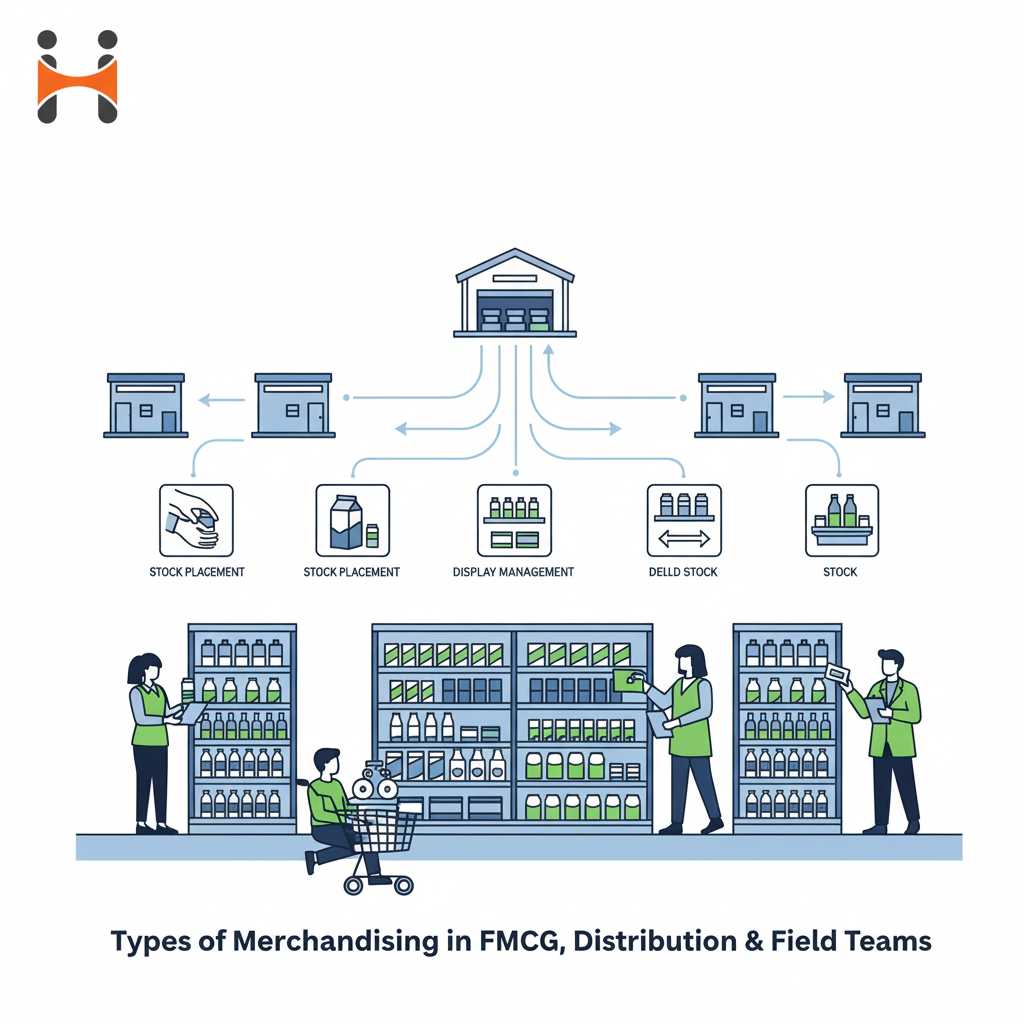
  • Types of Merchandising in FMCG, Distribution & Field Teams

    Types of Merchandising in FMCG, Distribution & Field Teams

    Merchandising plays a key role in FMCG, pharma, retail, and distribution. How products are displayed, managed, and sold affects sales, customer satisfaction, and operations. Businesses that want to track employee locations and improve field work need to understand the types of merchandising and use the right tools.

    At Happisales, we help distributors, retailers, and field teams handle merchandising smoothly while keeping inventory accurate and operations transparent. In this blog, we cover the main types of merchandising, common challenges, and how field force automation works in real situations.

    How Merchandising Supports FMCG and Distribution Operations?

    Merchandising covers all the work that helps sell products in retail and distribution. It is more than just placing items on shelves. It ensures products are available, visible, and attractive while giving your operations team useful data.

    Key activities in merchandising include:

    Product Placement

    Making sure products are easy to see and buy

    Inventory Management

    Keeping the right stock levels to avoid running out or having too much

    Promotional Execution

    Carrying out in-store promotions, discounts, and offers

    Retailer Engagement

    Building strong relationships with retailers to keep products available and follow compliance

    For businesses with field teams and distributors, merchandising includes field merchandising. This is the work done in stores to keep products in stock and make sure promotions are done correctly

    Main Types of Merchandising

    Merchandising can be divided into different types, each with its own goals, challenges, and benefits

    1. Field Merchandising

    Field merchandising is the work done by sales reps, merchandisers, and distributors in stores. We ensure that products are available, displayed properly, and sales opportunities are captured

    Key parts of field merchandising include:

    Shelf Audits
    Checking that products are placed correctly, fully stocked, and look appealing

    Order Capture
    Recording sales orders directly at the retailer

    Promotional Execution
    Carrying out in-store promotions and discounts

    Retailer Training
    Teaching store staff about product features, benefits, and promotions

    Personal Experience
    In our work with FMCG distributors, field merchandising proved very effective. Reps regularly conduct shelf audits and engage with retailers. This helps spot stock gaps and fix them before they affect sales. One client saw a 40 percent drop in order rejections within three months after setting up structured field merchandising processes

    Field merchandising is operational and links directly to inventory visibility, order management, and field force accountability. Software like Happisales makes this process easier.

    2. Product Merchandising

     Product merchandising focuses on organizing, pricing, and presenting items to boost appeal and sales. It overlaps with field merchandising but centers on the product rather than the execution.

    Key parts of product merchandising include:

    Product Placement
    Making sure high-demand items are easy to find

    Stock Rotation
    Tracking expiration dates and batches to reduce waste

    Price Accuracy
    Keeping prices correct across all locations

    POS Material Implementation
    Using banners, tags, and displays to promote products

    With tools like Happisales, sales reps can access product details and pricing on their mobile devices. This reduces errors, ensures compliance, and allows accurate order capture.

    3.  Trade or Promotional Merchandising

    Trade merchandising is about running promotions, discounts, and campaigns at the retailer level. It aims to influence buyers, increase sales, and make products more visible.

    Key parts of trade merchandising include:

    • Discounts and promotional offers
    • In-store displays and point-of-sale materials
    • Incentive programs for retailers
    • Campaign tracking and reporting

    The main challenges are inconsistent execution and difficulty tracking compliance across multiple stores. Happisales lets field teams record promotions in real time, so managers can track execution and results easily.

    4. Visual Merchandising

    Visual merchandising focuses on how products look and how appealing they are. While common in retail stores, it is also important in FMCG and distribution.

    Key parts of visual merchandising include:

    • Store layout optimization
    • Attractive displays and shelving
    • Placing high-margin or promotional products strategically
    • Keeping branding and signage consistent

    Visual merchandising depends on operational support from field teams. Even the best displays fail if products are not available or stock is outdated. Happisales helps by providing real-time stock visibility, accurate order placement, and timely replenishment.

    5. Digital Merchandising

    Digital merchandising is growing in importance with the rise of e-commerce and online retail.

    Key parts of digital merchandising include:

    • Accurate product listings and descriptions
    • Online promotions and campaigns
    • Managing customer reviews
    • Integration with digital ordering platforms for retailers

    Field teams help by making sure offline stock matches online listings. Software like Happisales keeps data synced between physical stores and digital channels.

    Top Issues in FMCG and Distribution Merchandising

    Even with clear merchandising strategies, businesses face several problems:

    1. Stockouts and Overstocking
      Without accurate inventory data, stores may run out of stock or have too much
    2. Inconsistent Execution
      Field reps may follow strategies differently across locations, causing uneven brand experience
    3. Manual Reporting
      Tracking merchandising activities by hand takes time and often has errors
    4. Employee Monitoring
      Supervising field teams and keeping them accountable is hard without real-time tracking

    These issues can lead to lost sales, unhappy retailers, and operational inefficiencies

    How Field Force Automation Supports FMCG Merchandising?

    To solve merchandising challenges, many businesses use field force automation platforms like Happisales. These tools combine merchandising with inventory management, order capture, route planning, and employee tracking.

    How Happisales Supports Field Merchandising?

    • Real-Time Inventory Visibility
      Sales reps and managers can see livestock across locations. This ensures accurate orders and reduces stockouts.
    • Offline Access
      Field staff can log orders, updates, and notes without internet. Data syncs automatically when connectivity returns.
    • Route Optimization
      Happisales plans efficient travel routes for field reps, cutting travel time and covering more stores.
    • Expense and Activity Tracking
      Track field staff visits, activities, and expenses to give managers useful insights.
    • Employee Location Tracking
      Managers can see field staff locations in real time, improving accountability and resource allocation.
    • Analytics and Reporting
      Happisales generates detailed reports on team performance, merchandising compliance, and operations. Managers can make decisions based on data.

    Personal Experience
    After using Happisales, a client in South India saw clear results. Field reps logged orders offline, routes were optimized, and managers tracked employees in real time. Orders were captured faster, stockouts dropped, and sales increased.

    Best Practices for Effective Field Merchandising

    To get the most from field merchandising, companies should follow these practices

    1. Regular Training
      Give field staff the knowledge they need about products, merchandising standards, and technology tools
    2. Consistent Communication
      Keep open channels between field teams and managers to address issues quickly
    3. Data-Driven Decisions
      Use insights from software to adjust merchandising strategies in real time
    4. Technology Integration
      Use field force automation to streamline work, track activities, and improve efficiency
    5. Performance Monitoring
      Check team performance regularly and provide feedback to help them improve

    Why FMCG and Distribution Companies Should Use Field Merchandising?

    Companies that use field merchandising with technology see clear results

    1. Better Stock Availability
      Products are available when needed and waste is reduced
    2. Stronger Retailer Relationships
      Orders are fulfilled on time and promotions are executed properly
    3. Higher Team Accountability
      Real-time tracking keeps field staff responsible for their work
    4. Increased Sales Efficiency
      Route planning and optimized visits help reps cover more stores
    5. Improved Decision-Making
      Analytics and reports provide actionable insights for managers

    Example
    One FMCG distributor saw a 40 percent drop in order rejections within three months of using Happisales. Field reps checked stock on their mobile devices before taking orders, ensuring customers got products reliably

    What’s Next?

    Merchandising is more than placing products on shelves. In FMCG and distribution, it combines field execution, operational visibility, and data-driven insights. Field merchandising makes sure products are available, orders are accurate, and promotions run smoothly.

    Happisales connects field teams, back-office staff, and managers with real-time data. This helps businesses improve merchandising, satisfy customers, and grow sustainably. click here for 14 days free and simplify field merchandising, inventory tracking, and team management with no credit card required.

  • Mastering Field Sales: How to Train Your Reps on Field Sales Apps and Sales Force Automation Software

    Mastering Field Sales: How to Train Your Reps on Field Sales Apps and Sales Force Automation Software

    Why Field Sales Engagement Platforms Matter

    In today’s market, using a robust field sales engagement platform is no longer optional, it’s a competitive necessity. These platforms streamline sales workflows, deliver real-time analytics, and enable better communication between field teams and managers.

    By leveraging a field sales engagement platform, businesses can:

    • Analyze customer interactions
    • Personalize field rep approaches
    • Increase customer satisfaction
    • Enable data-driven decision-making

    Staying ahead with the right field sales technology ensures your team adapts to evolving buyer behavior and market demands.

    Top Field Sales Apps in 2025

    What are the top field sales apps available, and how do they compare in terms of features and ease of use?

    Leading field sales apps in 2025 offer:

    • Offline data access
    • GPS tracking
    • Route optimization
    • In-app communication
    • Real-time order entry

    Comparison of top field sales apps:

    • App A: Known for user-friendly UI and custom workflows
    • App B: Strong in analytics and reporting
    • App C: Best for integration with legacy CRMs

    Evaluate based on ease of use, feature set, and scalability.

    Training Your Sales Team to Use Field Sales Apps

    How should I train my sales reps to effectively use new field sales technology?

    Effective field sales app training combines:

    • Hands-on experience
    • Role-playing exercises
    • E-learning and microlearning

    Start by identifying reps’ tech gaps and tailor the program accordingly. Create interactive workshops that simulate real-world usage. Reinforce learning with refresher sessions and support forums.

    Sales Force Automation Software: Benefits and Best Practices

    How can I determine which sales force automation software is best suited for my business needs?

    Sales force automation software (SFA) automates repetitive tasks and improves decision-making. Top benefits include:

    • Real-time lead prioritization
    • Automated scheduling
    • Accurate forecasting
    • Integration with marketing tools

    When evaluating sales force automation software:

    • Choose platforms with mobile-first design
    • Look for predictive analytics and lead scoring
    • Ensure CRM compatibility and API flexibility

    Implementing Effective Field Sales Training Programs

    A successful training program for field sales apps and SFA tools requires:

    • Clear KPIs and learning goals
    • Balanced curriculum (theory + practical)
    • Multiple learning formats (videos, simulations, live coaching)

    Encourage peer-to-peer learning and allow for real-time feedback collection to keep the program evolving.

    Measuring Training Success and App Adoption

    How can I measure the success of my field sales training program and app adoption?

    Metrics to track include:

    • Usage rates of the field sales app
    • Knowledge retention scores
    • Sales metrics before/after training
    • Rep satisfaction and confidence

    Use quizzes, live role-play evaluations, and CRM/app analytics to validate success.

    Case Studies: Field Sales Engagement Platforms in Action

    What are some real-world examples of companies successfully implementing field sales engagement platforms?

    1. FMCG Brand: Increased productivity by 25% within 6 months using a tailored field sales engagement platform.
    2. Pharma Company: Reduced sales cycle with sales force automation software and improved lead conversion.
    3. Retail Chain: Trained reps on a custom field sales app, leading to better customer satisfaction and repeat business.

    Future Trends in Field Sales Technology

    What future trends should I be aware of in field sales technology and automation?

    Trends shaping the next generation of field sales apps and SFA tools:

    • AI-powered sales recommendations
    • Voice-to-text note capturing
    • Predictive route planning
    • Embedded video calling within apps

    Investing early in emerging field sales technology helps future-proof your sales operations.

    FAQs

    What challenges do sales reps face when using field sales apps, and how can they be overcome?

    • Challenge: Tech resistance
      • Solution: Gamified onboarding and peer mentoring
    • Challenge: Poor mobile network coverage
      • Solution: Choose apps with offline functionality

    How do field sales apps help improve sales productivity and customer engagement?

    • Real-time insights and automation free up time
    • Location tracking and visit planning improve efficiency
    • Personalized follow-ups increase engagement

    What are the key features to look for in a field sales app or sales force automation software?

    • Custom workflows
    • CRM and ERP integration
    • AI and analytics
    • Offline support

    Book a demo today and experience how a tailored field sales engagement platform can elevate your sales strategy.

  • Mental health matters Part 1: Leverage these powerful tips to enhance the EQ of your sales reps

    Mental health matters Part 1: Leverage these powerful tips to enhance the EQ of your sales reps

    If you go ahead and subject your sales reps to an EQ test, the results are bound to shock you.

    You will be surprised to find that the average EQ of your sales reps, and by extensions reps across the globe is quite low.

    Before we explore what this means for your sales results and how you can overcome this challenge, let us first strive to understand the factors driving poor mental health in today’s day and age.

    Although technological progress and human intellect have advanced significantly in the last 2 centuries, this has also come at the cost of personal well-being for every single being on the planet.

    The nature of human intellect is such that it dissects everything and wants to fit life into its logic. It drives human beings to exploit the world around them, while making them forget that true happiness lies within.

    Moreover, technological progress has also wreaked havoc on the natural environment. Today, we are facing several catastrophic calamities such as global warming, soil extinction, and more.

    Scientists estimate that if we do not respond appropriately and deploy remedial measures to tackle these issues over the next 30 years, life on this planet may cease to exist altogether.

    As a generation of human beings, psychologists have proved beyond a shred of doubt that we are also the most narcissistic beings to have ever existed. 

    To put it simply, human beings today chase their own selfish agendas and lack a larger sense of inclusiveness towards life, and this attitude is naturally bound to have a detrimental impact on mental health.

    The misuse of gadgets has also led human beings to isolate themselves from life in its totality, and this unnatural seclusion is another factor that negatively impacts mental health.

    If mother nature has proved anything over time, it is the fact that life only happens well when we operate out of a larger sense of inclusiveness towards life. Ambition, greed and narcissism are surefire recipes for self-destruction.

    Having said that, let us dive into the mental health scenario that prevails in the sales industry and examine factors that drive poor mental health in sales circles!

    Mental Health in Sales:

    If you are in sales, you are familiar with the constant anxiety of not meeting your quota. You worry that an account you have been working on for weeks or months might drop out of the negotiations. 

    You also struggle to strike a balance between your professional and private lives since you are always chasing after prospects and trying to close deals. 

    If you do not find effective solutions to manage your daily stressors, these could affect your performance and overall health in the long run.

    Anxiety and depression are common in the sales industry due to the high demand and cut-throat environment. The chronic feeling of ineptness and the constant battle with the insecurity of not being able to deliver triggers fatigue, stress, and burnout. 

    It is a known fact that sales is a highly emotional job as employees are expected to constantly be confident, energetic, extroverted, and on-the-go.

    However, this is not always the case. Closing a deal can be relaxing, but losing a prospect that you have worked on for months on end can cause depression, which then affects your current disposition and mood.

    Below are some common mental health problems encountered in the sales industry:

    1. Behavioral and Emotional Disorders
    2. Clinical Depression 
    3. Obsessive-Compulsive Disorders (OCD)
    4. Anxiety

    Creating a culture where work-life balance is prioritized is the first step to tackle this problem. 

    Having dedicated support and medical staff who are trained to handle such cases is the next sequential step to ensure the well-being of your employees. 

    All this being said, managing mental health in sales is possible. Here are some tips to nurture a culture of mental well-being as a sales leader:

    1. Build a support system

    One of the first things you should do is to cultivate positive relationships with those around you. That means making an effort to do things with your coworkers outside the office. 

    Take people up on their invitations to movies, lunch, or an after-hours video conference to just chat. It’s a great way to let off some steam and share stories with the people that stand by you as you strive to grow professionally.

    1. Understand that you’re more than just your job 

    Sometimes the best thing that you can do is have a little perspective. Even if you don’t make your sales quota, it doesn’t define who you are as a person. Your job is not your identity and it doesn’t dictate your worth. You would never tell your friends they’re defined by their work performance, so why do you hold yourself to a different standard?

    Also, keep in mind that not meeting your quota isn’t always on you. Markets these days are highly volatile and there are tons of factors that affect whether people are prepared to buy— a global pandemic, summer vacations, an alarming news story, or maybe your customers are just busy! 

    If you don’t hit your numbers this month you can still spend that time strengthening relationships with existing customers and finding new leads that will result in you exceeding your numbers next month. 

    1. Enhance your physical fitness

    The very act of staying indoors all day long, not getting enough movement and fresh air into your lungs can have a detrimental impact both on your mental and physical health.

    The recipe for sound physical and mental health is quite simple: Maintain a consistent sleep schedule, include pure, natural and wholesome food items in your diet, and exercise.

    Yoga, walking, trekking, light weightlifting, calisthenics, gymnastics, martial arts and swimming are some excellent options to help improve your strength, flexibility, and mental well-being.

    Meditation is another excellent way to improve your inner well-being and health. Download Sadhguru application on your smartphone, and practise Isha Kriya, a basic guided meditation that can surely boost your health, energy levels and balance. 

    In a nutshell

    Human beings are complex psychosomatic beings. Everything that happens in your body affects your mind, and vice versa.

    Mental health is as important as physical health, and taking small positive steps to enhance the well-being of your mind is extremely important as you grow in your sales career.

    At the end of the day, we work to live and don’t live to work. If we fail to invest sufficient time and energy in cultivating joyful relationships, bonding with mother nature, exercising, eating well, performing social service and living a full-fledged life in general, all the economic activity we perform will amount to nothing and our lives will dwindle down to mere survival dramas.

    In the next blog of this two-part series, we’ll share additional tips and ways to enhance mental well-being while also examining strategies that you can deploy at an organization level to eliminate the root causes of poor mental health.

    Your sales reps will be all the more grateful, but above all you will have the satisfaction of putting your people first and helping them lead happy and harmonious lives. As a natural consequence, this endeavor will surely turbocharge your sales results.

  • How to write follow-up emails that buyers rave about: Leverage these proven strategies to skyrocket conversions

    How to write follow-up emails that buyers rave about: Leverage these proven strategies to skyrocket conversions

    Why generic follow up emails don’t work?

    Sending a generic, “just checking in” follow up email typically isn’t good enough. You’re probably feeling suspicious!

    After all, sales sequences, automated templates, and check-in emails are the gold standard. They’re adored by every seller prospecting and managing a pipeline of SMB-size deals. 

    Akin to how crutches help a physically challenged person to walk, automated follow-up emails serve as a support system to sellers as they rise through the ranks to tackle more strategic deals.

    However, the fact remains that the higher the contract value, the higher the bar for a thoughtful follow-up. The reality is that prospects don’t forget to follow up with you but rather de-prioritize the people who don’t help them get their job done and personalize their interactions.

    The reason why most follow-up emails go straight to the spam folder is simply because they read like a series of reminders. When a buyer reads a follow-up email, they automatically run a mental calculation: “Is the value that I’m getting from this interaction worth the time I’ll invest into it?”

    So, how do you write a sales follow up email that actually converts your leads?

    When should you follow up? How do you maintain contact without being pushy? What exactly should you say in your follow up emails?

    We’ll answer all of these questions and more in this blog. Let’s dive right in and explore what it takes to master the art of following up!

    Tips to craft forward-worthy follow up emails

    The mark of a truly helpful and engaging follow-up email, is that its forwarded around and not deleted.

    Use these six tips to help your buyers accomplish their tasks and capture their attention.

    1. Always introduce new information 

    Go back to the emails you just reviewed. Were you rehashing what’s already been said or actually introducing new information? 

    You have a unique vantage point. You see where customers struggle, where the industry’s heading, and what top performers do differently.

    All of these insights give you an opportunity to share a new point of view. Use your follow-up emails to create curiosity and a feeling of, “Every time I hear from ___________, I discover something new.” 

    Think of a kid on Christmas morning, ready to open a present and see what’s inside. That’s the feeling you should strive to create in the minds and hearts of your buyers!

    1. Use data and insights

    Augment everything you say up with third-party statistics and anecdotes from industry thought leaders. 

    You should also leverage social proof like testimonials and case studies, showcasing the results you’ve generated for clients just like them.

       3. Leave them better off 

    Will your message help your buyer do their job better than they could do it before? 

    Most times, value to buyers is delayed until the point of purchase when they can start using a product. But there’s an incredible opportunity to make the buying process valuable, too. 

    People go where value is, so make your process that place. Introduce a template, feedback, data source, or other resource that’s hard to find.

        4. Craft a clever subject line

    Your subject line should be given more importance than the actual content of the email. After all, one of the first things your prospect lays their eyes on is the subject line. 

    A well-known research study unearthed the fact that 47% of all emails are discarded by recipients due to uninteresting subject lines! That is a huge percentage you cannot afford to risk. 

    Your subject line will determine the success or failure of your cold email campaign. Here are some spam triggering words and phrases that you would be well-advised to avoid:

    • Exclusive Deal
    • Hurry up 
    • Instant 
    • Once in a lifetime 
    • Take action 
    • Please read 
    • Urgent 
    • Pure profit 
    • 100% free 

    There are three key rules to adopt while writing follow-up email subject lines:

    • Personalize wherever possible! 
    • Keep it short and to the point 
    • Include intriguing questions 

    Optimize the length of your subject line, keep it at 9 words and 60 characters, and ensure it is readable for mobile users. Also, don’t forget to A/B test your subject lines to figure out what’s resonating well with your audience. 

          5. Add adequate value

    As an email recipient yourself, you understand the importance of valuable content. If you receive an email that adds no value to your life then you will most likely ignore it.

    The number one reason why sales emails do not elicit responses is because they lack value. Do not send a follow-up email without adding in more value than you did previously and demonstrating your worth.

    Sending ‘generic’ follow-up emails will not work in your favor either. The whole ‘catching up’ strategy is antiquated and outdated, and prospects deserve much more than that. 

    Find ways to delight your prospects in every interaction and make it worth their while. Here are a few ways you can provide value to your prospect: 

    • Share customer testimonials 
    • Offer solutions for specific pain points 
    • Blog posts 
    • E-books
    • How-to guides 
    • Video guides
    • Case studies 
    • Webinar 
    • Personalized offers 
    • Extended free trial 

    Whatever way you decide to add value, ensure it is relevant to them. In order to open the lines of communication you need to incentivize your prospects and push them to respond. 

    Additionally, you can also ask them for their opinions about certain things, for example, you can ask your lead if the pricing doesn’t work for them? Or if your product/service is lacking a feature that they need? 

    This will create a positive business relationship and will make them feel that they are valued and respected, which is extremely important. After all, the fundamental purpose of any business endeavor is to add value and earn goodwill while also earning reasonable profits.

           6. Enrich your emails by adding your personality

    People do business with people they like or respect. You should always be yourself during the entire sales process, but especially during your follow-ups.

    Above all, people bond with people who have a life beyond work, avoid being pretentious and maintain vibrant emotional and mental states of experience.

    Nobody wishes to do business with a monotonous, profit-oriented and narrow-minded drone who lacks a larger perspective of life and has nothing to converse about beyond deals, deadlines and financial matters.

    Conduct in-depth customer research and dig deep into your customers’ hobbies, pain-points, dreams and aspirations. Invite them for lunch or take them out for a game of golf and build a relationship that transcends work.

    Talk to them about movies, music, poetry and any other mutual interests that you share without coming across as desperate. They will not only be willing to do more business with you but evolve into trustworthy friends who will stand by your organization through thick and thin. 

    In a nutshell

    In this article, we’ve only scratched the surface of what it takes to craft perfect follow-up emails that will transform your prospects into brand advocates for your business and organization.

    In the next article of this 3 part guide, we’ll explore follow-up email templates that you can use to enchant your prospects and elicit a positive response.


    Until then, stay tuned!

  • Top strategies to reduce Field Service Operation Costs

    Top strategies to reduce Field Service Operation Costs

    One of the paramount concerns for every field service organization is its high operational costs. In recent times, most organizations are striving to reduce them without compromising the quality of the services offered.

    At the crux, to achieve a competitive position in the service industry, one needs to remain profitable while fulfilling customer expectations and keeping them satisfied.

    To achieve this, it is essential to deep dive into these issues and address them. Let us look at some of the strategies that can be implemented to reduce the costs-

    1. Improving the effectiveness of the technician’s first visit – A lot of the field technicians complain about the lack of proper information available to go in for the initial visit.

    This leads to more follow-up trips, thereby increasing the cost of fuel expenses and resources. To prevent this, you should find out the customer’s issues along with their expectations in advance.

    This way you can send the right technician along with the appropriate equipment to solve the issue in the first visit itself.

    Further, a follow-up should be initiated with the customer to ensure that the task has been accomplished to the customer’s satisfaction thereby improving the trust and goodwill of your organization.

    1. Optimizing the Inventory– It is never a good idea to overstock or understock inventory because holding too much inventory can eat away the profits whereas understocking leads to losing potential customers.

    You need to strike the right balance between the two. To achieve this, you need to evaluate your business needs and requirements and find the right inventory management tools that provide the real-time status of the inventory.

    These tools will aid in improving inventory management and cashflows, saving storage costs, and retaining customers.

    1. Ensuring scheduling is up to date- Poor scheduling practices often lead to internal conflicts within the team, low productivity, and high field service operation costs.

    To avoid such conflicts, you can employ a smart field service software that can help in assigning tasks based on the technician’s skills, in other words, putting the right person for the right job, tracking the location of the technicians on a real-time basis to improve efficiency, and optimizing the routes to save travel time and fuel costs.

    1. Reducing costs of Training and Recruitment – Ideally, hiring new candidates and providing them with the necessary training involves a huge cost.

    One of the effective ways to save such recruitment and training costsis by retaining the best talent. To do that, you should motivate the employees by recognizing them periodically.

    This recognition should be data-driven and not be fuelled by any biases. By using the right software, you can build a performance evaluation profile for each technician based on the metrics such as the number of work orders assigned and finished in a day, type and current status of the task assigned, inspection, and validation of the task, etc.

    You need to set optimal performance metrics to perform at the best productive level. The performance profile of each employee can be evaluated against these metrics to determine appropriate rewards and compensation.

    1. Going Digital- About 50% of the field service organizations still operate using manual methods. Such methods are neither cost-effective nor efficient.

    If you have hired people to perform tasks such as scheduling and planning the work, it is time to automate it. Using a filed sales management software tool allows you to gather important information such as invoices, billings, business contracts, attendance and leaves of the employees, etc leaving no room for errors.

    This way the employees can now focus more on meaningful tasks. So, the first step is to identify the business processes that are redundant or dependent more on paper, examine the cost associated with people performing such tasks, and then plan to automate them in order to save on such expenditures.

    1. Customer-centric support solutions: Customers often experience unnecessary wait times even for issues that can be resolved online.

    Innovative solutions can be provided to handle such issues. You can implement AI-enabled Chatbots that can handle redundant customer queries.

    Customer rating can be captured for all the AI-resolved issues. Technicians can further review the ratings and update the AI resolution mechanism on a regular basis.

    A ticketing system can be used to report issues that are not resolved through AI support. All such issues reported by customers through tickets can be reviewed for online resolution by interacting with the customers.

    Technicians can be assigned for field resolution only on a need and priority basis. In this manner, you can create a better customer-centric experience and also utilize the technician’s time more efficiently and effectively.

    In a nutshell

    Optimizing field service costs is imperative if you are running a field service organization. Digitizing and using relevant field service tools can help you achieve your goals while remaining at the top of your game.

    The above-mentioned strategies are some of the ways that can help you cut down on costs, and focus on elevating customer satisfaction.

  • How to craft winning sales pitches: The ultimate guide (Part 1)

    How to craft winning sales pitches: The ultimate guide (Part 1)

    The first thing that pops up in people’s minds when they hear the term sales pitch is an unwarranted phone call or an awkward email from a pushy and aggressive seller.

    Thanks to these terrible salesmen, people around the world have grown wary of sales pitches and do their best to avoid them. But a good sales pitch is so much more than an intrusive phone call or email.

    In fact, a great pitch should make a buyer’s life better by connecting them with products and solutions that solve their most urgent problems.

    In this guide, we’ll decode the nuances of an effective sales pitch and discuss various strategies that you can use to optimize your outreach efforts. Finally, we’ll explore some exceptional sales pitch templates that will help you nail your conversions!

    Let’s dive right in.

    What is a sales pitch?

    A sales pitch is a well-crafted sales presentation. Typically, a salesperson gets less than two minutes to explain how their business will benefit the prospect. 

    The attention span of people in this tech-driven world is ever shrinking. As such, salespeople no longer have the luxury of an hour-long presentation geared towards selling a specific product or service. 

    A good sales pitch needs to convey the intended message concisely in a compelling manner. If the sales pitch is on point, you are on the right path to making profitable sales. 

    The first few minutes of a business conversation determine the direction your interactions will take. Be sure to use this sales pitch as your attempt to convince the prospect about the superiority of the service you are offering. 

    If you are selling a product, a sales pitch is your chance to dispel a prospect’s belief about the product. This is when you reassure them of the benefits they will enjoy if they buy the product you are selling.

    The anatomy of a successful sales pitch

    Sales pitches can take on many different forms and use different approaches. But when you break them down, they almost always have these five key elements:

    1. The open

    The open is the introduction. It’s as simple as saying hello, introducing yourself, and asking the prospect how they are. It’s also your first opportunity to start building rapport and break the ice with your prospects.

    2. Identification of the problem, pain point, and/or goal

    By asking a few meaningful and well-thought-out questions about their work, you’ll start getting a better understanding of what the prospect’s challenges and goals are. 

    Using active listening you’ll begin to understand how your product can help address the prospect’s issues in order to reach their goals. 

    3. Demonstration of value

    Once you’ve established rapport and begun to understand the scope of their needs, you can begin to address each one using your product as the solution. 

    You should be able to speak to one or more of their pain points with how your product can solve the problem. 

    4. Supporting facts

    If you want to build trust, you should be prepared to support your pitch with facts and figures. Consider using social proof, like positive results that show how you beat customer expectations or prove that your other customers derived value from your product or service.

    5. The close

    By now, you should’ve clearly shown your prospect the value of your product and how it’s going to make their job or life easier. The close is essentially the point where they say yes and the transaction occurs. 

    The best sales pitch templates ever

    Having established the elements of a winning sales pitch, it is time to witness these in action. Here are some sales pitch templates which will supercharge your growth!

    Data dump

    Data is a great way to catch buyer attention, especially if it can help them make the case to their team for your product.

    The bad news: marketing burn is all too real these days. The good news? Help is on the way. New research shows that our platform can deliver:

    • 72% increase in buyer engagement
    • 50% in open-rates
    • 20% decrease in attrition 

    Show that you care

    Highlighting your prospects’ pain points and offering personalized solutions is an excellent way to forge meaningful customer relationships. 

    G2 is one company that pulls this off really well in its pitch:

    “G2 plays a huge role by providing unique, authentic peer advice in real time. We give buyers better guidance than traditional analyst firms, which can take up to 2 years to update and publish technology research. That timeline just can’t keep up with the pace of technology. At G2, we aim to be a trusted source that helps every business professional in the world make better technology decisions.”

    When they discuss how you’re being told by analysts what to do, or people who haven’t used a product, they highlight a clear disconnect in the market between what you need and what you get. 

    The company allows verified users of products to write reviews and becomes an essential resource for their users.

    Make a note of what really annoys your customer and pitch how your service can resolve this grievance. It’s another way of re-framing the customer’s needs, and it works because it’s a powerful way to describe the situation.

    In a nutshell

    We hope you have a clear idea of what an ultra-effective sales pitch looks like by now. An important note to make about these sales pitches is that they are all amazingly optimized for a short conversation.

    Lack of brevity can quite literally break your sales pitch and ruin your chances of converting prospects into customers. So, keep your sales pitch short, clean, and simple! Your customers will thank you.

    In the next article of this two-part series, we’ll list a few more sales templates that you can use and show you how you can craft your own pitches as well. Until then, stay tuned!

  • 4 Ways to Build the Ultimate Sales Kickoff

    4 Ways to Build the Ultimate Sales Kickoff

    It’s never been more crucial to make the most of face-to-face moments worldwide when in-person discussions are supplanted by Skype meetings, e-mails & instant messaging conversations. A clever annual sales launch meeting has become a reliable way to create energy.

    Let’s discuss the importance of a sales kickoff discussion, how to narrow down the priorities that lead to company goals & the parts that produce a robust sales kickoff discussion with the best methods from renowned firms.

    What’s a sales kickoff?

    A sales kickoff discussion aims to gather your complete sales team, share best practices, product updates, and new sales methods, and re-energize everyone to hit the streets and bring in new business.

    For most field force managers, it’s a significant expenditure regarding travel and production costs and lost opportunities. In addition, taking your sales crew out of the picture for a full day or two might be difficult to sell at any organisation.

    On the other hand, a sales kickoff meeting should leave your reps feeling motivated, confident, respected, and more prepared to interact with leads and close sales if done correctly.

    Key advantages of a having a solid sales kickoff plan:

    Sales kickoff events are crucial in getting your year off to a good start. They keep your team and stakeholders updated and engaged on your year’s goals and objectives and help grow and enhance a sales team’s vision and leadership. 

    It is why sales launch events are so important: they give the team motivation and a surge, putting them on the right course for the rest of the year. So, what are the benefits of a well-planned sales kickoff plan?

    1. Creating Friendly Relationships & Trust

    Face-to-face interactions provide a one-of-a-kind chance to connect & form personal bonds. When teams are anchored on solid, productive relationships, they can be 10 times highly productive for the entire year.

    Furthermore, spending time with teammates and interacting with them fosters trust & emotions, laying the framework for joint ventures.

    1. Energised Team

    A successful & interesting meeting always got a steady flow of energy. A captivating speaker, an awards ceremony, or a little pause to create a positive vibe are amazing techniques to refresh your group.

    1. Focus Throughout the Year 

    Online meetings are used for multitasking & distraction. If you bring them face-to-face, you are more inclined to capture and hold your team’s focus throughout your plan. When people gather for the sales kickoff discussion, it’s also a wonderful opportunity to educate and train your team on the business.

    4 tips for creating a killer sales kickoff:

    Sales kickoffs can raise morale, establish team trust and rapport, and guarantee that everyone in the company works on the year’s goals and objectives. Here are our four particular kickoff planning suggestions!

    1. Kickstart with your plans

    Your sales team must be organised with your firm’s broader goals to meet your revenue targets. Your sales team’s efforts must be in line with the company’s objectives to be effective. 

    Your sales kickoff meeting is a one-of-a-kind opportunity to interact with those higher-level goals or strategies that aren’t making it down to leadership and use mobile sales app to expedite such.

    This open & deliberate talk about your company’s strategies and objectives can help your staff understand the vision & can be a great motivator. Use this opportunity to incorporate your company’s story into the one told at your kickoff.

    1.  Make it engaging

    Choosing a topic for your sales kickoff will help define the event’s mood and purpose. So, why do you need to pick a theme for the sales kickoff? First, if all of your content revolves around a single theme, it will be more interesting and memorable. 

    Second, it increases the level of amusement. You can include jokes, slideshows, skits, mini-contests, and more with a theme. 

    Finally, a theme helps you stay on target. When kickoffs are all over, reps forget what they’ve heard, and the information has no enduring significance. So, give your kickoff a theme to make it more successful.

    1.  Involve the right people

    According to research, group members can stay engaged when they get any idea in the process. Polling the team well before the meeting is a smart approach to involve them in the planning. Of course, it’s critical to include their input and add policy goals depending on their suggestions.

    Delegating some instructions & tasks to your group can help in management & scheduling is another way to involve your team. At the same time, you can use a sales force tracker to monitor their activities.

    1.  Make use of advanced technology

    Everyone nowadays is glued to their phones. Therefore, look for methods to integrate tech concepts into your meeting when preparing it. For example, incorporate a streaming poll system to reach your customers during your online sessions, create an easy app to manage the entire schedule & sign up for group discussions. 

    You can also organise a virtual event! Using technology, irrespective of whatever option you choose, you need a simple method to turn your resources interest and informed while organising the event.

    Final Words:

    Your sales launch meeting can be an amazing way to get your team together, agree on a strategy, build excitement, and encourage collaboration in the months ahead. Building camaraderie in today’s extremely competitive industry is more crucial than ever.Get benefit of this great opportunity to get your team on the same page, whether you can schedule an in-person event or host one using a field assist app like Happisales. Companies that invest in their employees are the most successful. One method to show your team that they have your complete support is to host a creative sales kickoff event.

  • Top 10 Problems in Sales with Simple Solutions

    Top 10 Problems in Sales with Simple Solutions

    Selling is hard work. In order to achieve your targets, a salesperson has to address a number of issues. In order to achieve your targets, a salesperson has to address a number of problems in sales on a daily basis. Technology has helped buyers become more knowledgeable than ever before – they are able to make informed choices by doing basic research about the company, its products and offerings.

    Salespeople today face multiple problems in sales, especially after the rise of digital-first buyers and remote interactions. Some of the challenges that have risen after the advent of social media and the “new normal” include building trust, being productive, nurturing prospective leads, and more. So, yes, closing deals is more of a challenge these days for sales personnel and in this blog post, we will try to understand 10 common sales challenges that must be addressed to clinch the deal! Can a field service management software help? Let’s find out.

    What are the challenges faced by sales personnel?

    Some of the challenges that have risen after the advent of social media and the “new normal” include building trust, being productive, nurturing prospective leads etc. Let us examine them one by one.

    1. Building Trust:

    The Covid-19 pandemic pushed most sales personnel to rely primarily on email and telephone to communicate with their prospects. Potential clients receive a great deal of emails and phone calls, so standing out as the best vendor may be difficult. Developing credibility online necessitates creative strategies for distinguishing yourself from your competitors. A personalised approach can help achieve this. Making use of field service management software can smoothen this process. It is also vital that sales personnel ensure that their efforts are relevant, timely, and appropriate for the platform being used.

    2. Less Number of Qualified Leads:

    Statistics indicate that sales personnel spend less than 36% of their time selling. It is primarily a matter of not spending enough time developing connections and prospecting. As far as discipline is concerned, making time to prospect every day requires setting aside time and minimising distractions. New opportunities can be generated by combining a territory and account strategy, blocking time, and an insight-based approach.

    3. Goal Setting:

    In order to achieve success, realistic sales targets that are actionable and attainable should be set, rather than focusing too much on just numbers. To meet targets, your sales team may end up pursuing low-quality, ineffective leads. Sales team managers utilise field sales tracking software to assign  and track these goals and targets. 

    4. Closing Deals:

    Economic circumstances are difficult all over the world, and customers do not want to feel compelled to buy in today’s competitive market. That is why closing deals are difficult. It is usually plagued by problems much sooner in the sales cycle. The most efficient way to increase your close rates is to make the buyer’s journey easier and to ensure that all key dialogues occur in the right order. If sales people don’t begin to bargain right away, they will run into a lot of problems. It is beneficial to utilise the entire sales discussion to explain the pricing, triangulating the competitors, and emphasising the amount of effort needed to achieve the client’s goals. In this manner, profits can be maximised. The buying cycle can be documented in the field sales tracking app too to enable easy tracking.

    5. Discussing Pricing:

    Most often, the decision to choose a product or service boils down to the pricing. To weed out the unqualified prospects, it’d make sense to present the pricing on the company website. Knowing your competitors and what the market charges is also essential. Sales personnel need to recognize if they are genuinely meeting their needs with the service or product.

    6. Productivity Issues:

    After the pandemic, many sales organizations moved to a remote sales model. Such firms were faced with inefficiencies and lack of cohesiveness. The pandemic also saw changes in people’s buying patterns. The changing nature of buying patterns presents reps with new challenges, managers with new methods to boost seller productivity, and executives with new challenges to drive development. With field sales tracking software such as Happisales, managers are able to provide clarity and sound advice as and when their team members are found struggling to adjust to prospects’ changing habits and sensitivities.

    7. Nurturing Leads at Right Time:

    Sending emails and making phone calls to a prospect list is simple, but doing this manually will not only take time but it might hamper relations too. Without comprehensive activity monitoring in place, analysing each prospect takes time and leaves gaps. When using a mobile sales app for field service tracking software such as Happisales, sales personnel can set up automated reminders for themselves to analyse a prospect once specific events occur. Automations that send emails to prospects at predetermined intervals can also be triggered by actions.

    8. Wasting Time on Unqualified Leads:

    As mentioned earlier, the amount of time spent on selling is far lesser than the other work done by a sales representative. Erroneous prospect data can lead sales professionals to spend nearly a quarter of their time pursuing unqualified leads. This may severely demotivate your sales staff, resulting in a negative impact on your sales funnel and, eventually, your figures.

    By ensuring accurate data for your sales team to analyse, you can solve this problem. Solutions for field sales tracking such as Happisales ensure that your sales team is spending their time productively nurturing the qualified prospects.

    9. Time Management:

    The majority of your sales team’s time is spent on administrative tasks like data entry and report generation. This can be addressed by automating these simple administrative tasks with mobile sales app for field sales tracking such as Happisales. Having the right tools and technology at their disposal will ensure your sales team has more time on hand to devote to key sales tasks. Meeting scheduling solutions allow prospects to arrange time on your reps’ calendars promptly, avoiding extensive email threads. Email templates also save time.

    10. Poor Teamwork:

    In sales, teamwork is key. You can find creative solutions to problems by working in a group and benefit from the expertise and experience of others. Team members aren’t the only thing that makes a team successful. Team sales can be particularly challenging for sales staff that are used to working alone. Establishing a collaborative atmosphere will help your sales staff be successful. Regular communication will prevent a disconnected selling process.

    Conclusion:

    These are some of the most common problems in sales that field executives encounter in their day-to-day work. By ensuring better teamwork, improved time management, and leveraging technology like field service management software such as Happisales, your business can overcome these issues effectively. To find out more about it, schedule a demo today!