Tag: Sales Force Automation

  • What Is the Difference Between Primary and Secondary Sales?

    What Is the Difference Between Primary and Secondary Sales?

    If you’re running a sales crew or handling a distribution setup, you gotta know what’s up with primary and secondary sales-it’s like the secret sauce for winning. Primary sales? That’s when stuff goes from the factory to the distributors, like the first handoff. Secondary sales are how those products get from distributors to the shops selling to folks like us. Keep an eye on both, and you’re gonna nail your stock game, plan like a pro, and boost those sales. Throw in some field force automation apps, and your team can track what’s poppin’ live-see who’s hustling hard and turn all that sales info into straight-up gold.

    What are Primary Sales?

    • Definition: Primary sales are transactions where the manufacturer or principal sells products to an intermediary-typically a distributor, wholesaler, or stockist.
    • “X” involved? Manufacturer → Distributor.
    • Purpose: Move bulk inventory into the distribution channel; generate revenue for the manufacturer; fulfill replenishment and stocking agreements.
    • Key metrics: Purchase orders raised, invoice value, delivery quantities, dealer/stockist receivables, onboarding of new distributors.

    Why it matters: Primary sales tell you how much stock you’ve supplied into the market pipeline. They are critical for production planning, manufacturing schedules, and cash flow forecasting.

    What are Secondary Sales?

    • Definition: Secondary sales (often called “sell-through”) are transactions where distributors or wholesalers sell goods to retailers, modern trade, or directly to trade customers.
    • “X” involved? Distributor → Retailer/Dealer (or B2B customer).
    • Purpose: Show real market demand, track product movement on shelves, confirm demand, and prompt restocking.
    • Key metrics: Retailer sales invoices, SKU sell-through rates, retail stock-outs, collections, POS receipts.

    Why it matters: Secondary sales are the true signal of consumer demand. You can’t properly forecast where to produce or how to route stock without accurate secondary sales data.

    What are Tertiary Sales?

    • Definition: Tertiary sales refer to the final step—retailer or point of sale selling to the end consumer (retailer → consumer).
    • “X” involved? Retailer → End customer.
    • Purpose: Get people to buy the brand, grab more market share, and prove the product fits the market.
    • Key metrics: Store sales, customer receipts, retail sell-out numbers, how fast SKUs sell.

    Why it matters: For lots of manufacturers, data from this level shows if promotions work, how price changes affect sales, and what customers really do.

    Primary vs Secondary vs Tertiary Sales – Quick Comparison

    AspectPrimary SalesSecondary Sales
    Tertiary Sales
    Flow
    Manufacturer → Distributor

    Distributor → Retailer
    Retailer → Consumer
    Main metricInvoice to distributorSell-through to retailerPOS/consumer purchases
    Visibility challengeEasy to track (manufacturer invoices)

    Harder — depends on distributor reporting
    Hardest — requires retailer/POS integration

    Key use

    Production & supply planning
    Demand sensing & replenishment
    Marketing effectiveness & consumer insights
    Primary vs Secondary vs Tertiary Sales

    Short answer for a decision-maker: Primary = supply, Secondary = distribution execution, Tertiary = consumer demand. You need all three for a robust sales distribution strategy.

    Why the Difference Matters for Your Distribution Strategy?

    • Forecasting accuracy: Forecasts based only on primary sales assume sell-through equals supply. That’s optimistic at best. Secondary data corrects that assumption.
    • Stock optimization: If you only track primary sales, you risk overstock at distributors and stockouts at retail. Secondary and tertiary views enable balanced inventory.
    • Promotion ROI: Promotions measured at retail (secondary/tertiary) validate whether discounts or merchandising actually produced sales.
    • Collections & working capital: Secondary sales visibility helps finance teams reconcile distributor receivables versus real retail collections.
    • Execution & accountability: Knowing where and when field teams visit stores (and what they do there) is essential to close the loop between plan and reality.

    Common Challenges in Tracking Primary & Secondary Sales

    • Data silos: Primary invoices are typically in an ERP; secondary sales sit with distributors or at POS systems. Consolidation is rare without integration.
    • Delay in reporting: Distributors often report weekly or monthly – too slow for daily execution fixes.
    • Inconsistent formats: Different distributors report in different templates, causing manual reconciliation errors.
    • No field-level visibility: Managers don’t know if reps actually visited stores, executed promotions, or submitted accurate orders.
    • Offline markets: Many retail outlets – especially in rural or low-connectivity zones-operate offline, making real-time reporting tricky.

    From our experience working with field sales teams, these issues turn a straightforward distribution model into a guessing game. One retailer using a field force automation approach saw measurable lift in store coverage after standardizing reporting flows; that kind of operational clarity starts with tracking.

    How to Track Primary and Secondary Sales?

    To manage sales distribution, companies need good systems and solid fieldwork. Here’s how to do it.

    1. Link ERP to distributor reports. Connect primary invoice data from your ERP to distributor sales reports. Auto-reconcile when you can.
    2. Get secondary data straight from the source. Have distributors use an app or upload POS reports. Daily sales apps give you real data instead of weekly guesses.
    3. Use GPS to track field activity. GPS-verified visits confirm sales calls happened. If a rep says they visited but GPS doesn’t match, follow up.
    4. Support offline data collection. Field tools should work offline and sync when online. This matters for rural areas.
    5. Use a single dashboard. Put primary, secondary, and tertiary metrics together to see gaps and opportunities.
    6. Improve forecasts. Use past primary and secondary data plus field team input for better short-term predictions.

    Where Technology Makes the Difference (and Why Field Force Automation Matters)?

    Manual aggregation of invoices and retail statements is slow and error-prone. The field is messy: missed visits, delayed collections, and inconsistent order entry. That’s why modern distribution leaders use field force automation platforms to:

    • Capture sales, orders, and collections at the point of activity (mobile-first experience for field reps).
    • Verify activity with GPS and timestamps, eliminating disputes over whether a visit happened.
    • Provide real-time KPI dashboards that show store coverage, sell-through, outstanding collections, and target achievement.
    • Sync offline work when connectivity returns, ensuring no visits are lost.
    • Enable route optimization & reminders, improving the number of productive visits per day.
    • Feed forecasting models with timely secondary sales and qualitative field notes.

    When teams use such systems, primary invoices and secondary sell-through data become living inputs to forecasting and strategy rather than stale spreadsheets.

    How Happisales (Company Perspective) Solves These Problems?

    At Happisales we’ve seen the transformation that happens when companies combine data discipline with field execution. Here is how our platform supports a full distribution view:

    • Primary sales visibility: Auto-import or reconcile primary invoices from your ERP so you always know how much stock you’ve supplied to each distributor.
    • Secondary sales capture: Field reps and distributor agents log retailer orders and sell-through at POS; this data feeds dashboards every day.
    • Tertiary indicators: Where retailers are integrated, POS feeds or photographed invoices enrich tertiary insights.
    • Location tracking & verification: GPS-verified visits and geofencing show actual store coverage. Managers can see “who visited which store and when.”
    • Daily sales reporting & KPIs: Customizable dashboards let you track visits-per-day, sales-per-rep, collection efficiency, and stock-outs.
    • Offline-first mobile app: Field staff record activities without internet; everything syncs automatically next time they’re online.
    • AI-powered suggestions: Our ML features spot underperforming routes and suggest priority visits based on historic sell-through and current stock levels.

    From our customer interactions, bringing these pieces together tends to increase retailer coverage and reduce stock-outs. One client reported a notable improvement in store visits after enforcing GPS-verified visits and route planning – small operational changes with visible business outcomes.

    Why Secondary Data Improves Predictions (Sales Forecasting Techniques)?

    Forecasting is only as good as the data you feed it. Here are ways to combine primary and secondary signals for better forecasts:

    • Quantitative methods. Use time-series analysis, moving averages, and regression with shipment and sell-through data.
    • Qualitative methods. Get input from field reps, distributors, and market trends. These help during launches or promotions.
    • Hybrid forecasting. Mix historical sell-through data with real-time field input and AI for short-term restocking predictions.

    When secondary data is current (daily/weekly), forecasts become actionable-reducing both overstock and lost sales.

    What’s Next?

    The Better Question Is Not Which Layer Wins, But How You Link Them. Primary sales tell you what you shipped; secondary sales tell you what actually moved; tertiary sales tell you whether the consumer bought it. None of these layers are optional if you want a reliable sales distribution strategy.

    If your goals include tracking employee location, reducing missed visits, improving sell-through, or tightening collections, you need a system that captures field activity reliably and merges it with primary and tertiary signals. That’s what field force automation is for: a practical, tactical bridge between plan and reality.

    Ready to stop guessing and start acting? Try a free demo of Happisales (14 days, no credit card) and see how GPS-verified visits, daily sales reporting, and reconciled primary/secondary dashboards can turn your distribution chain from opaque to orchestrated.
  • Store Management System with Field Force Automation

    Store Management System with Field Force Automation

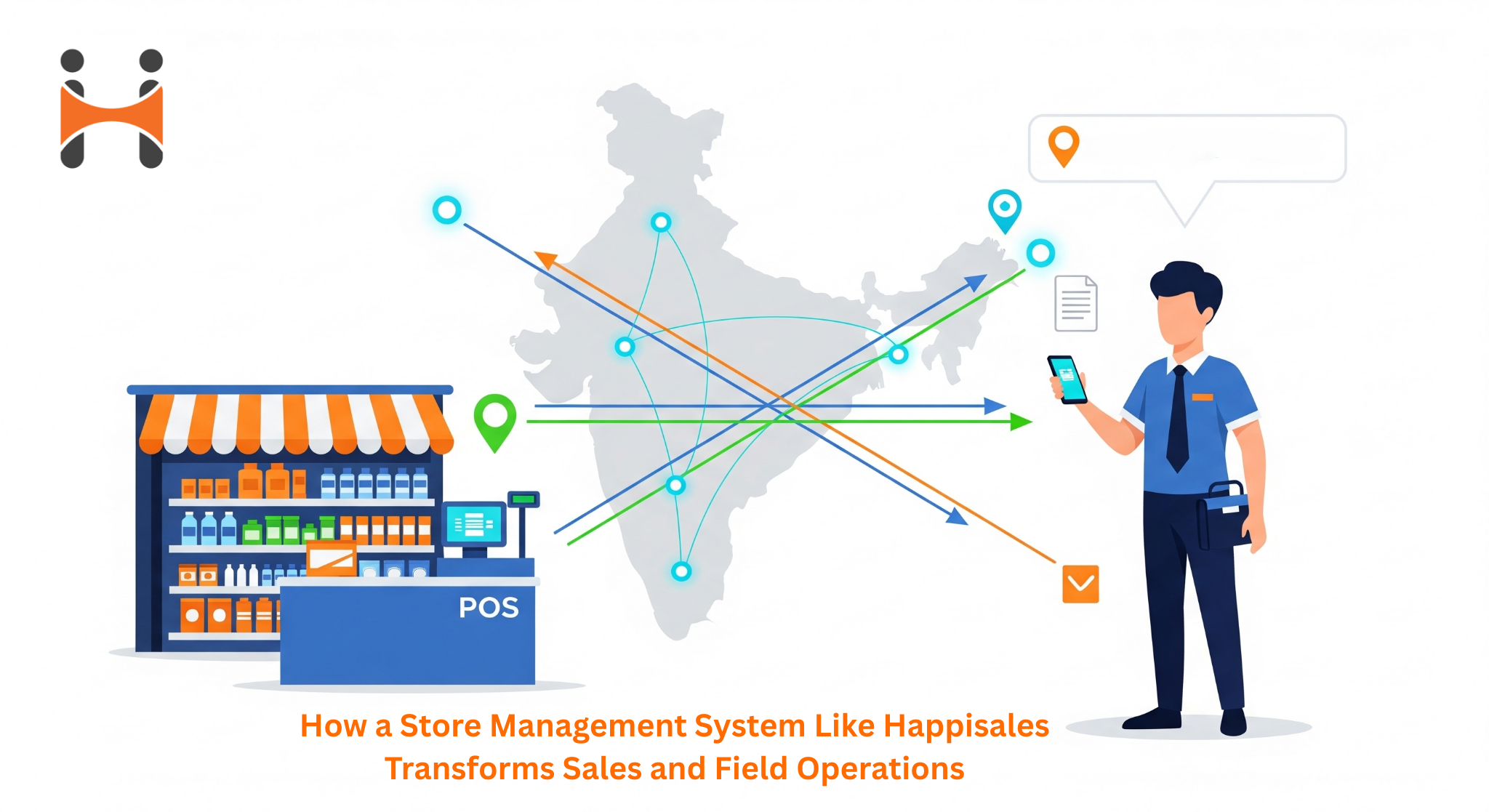
    How a Store Management System Like Happisales Transforms Sales and Field Operations?

    Running sales and store operations in India is not easy. Products run out of stock. Orders get delayed. Sales reps sometimes log fake visits. Collections pile up. And managers often rely on paper reports that are already outdated by the time they arrive.

    Happisales is designed to be the best store management system India for businesses that want real-time visibility, faster collections, and trustworthy employee tracking. Our platform also acts as a field force automation software for FMCG, helping distributors, pharma, and retail chains manage their field teams efficiently.

    This is where a modern store management system makes a difference. It’s not just about POS or billing anymore. It’s about connecting your stores, field sales, and back office into one system so you know exactly what’s happening in real time.

    Why the meaning of “store management system” has changed?

    Old view
    A tool to manage billing, POS, and stock inside a store.

    Today’s view
    A cloud system that links billing, inventory, sales tracking, employee location, beat planning, expense claims, and analytics.

    The winner is no longer the software with the fastest checkout. It’s the one that connects the store with your sales team on the road.

    The three big problems Indian businesses face :

    1. No real-time visibility
      Field reps and stores work on different timelines. Orders taken in the field reach stores late or not at all. Stock data is unreliable.
    2. Losses from manual processes
      Paper orders, delayed collection reconciliation, and expense claims handled in Excel cause leakages and waste time.
    3. Poor accountability and coaching
      Managers don’t know if a rep visited a customer, what happened there, or why orders are dropping. Feedback is based on guesswork.

    We’ve seen these issues again and again with distributors, FMCG, pharma, and retail chains. That’s why we designed Happisales to fix them.

    How Happisales solves these problems?

    Real-time order and inventory sync

    • Reps capture orders on their phone
    • Orders sync instantly or once the rep is back online
    • Inventory updates immediately
    • Stockouts drop and customers get faster delivery

    Employee location tracking with visit proofs

    • Track rep locations only during work hours
    • Geotagged photos and notes confirm visits
    • No fake visit claims
    • Managers get transparent coverage reports

    Planned beats and route optimization

    • Routes are auto-created based on geography and customer priority
    • Reps travel less and meet more customers each day
    • Fuel and travel costs come down

    Offline-first mobile app

    • Works without internet
    • Reps can still log orders, collections, and expenses
    • Data syncs when network returns
    • Essential for Tier 2 and Tier 3 regions

    Order to collection flow

    • Covers order capture, invoice, payment, and reconciliation
    • Managers get collection dashboards and alerts
    • Cash flow improves and DSO comes down

    Expense tracking and approvals

    • Reps upload bills and receipts inside the app
    • Managers approve or reject with one click
    • Data flows into payroll or ERP
    • Reimbursements are faster and clearer

    Analytics and coaching tools

    • Tracks 15+ metrics like visits per day, order conversion, average order size, route use
    • AI nudges suggest which customers to prioritize or which reps need training
    • Coaching is based on data, not guesswork

    Why this matters for Indian businesses?

    • Affordable with fast ROI
      Most Indian SMEs worry about software cost. Happisales clients see benefits like faster collections and fewer stockouts within 60–90 days. The system pays for itself quickly.
    • Simple to use
      Field reps don’t need long training. The app is mobile-first, works in local languages, and is easy to learn in a single session.
    • Mobile-first adoption
      Many reps in India only use smartphones. Happisales is designed for that. No laptop or IT team required.
    • Trust over tracking
      Tracking is transparent and limited to business hours. Managers see what they need, reps feel respected. This balance builds trust.

    Practical results we’ve seen:

    • A regional distributor cut stockouts by 30% in three months by syncing field orders with store inventory.
    • A sales manager increased customer visits by 22% using route optimization. Collections improved in the same quarter.
    • An FMCG company reduced reimbursement timelines from weeks to same-week approval. Field morale improved and HR saved time.

    Using location tracking responsibly

    • Inform employees how, when, and why location data is tracked
    • Track only during work hours not 24×7
    • Save only what’s needed for visits and collections
    • Limit access so only relevant managers can see it
    • Auto-delete old logs after an agreed period

    This keeps employee trust while giving managers the accountability they need.

    Why Happisales is different from POS or basic RMS?

    • POS = billing and receipts only
    • Basic RMS = inventory and reports
    • Happisales = POS + RMS + field automation + employee tracking + offline mode + analytics

    This is the difference between knowing only store sales and connecting it to field performance, customer visits, and collections.

    How to roll this out without friction?

    1. Pilot first
      Test in one or two regions with 10–30 reps.
    2. Map current processes
      Fit existing order and collection flows into the system. Don’t force big changes.
    3. Train and reward
      Keep training short. Use small incentives to encourage adoption.
    4. Scale slowly
      Expand region by region. Watch the KPIs and tweak.
    5. Keep improving
      Use analytics to refine routes and focus coaching.

    Teams adopt faster when they see quick wins like faster reimbursements or fewer hours wasted on the road.

    What to track (KPIs)?

    • Stockouts percentage
    • Orders per rep per day
    • Delivery time in hours or days
    • DSO or collection timelines
    • Expense processing time
    • Active reps vs total reps
    • Trial to paid conversion

    Always note baseline numbers before rollout. Check weekly in the first 90 days, then monthly.

    Common pitfalls and fixes :

    • Trying to solve everything at once
      Start with order capture and route planning first.
    • Change management issues
      Use short training, visible KPIs, and small rewards.
    • Overly intrusive tracking
      Keep it transparent and limited to working hours.
    • ERP integration delays
      Plan integrations early to avoid double work.

    What’s next?

    A store management system that links sales, collections, expenses, and employee tracking gives measurable results. The gains are faster collections, fewer stockouts, and better accountability — all with respect for employee privacy.

    Ready to experience the best store management system India and field force automation software for FMCG? Start a free 14-day trial with no credit card and see how Happisales can transform your sales, collections, and field operations.

  • Field Sales Application for FMCG | Maximize Coverage & Growth

    Field Sales Application for FMCG | Maximize Coverage & Growth

    In the fast-moving consumer goods (FMCG) industry, the battle for shelf space, market penetration, and customer loyalty is relentless. With razor-thin margins and ever-changing consumer demands, companies need more than just good products to succeed—they need streamlined operations, real-time visibility, and the agility to respond instantly. This is where field sales application is transforming how sales teams work on the ground, helping them maximize coverage and gain a competitive edge. 

    The FMCG Challenge: Complexity on the Ground 

    The FMCG Challenge: Complexity on the Ground

    FMCG field sales operations involve thousands of SKUs, large distributor networks, frequent visits to retailers, and tight delivery timelines. Without the right tools, managing such complexity becomes inefficient and costly. Sales reps often spend more time navigating manual processes than building relationships or closing deals. This lag not only affects individual performance but also impacts the company’s ability to hit market share goals and service expectations. 

    Enter Field Sales Apps: Powering Smarter Coverage 

    Enter Field Sales Apps: Powering Smarter Coverage

    A field sales Application eliminates these inefficiencies by digitizing and automating key sales activities such as route planning, order management, stock checks, customer interactions, and reporting. Sales reps can access all the data they need from a single interface on their mobile devices—be it inventory levels, pricing updates, or customer order history. 

    More importantly, these apps help maximize field coverage. Geo-fencing and route optimization tools ensure that no territory is left untapped and that field reps spend more time in-store rather than on the road. Sales managers get live updates on visit status, order bookings, and attendance, which allows for better resource planning and performance management. 

    Why Sales Force Automation Software Matters

    Beyond basic field tracking, sales force automation software brings intelligence and structure to your sales workflow. It automates repetitive tasks like data entry and report generation, ensuring that nothing falls through the cracks. Features such as intelligent lead allocation, customer profiling, and activity-based tracking empower field sales teams to work smarter, not harder. 

    Moreover, such platforms provide sales heads and regional managers with dashboards that offer a bird’s-eye view of the entire operation. This kind of real-time analytics helps in making data-driven decisions on product placements, promotional strategies, and performance incentives. 

    Field Force Automation Software: Closing the Last-Mile Gap

    In the FMCG sector, success is often determined by how well a company executes its last-mile delivery strategy. Field force automation software bridges the gap between the warehouse and the point-of-sale by ensuring alignment between logistics, merchandising, and sales. Retailers get their stock on time, customer complaints are addressed faster, and promotional compliance is ensured, making your brand more reliable in the eyes of the buyer. 

    Digital Is the New Differentiator

    In an industry as competitive as FMCG, small improvements in efficiency can result in significant market gains. A Field sales Application, backed by robust sales force and field force automation tools, are no longer optional, they are essential. Companies that embrace these digital solutions can not only boost their sales productivity but also deliver better customer experiences, improve field coverage, and gain the edge in a crowded marketplace. 

    Explore more about field sales solutions at Happisales

  • From Paper Trails to Digital Success: Transforming Field Sales with Mobile Technology 

    From Paper Trails to Digital Success: Transforming Field Sales with Mobile Technology 

    Field sales has long been the backbone of business growth and customer engagement. Traditionally, sales representatives armed themselves with notebooks, paper order forms, and a Rolodex, spending countless hours on the road, often disconnected from the main office and reliant on outdated information. This paper-driven approach, while effective in its time, was fraught with inefficiencies, missed opportunities, delayed updates, and administrative burdens that slowed down the sales process. 

    The Digital Shift in Field Sales 

    The digital revolution has dramatically reshaped the field sales landscape. Mobile technology now empowers sales reps to access real-time information, manage schedules, update customer records, and even close deals on the spot, all from their mobile devices. This shift from paper trails to digital tools has not only streamlined operations but also elevated the customer experience, enabling faster responses and more personalized service. 

    Key Drivers of Transformation 

    • Connectivity and Real-Time Access: Mobile technology ensure that field sales teams remain connected to the central office and to each other, regardless of location. Reps can instantly retrieve product details, check inventory, and respond to customer inquiries, making them more agile and responsive in the field. 
    • Automation of Routine Tasks: Field sales automation software has revolutionized how teams operate by automating repetitive tasks such as lead generation, route planning, appointment scheduling, and reporting. This not only saves time but also allows sales reps to focus on building relationships and closing deals, rather than getting bogged down by paperwork. 
    • Enhanced Data Accuracy: Manual data entry is prone to errors, which can lead to missed opportunities and inaccurate forecasts. Digital tools ensure that data is captured accurately in real time, providing managers with actionable insights to refine strategies and drive better outcomes. 
    • Optimized Scheduling and Routing: AI-powered solutions help field sales teams plan their visits more efficiently, prioritize leads, and optimize routes, ensuring that every trip is productive and cost-effective. 

    The Role of Field Sales Apps 

    A modern field sales app is at the heart of this transformation. Designed for on-the-go access, these apps enable representatives to manage leads, update records, place orders, and monitor daily tasks from their smartphones or tablets. Features such as GPS navigation, e-signatures, and real-time analytics further enhance productivity and accountability. 

    For example, field sales apps allow sales reps to: 

    • Log activities and update customer information instantly 
    • Access up-to-date product catalogues and inventory levels 
    • Generate quotes and process orders in the field 
    • Communicate seamlessly with managers and team members 

    Benefits Beyond Efficiency 

    The adoption of mobile technology in field sales brings a host of benefits: 

    • Increased Productivity: By automating administrative tasks and providing instant access to information, sales teams can spend more time selling and less time on paperwork. 
    • Improved Customer Experience: Faster response times and personalized service lead to higher customer satisfaction and loyalty. 
    • Cost Savings: Optimized routes and reduced manual errors translate into lower operational costs and higher margins. 
    • Better Decision-Making: Real-time data and analytics empower managers to track performance, identify trends, and make informed decisions. 

    Embracing the Future 

    As market demands and customer expectations continue to evolve, the digital transformation of field sales is no longer optional, it’s a strategic imperative. Companies that invest in field sales automation software and embrace mobile-first solutions are better positioned to seize market opportunities, enhance team performance, and deliver exceptional customer value. 

    In summary, the journey from paper trails to digital success is redefining what’s possible in field sales. By leveraging the power of mobile technology, organizations are not just improving efficiency, they’re unlocking new levels of growth, agility, and competitive advantage. The future of field sales is digital, connected, and driven by innovation, are you ready to make the leap? 

  • Struggling to Hit Your IT Sales Targets? Here’s How Top US Sales Leaders Are Using Real-Time Data to Dominate.

    Struggling to Hit Your IT Sales Targets? Here’s How Top US Sales Leaders Are Using Real-Time Data to Dominate.

    Let’s be brutally honest for a moment. If you’re leading an IT sales team in the US today, you’re in a relentless sprint. The competition isn’t just fierce; it’s smarter. They’re agile. They’re predicting. And if you’re still waiting for end-of-month reports to tell you what went wrong, you’re not just behind—you’re losing ground.

    I’ve seen it countless times over my two decades in this game. Brilliant sales VPs, sharp directors, and ambitious managers, all feeling the immense pressure. They’re trying to grow revenue for cutting-edge SaaS, complex cybersecurity solutions, or critical IT services, but they’re flying blind, making decisions based on intuition or stale data.

    Here’s the truth: The most successful IT sales organizations in America aren’t just tracking sales. They’re using real-time data to see into the future of their pipeline, coach with surgical precision, and outmaneuver competitors with an almost unfair advantage.

    This isn’t about some distant, theoretical future. This is about your sales team, today. It’s about giving you the clarity and control you desperately need.

    Are You Facing These Pain Points in Your US IT Sales Operations?

    Take a deep breath. Do any of these resonate?

    • “My forecasts feel like educated guesses.” You’re constantly adjusting, stressing about hitting quarterly numbers, and feeling like you’re reacting instead of proactively guiding the ship.
    • “I know we have bottlenecks, but I can’t pinpoint where or why.” Deals are getting stuck. Reps are struggling. But isolating the exact problem in a complex IT sales cycle feels like finding a needle in a haystack.
    • “My coaching is generic. I wish I could give specific, data-backed advice.” You want to elevate your team, but without clear, immediate insights into individual performance gaps, your coaching sessions feel less impactful.
    • “We’re missing opportunities. I can feel it.” A new market trend emerges, a competitor pivots, or a specific product suddenly gains traction, and you’re always a step behind.
    • “My sales reps are good, but they’re not operating at their peak potential.” You know they have more in them, but how do you unlock it without micromanaging?

    If you nodded to any of those, know this: you’re not alone. And more importantly, there’s a powerful solution.

    The Secret Weapon: Real-Time Sales Tracking for IT Leaders

    Imagine having a living, breathing pulse on every single sales activity, every lead progression, every deal status—as it happens. This isn’t just reporting; it’s dynamic intelligence.

    Here’s how it transforms those pain points into powerful opportunities:

    • From Guessing to Predictive Power: Instead of looking backward at lagging indicators, you’re leveraging live data to forecast with unprecedented accuracy.
    • From Bottlenecks to Breakthroughs: Instantly identify where deals are stalling, which IT solutions are struggling to gain traction, or which reps need immediate support.
    • From Generic to Surgical Coaching: Drill down into specific calls, emails, or demo performances to offer tailored, impactful guidance that genuinely moves the needle for each rep.
    • From Missing to Seizing Opportunities: Spot emerging trends in client needs, rapid interest in new IT services, or sudden competitive moves, allowing you to pivot strategies in hours, not weeks.
    • From Potential to Peak Performance: Empower your team with transparency and targeted feedback, fostering a culture of continuous improvement and self-correction.

    The Bottom Line: Stop Playing Catch-Up. Start Leading.

    For IT sales leaders in the US, real-time sales tracking isn’t a nice-to-have; it’s a strategic imperative. It’s the difference between hoping to hit your numbers and knowing, with precision, how to smash them. It’s the difference between reactive problem-solving and proactive, confident leadership.

    Imagine the confidence you’d have, the peace of mind knowing you have your finger on the pulse of every deal, every rep, every opportunity. The ability to make data-backed decisions that propel your team forward, consistently hitting and exceeding targets.

    This level of insight transforms not just your sales numbers, but your entire sales culture. It empowers your team, reduces stress, and ultimately, helps you build a sales machine that consistently delivers.

    Ready to Transform Your IT Sales into an Unstoppable Force?

    If you’re an IT sales leader in the US tired of the guesswork and ready to harness the true power of real-time data, Happisales is your partner.

    We’re not just consultants; we’re architects of sales transformation. With two decades of experience helping companies like yours thrive, we specialize in:

    • Deep-Dive Audits: Uncovering your specific sales data gaps and opportunities within your existing IT sales stack.
    • Custom Dashboard Design: Building intuitive, real-time dashboards specifically tailored to your IT services, products, and sales goals.
    • Seamless Tech Integration: Connecting your CRM, sales engagement, and BI tools to create a unified, intelligent sales ecosystem.
    • Targeted Coaching Enablement: Equipping your sales managers with the tools and training to leverage real-time data for unparalleled rep development.
    • Data-Driven Go-to-Market Strategy: Ensuring your sales efforts are always aligned with the latest market trends and competitive intelligence.

  • Mastering Field Sales: How to Train Your Reps on Field Sales Apps and Sales Force Automation Software

    Mastering Field Sales: How to Train Your Reps on Field Sales Apps and Sales Force Automation Software

    Why Field Sales Engagement Platforms Matter

    In today’s market, using a robust field sales engagement platform is no longer optional, it’s a competitive necessity. These platforms streamline sales workflows, deliver real-time analytics, and enable better communication between field teams and managers.

    By leveraging a field sales engagement platform, businesses can:

    • Analyze customer interactions
    • Personalize field rep approaches
    • Increase customer satisfaction
    • Enable data-driven decision-making

    Staying ahead with the right field sales technology ensures your team adapts to evolving buyer behavior and market demands.

    Top Field Sales Apps in 2025

    What are the top field sales apps available, and how do they compare in terms of features and ease of use?

    Leading field sales apps in 2025 offer:

    • Offline data access
    • GPS tracking
    • Route optimization
    • In-app communication
    • Real-time order entry

    Comparison of top field sales apps:

    • App A: Known for user-friendly UI and custom workflows
    • App B: Strong in analytics and reporting
    • App C: Best for integration with legacy CRMs

    Evaluate based on ease of use, feature set, and scalability.

    Training Your Sales Team to Use Field Sales Apps

    How should I train my sales reps to effectively use new field sales technology?

    Effective field sales app training combines:

    • Hands-on experience
    • Role-playing exercises
    • E-learning and microlearning

    Start by identifying reps’ tech gaps and tailor the program accordingly. Create interactive workshops that simulate real-world usage. Reinforce learning with refresher sessions and support forums.

    Sales Force Automation Software: Benefits and Best Practices

    How can I determine which sales force automation software is best suited for my business needs?

    Sales force automation software (SFA) automates repetitive tasks and improves decision-making. Top benefits include:

    • Real-time lead prioritization
    • Automated scheduling
    • Accurate forecasting
    • Integration with marketing tools

    When evaluating sales force automation software:

    • Choose platforms with mobile-first design
    • Look for predictive analytics and lead scoring
    • Ensure CRM compatibility and API flexibility

    Implementing Effective Field Sales Training Programs

    A successful training program for field sales apps and SFA tools requires:

    • Clear KPIs and learning goals
    • Balanced curriculum (theory + practical)
    • Multiple learning formats (videos, simulations, live coaching)

    Encourage peer-to-peer learning and allow for real-time feedback collection to keep the program evolving.

    Measuring Training Success and App Adoption

    How can I measure the success of my field sales training program and app adoption?

    Metrics to track include:

    • Usage rates of the field sales app
    • Knowledge retention scores
    • Sales metrics before/after training
    • Rep satisfaction and confidence

    Use quizzes, live role-play evaluations, and CRM/app analytics to validate success.

    Case Studies: Field Sales Engagement Platforms in Action

    What are some real-world examples of companies successfully implementing field sales engagement platforms?

    1. FMCG Brand: Increased productivity by 25% within 6 months using a tailored field sales engagement platform.
    2. Pharma Company: Reduced sales cycle with sales force automation software and improved lead conversion.
    3. Retail Chain: Trained reps on a custom field sales app, leading to better customer satisfaction and repeat business.

    Future Trends in Field Sales Technology

    What future trends should I be aware of in field sales technology and automation?

    Trends shaping the next generation of field sales apps and SFA tools:

    • AI-powered sales recommendations
    • Voice-to-text note capturing
    • Predictive route planning
    • Embedded video calling within apps

    Investing early in emerging field sales technology helps future-proof your sales operations.

    FAQs

    What challenges do sales reps face when using field sales apps, and how can they be overcome?

    • Challenge: Tech resistance
      • Solution: Gamified onboarding and peer mentoring
    • Challenge: Poor mobile network coverage
      • Solution: Choose apps with offline functionality

    How do field sales apps help improve sales productivity and customer engagement?

    • Real-time insights and automation free up time
    • Location tracking and visit planning improve efficiency
    • Personalized follow-ups increase engagement

    What are the key features to look for in a field sales app or sales force automation software?

    • Custom workflows
    • CRM and ERP integration
    • AI and analytics
    • Offline support

    Book a demo today and experience how a tailored field sales engagement platform can elevate your sales strategy.

  • Best Use Cases for a Field Sales App in Pharma: Real-World Wins That Boost Rep Productivity

    Best Use Cases for a Field Sales App in Pharma: Real-World Wins That Boost Rep Productivity

    What if your best medical rep could see more doctors, cut down on admin work, and close more orders, all without burning out?

    Pharmaceutical sales isn’t just about selling, it’s about timing, trust, and total precision. With compliance, competition, and constant fieldwork in play, your reps need more than spreadsheets and schedules, they need smart tools that move as fast as they do.

    Enter the field sales app: a complete command center in your rep’s pocket.

    Here’s how it delivers real, repeatable value every day.

    ✅ Pro Move #1: Plan Smarter, Visit More

    Covering huge territories and juggling doctor appointments isn’t easy.
    A field sales app automatically maps optimized routes, tracks visit history, and helps schedule appointments so your reps stay sharp and on time.

    Result: More quality visits. Less burnout.

    📦 Pro Move #2: Track Every Sample and Detail

    Samples and promotional materials are critical,but they’re also heavily regulated.
    The app logs who received what, when, in real time. Say goodbye to lost samples and messy inventory sheets.

    Result: Full compliance. Zero guesswork.

    🧠 Pro Move #3: Sell Smarter with E-Detailing

    Forget outdated flipcharts. Today’s reps impress with interactive presentations, videos, and product literature, all directly inside the app.

    Result: Consistent messaging. Stronger engagement.

    🛒 Pro Move #4: Book Orders on the Spot

    Why wait to send an email when your rep can place an order live, check stock, and apply deals, right from the chemist’s shop?

    Result: Faster conversions. Happier distributors.

    📊 Pro Move #5: Real-Time Reporting Made Easy

    No more late-night reports or manual tracking. The app logs every visit, order, and detail as it happens. Managers get live dashboards and reps get their time back.

    Result: Instant visibility. Total control.

    📣 Pro Move #6: Capture What Competitors Miss

    Doctors share things, new competitors, shifting preferences, feedback. The app makes it easy to capture those insights and feed them into your marketing playbook.

    Result: Smarter strategies. Data-backed moves.

    It’s Time to Power Up Your Field Force

    In today’s high-pressure pharmaceutical environment, even top-performing reps can hit walls with outdated systems. If your team is still managing doctor visits, order booking, and reporting with spreadsheets, you’re missing a huge opportunity.

    With Happisales, pharma field teams get:

    • 🗺️ Smarter route planning & visit tracking
    • 📦 Real-time sample and promotional stock logging
    • 🧾 Instant chemist orders with stock insights
    • 📽️ Interactive e-detailing and brand presentations
    • 📊 Live dashboards for managers
    • 📝 Field-level insights for marketing and strategy

    ⭐ Trusted by Leading Pharma Brands

    From generics to specialty medicines, Happisales is trusted by pharma companies across India to help MRs stay productive, compliant, and ahead of the curve. Whether your team has 10 reps or 1,000, the platform scales with you.

    🚀 See the Difference for Yourself

    Start your free trial today and explore why pharma leaders are choosing Happisales to digitize their field force.

    ✅ Instant access
    ✅ No credit card required
    ✅ Full-feature access from Day 1

    👉 Click here to start your free trial

    Your competitors are already switching—don’t get left behind.

  • How to craft winning sales pitches: The ultimate guide (Part 1)

    How to craft winning sales pitches: The ultimate guide (Part 1)

    The first thing that pops up in people’s minds when they hear the term sales pitch is an unwarranted phone call or an awkward email from a pushy and aggressive seller.

    Thanks to these terrible salesmen, people around the world have grown wary of sales pitches and do their best to avoid them. But a good sales pitch is so much more than an intrusive phone call or email.

    In fact, a great pitch should make a buyer’s life better by connecting them with products and solutions that solve their most urgent problems.

    In this guide, we’ll decode the nuances of an effective sales pitch and discuss various strategies that you can use to optimize your outreach efforts. Finally, we’ll explore some exceptional sales pitch templates that will help you nail your conversions!

    Let’s dive right in.

    What is a sales pitch?

    A sales pitch is a well-crafted sales presentation. Typically, a salesperson gets less than two minutes to explain how their business will benefit the prospect. 

    The attention span of people in this tech-driven world is ever shrinking. As such, salespeople no longer have the luxury of an hour-long presentation geared towards selling a specific product or service. 

    A good sales pitch needs to convey the intended message concisely in a compelling manner. If the sales pitch is on point, you are on the right path to making profitable sales. 

    The first few minutes of a business conversation determine the direction your interactions will take. Be sure to use this sales pitch as your attempt to convince the prospect about the superiority of the service you are offering. 

    If you are selling a product, a sales pitch is your chance to dispel a prospect’s belief about the product. This is when you reassure them of the benefits they will enjoy if they buy the product you are selling.

    The anatomy of a successful sales pitch

    Sales pitches can take on many different forms and use different approaches. But when you break them down, they almost always have these five key elements:

    1. The open

    The open is the introduction. It’s as simple as saying hello, introducing yourself, and asking the prospect how they are. It’s also your first opportunity to start building rapport and break the ice with your prospects.

    2. Identification of the problem, pain point, and/or goal

    By asking a few meaningful and well-thought-out questions about their work, you’ll start getting a better understanding of what the prospect’s challenges and goals are. 

    Using active listening you’ll begin to understand how your product can help address the prospect’s issues in order to reach their goals. 

    3. Demonstration of value

    Once you’ve established rapport and begun to understand the scope of their needs, you can begin to address each one using your product as the solution. 

    You should be able to speak to one or more of their pain points with how your product can solve the problem. 

    4. Supporting facts

    If you want to build trust, you should be prepared to support your pitch with facts and figures. Consider using social proof, like positive results that show how you beat customer expectations or prove that your other customers derived value from your product or service.

    5. The close

    By now, you should’ve clearly shown your prospect the value of your product and how it’s going to make their job or life easier. The close is essentially the point where they say yes and the transaction occurs. 

    The best sales pitch templates ever

    Having established the elements of a winning sales pitch, it is time to witness these in action. Here are some sales pitch templates which will supercharge your growth!

    Data dump

    Data is a great way to catch buyer attention, especially if it can help them make the case to their team for your product.

    The bad news: marketing burn is all too real these days. The good news? Help is on the way. New research shows that our platform can deliver:

    • 72% increase in buyer engagement
    • 50% in open-rates
    • 20% decrease in attrition 

    Show that you care

    Highlighting your prospects’ pain points and offering personalized solutions is an excellent way to forge meaningful customer relationships. 

    G2 is one company that pulls this off really well in its pitch:

    “G2 plays a huge role by providing unique, authentic peer advice in real time. We give buyers better guidance than traditional analyst firms, which can take up to 2 years to update and publish technology research. That timeline just can’t keep up with the pace of technology. At G2, we aim to be a trusted source that helps every business professional in the world make better technology decisions.”

    When they discuss how you’re being told by analysts what to do, or people who haven’t used a product, they highlight a clear disconnect in the market between what you need and what you get. 

    The company allows verified users of products to write reviews and becomes an essential resource for their users.

    Make a note of what really annoys your customer and pitch how your service can resolve this grievance. It’s another way of re-framing the customer’s needs, and it works because it’s a powerful way to describe the situation.

    In a nutshell

    We hope you have a clear idea of what an ultra-effective sales pitch looks like by now. An important note to make about these sales pitches is that they are all amazingly optimized for a short conversation.

    Lack of brevity can quite literally break your sales pitch and ruin your chances of converting prospects into customers. So, keep your sales pitch short, clean, and simple! Your customers will thank you.

    In the next article of this two-part series, we’ll list a few more sales templates that you can use and show you how you can craft your own pitches as well. Until then, stay tuned!

  • Field Force Automation Software Benefits for Businesses

    Field Force Automation Software Benefits for Businesses

    Field force management is a highly challenging task: it can be especially gruelling since you are not physically present with your field force executives. Many industries have a large deskless workforce deployed across the globe to perform a wide variety of tasks. After all, you cannot run a business with the help of desk jockeys alone!

    That being said, there are several things that you need to ensure to streamline field force management:

    • frontline workers maintain excellent standards of operational execution and compliance
    • data is accurately captured in the field and used effectively by the head office to drive continuous process improvements
    • workers in the field are provided with an enriching experience that nurtures and brings forth their full potential

    Field Force Automation is a fantastic tool that can help organizations achieve the objectives mentioned above. It ensures greater efficiency and compliance. In addition, it optimizes employee performance and establishes real-time communication between the head office and operational frontline.

    Let’s dive deeper, understand what is FFA and the benefits that it offers to your business.

    What is Field Force Automation

    Field Force Automation is an aspect of field service software that leverages mobile technology such as mobile devices, wearables, and IoT sensors to facilitate bi-directional communication between technicians in the field and the head office. Data is instantly recorded in the back-end, eliminating the time spent on manual data entry and the risk of errors associated with it.

    By implementing FFA, organizations allow field force executives to capture and share data in real-time, enabling managers to evaluate, provide feedback and boost performance. 

    Advantages of Field Force Automation 

    Increase efficiency

    By leveraging analytics, you can process the abundant amount of data generated in the field and gain valuable insights into locations having plenty of business opportunities. Route optimization empowers field workers to navigate their territory in the most efficient way, reducing the time and cost of traveling. 

    Assign leads automatically

    When a lead is captured, the FFA software automatically assigns that lead to the relevant salesperson based on certain criteria like zip code, product, or proximity. This reduces response time drastically. The sales rep receives instant mobile notifications and can access the available lead details with just a tap.

    Achieve greater visibility

    Operational directors can use FFA to gain greater visibility over performance in the field which helps to eliminate inefficiencies and reward top performers.

    Field Service Management Software allows you to see what is happening on the field from a distance with real-time geo-tracking, spontaneous updates on sales activities with customers, or requests for assistance from the manager. 

    It makes it easier to track the performance of your sales team members without breathing down their necks. A simple dashboard on the web app provides you with a clear report of all sales reps, which includes what they’re currently working on, their location at the moment, the client they’re meeting, the distance they’ve travelled, etc. 

    Build meaningful and personalized customer relationships

    FFA allows you to forge longstanding trust-based relationships with customers and deliver an engaging customer experience. It provides customer information and history to your field force executives, enabling smooth interactions with customers. 

    The automation tools are often identity-driven: they can identify past track records, touchpoints, and communication history, helping your field force executives to better plan their approach to customer service.

    FFA software can provide notifications to the customer about shipping status, delays, etc. to make sure the customer is informed throughout the entire process. To put it simply, it helps customers identify and relay their requirements accurately, allowing you to better serve your customers.

    This kind of directive and administrative software improves communication and shows both the customer and the home office more about what is needed and what the company can do to serve a particular client well.

    Nurture the well-being of your employees

    A seed does not grow into a tree, simply because of your desire to eat its fruit. It needs healthy soil, manure, sunlight, water, and active nourishment from your side to blossom into a full-fledged tree.

    The same holds true for your field force employees. You need to create a positive, uplifting atmosphere in which your field force employees can thrive. FFA technology enhances employee engagement in several ways.

    It allows organizations to create a knowledge repository of field workers’ expertise and enables employees to upskill quickly. If any of your frontline workers leave the workforce, their expertise can be preserved and used by newcomers in the organization.

    Field force automation solution also empowers frontline workers to execute tasks, communicate and collaborate with greater effectiveness, saving them valuable time and providing them with a frictionless experience.

    Using FFA software, organizations can transform frontline operations into a fun-filled process and enhance employee involvement. You can recognize and celebrate individual achievements, offer personalized feedback, and set performance incentives to bolster employee spirit. 

    In a nutshell

    Looking for robust FFA software to turbocharge your field force operations? We’ve got the perfect solution for your needs.

    Happisales is a neat and elegant field force engagement platform that allows you to perform sales, collection, order, and service in a synchronized way. Using Happisales, you can log customer data effectively, avail push notifications based on tasks performed in the field, and track the journey of your field executives in real-time.

    It is a progressive solution that automatically plans the best travel route based on the location of meetings and generates actionable customer insights, enabling your field reps to create meaningful customer experiences. 

    Designed to enhance collaboration between managers and field reps, Happisales allows managers to assess and maximize the performance of field executives. In addition, it simplifies attendance tracking as well as order management enabling you to optimize field force activities. 

    So, what are you waiting for? Talk to our experts and schedule a free demo today!

  • Upcoming Trends in Field Force Automation to look forward in 2021 – 2026

    Upcoming Trends in Field Force Automation to look forward in 2021 – 2026

    Field force automation is a resource still not fully understood by most companies. Fairly explained, it is a new enterprise entity capable of aiding field service businesses in enhancing their efficiency and productivity, capturing more data than in the past. Understanding the basics of FFA can help businesses escalate their customer experiences, generate more revenue, and empower their field workforce. 

    FFA is a revolution to the working framework of the 21st century, introducing the use of Field force tracking software to bring solutions to the workforce and the managerial positions, turning their field service operations into an automated and mechanized machine. 

    The exponential increase in penetration of the Internet and digital tools, the urgency in automating repetitive tasks, the growing adoption of advanced technologies like Artificial intelligence or cloud computing are the major drivers of the growth of the global Field force automation industry. 

    The soaring need for sales force automation considerably influences market expansion, assisting sales representatives in many tasks via software like Sales force tracker. Adoption of such solutions brings an enhanced customer experience, streamlined sales, and improved workforce efficiency.

    The Global Field force automation forecast of the growth trends from 2021 to 2026 offers insightful data for business strategists, providing an overview of the growth factors, futuristic cost expectations, revenue, supply data, and demand dynamics, besides elaborately describing the value chain and distributor analysis. 

    Market statistics:

    Amidst the global pandemic crisis, the global market of FFA may reach USD 1251.33 million in 2020, which can rise to an estimated USD 1477.79 million in the year 2021. The market expects to reach USD 3453.51 million by 2026, growing at 18.43% CAGR. 

    The global report provides the market sizing and the forecast of the major currencies- USD, AUD, EUR, JPY, and GBP. The forecast allows the business leaders to make better decisions, particularly when the currency exchange data is available at their fingertips. 

    The report considers 2018 and 2019 as historical years, 2020, the base year with 2021 as the estimated year, further considering 2022 to 2026 as the forecast period. 

    The Field force automation US market is estimated to reach USD 371.8 million in 2020. China is projected to reach s size of USD 985 million by 2027, with a CAGR of 22.1% along the period 2020 – 27. 

    Notable markets also include Japan and Canada, forecasted to grow at a CAGR of 12.3% and 15.2%, respectively, with Germany estimated to grow at 13.6% CAGR. 

    Impact of the pandemic on the economy and how FFA helps work around it:

    The COVID-19 pandemic has been one of the biggest crises to the human race, impacting people of all races, effectively visible in the global economies’ negative GDP growth and a rise of unemployment in developing countries. 

    There are only a few exceptions among global industries that didn’t face the Covid adversities, and the struggle may continue for some time. However, the 2021 overviews of economic dynamics have been consistently positive, with expectations of improvements in the forthcoming months. 

    Technology can play a vital role in curbing pandemic distress to a large extent. Companies deploy large and innovative Field force tracking solutions to manage the sales operations. The field force management effectively provides real-time solutions to the most critical challenges of businesses amidst the pandemic.

    • We are ensuring the wellbeing of the workforce by the use of advanced sales force automation solutions. 
    • We create a well-established connection with the field team via the Sales force tracker.
    • The field force automation solutions are effective in providing automation during order placement or fulfillment without manual attention. 
    • The sales force automation solutions provide integration of cutting-edge data analytics platforms, measuring the COVID impact.

    Market Segments:

    The global forecast of the Field force automation solution market categorizes the growth trends and revenue based on the following submarkets-

    • The global market across large, medium and small enterprises can overlap organizational size. 
    • Based on deployment, the market use On-premises and On-cloud. 
    • On a vertical basis, the market runs across Real Estate, Energy Sectors, Healthcare, IT, Manufacturing, and Transportation. 
    • Based on geography, the global market across the nations of America (Canada, Brazil, Mexico, US, and Argentina), Europe (UK, Italy, Germany, and France), Asia-Pacific (India, Australia, China, Japan, Malaysia, South Korea, and Taiwan), Middle East (Qatar, Saudi Arabia, and UAE) & Africa.

    Growth Trends:

    • Inventory Management – Deployment of inventory management solutions can aid service to offer cost-effectiveness to customers, simplify management services for technicians in several V2B operations, and ease operations in the healthcare sector. The introduction of AI in cloud-based solutions may aid small and large firms in managing their field workforce. 
    • Significant Growth Rate – The Asia-Pacific region can rise due to many SMEs adopting field service management solutions. The global expansion is s major driver for adopting Field force automation solutions, inducing the growth of such solutions’ requirements. 
    • Competitive Landscape – The market landscape of sales force management is quite fragmented, with existing prepackaged solutions but no sole vendor dominating the market. There exist several mergers and collaborations in the market. 

    Conclusion:

    The Field service management firms are witnessing immense pressure to effectively lead teams, ensure their safety, and comply with the regulations of the pandemic. Such a situation cannot get burdened with miscommunication or distrust. 

    It is a high time of distress and crisis, exacerbating fear and distrust, a critical period that calls for emphasizing confidence development within organizations. In the current wake of the Covid pandemic, the estimated growth of Field force automation may further rise, with the pandemic restricting the effective management of remote fieldwork.

    The pandemic has led to limitations in field services, a substantial boost to the adoption of FSM solutions. Such deployment offers better service experiences, including automation in customer communications and feedback capabilities to the current workflow that can elevate your business. Do check out our blogs for more valuable insights.